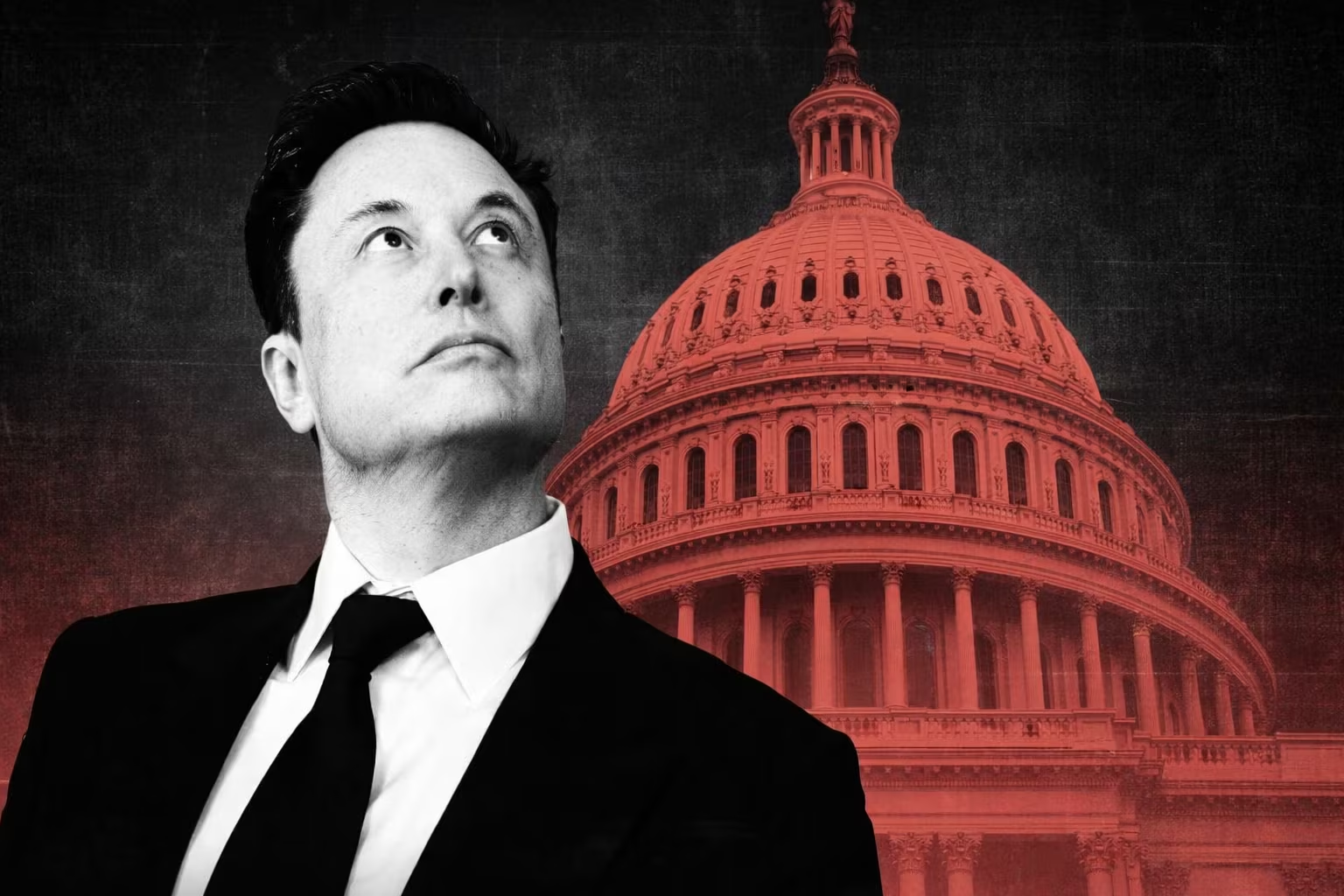
Elon Musk has once again thrown himself into American politics, bolstering Republicans ahead of the 2026 midterm elections. After pouring hundreds of millions of dollars into the 2024 campaign and, in the spring of last year, saying he intended to scale back his political giving, his return to big-ticket financing was unexpected—but a conspicuous signal for the Republican Party.
According to federal filings, by the end of 2025 Musk had donated $20 million to two key Republican organizations, then added another $10 million last month to a Senate race in Kentucky. That has fueled talk that the billionaire could again play a decisive role in the fight for control of Congress. Yet he remains a politically divisive figure. As Casey Myers, a professor at Virginia Tech, notes, money matters in politics, but Musk’s involvement puts Republicans in a difficult position precisely because of his polarizing public image.
In 2024 Musk spent at least $250 million backing Donald Trump’s campaign, making him the largest donor of that election cycle. After Trump’s victory, he joined the president’s inner circle and took charge of the Department of Government Efficiency, known as DOGE. But the drive for sweeping cuts to federal spending and staffing drew fierce criticism and quickly became politically toxic.
Musk’s political clout faltered in Wisconsin in the spring of last year, when he used his super PAC, America PAC, to spend $12 million backing a conservative candidate for the state’s supreme court. Even so, a liberal contender prevailed. Brandon Scholz, a Republican strategist, later recalled that Musk was highly visible in the closing weeks of the campaign, including announcements of $1 million giveaways. Democrats, however, managed to channel voters’ irritation toward Musk and DOGE—and many within the Republican Party ended up pinning the defeat on him.
In May Musk publicly said he planned to sharply cut his political spending. “In terms of political donations, I’m going to do a lot less,” he said at the time, adding that he did not yet see a reason to be actively involved. Soon afterwards he left the White House, entered a public feud with Trump, and even floated the idea of creating a third party. According to Myers, the possibility of an irreversible rupture was being discussed seriously then—one that could have undercut Republican momentum.
Yet by late June Musk had changed course again, donating $5 million apiece to super PACs tied to Republican leadership in the House and the Senate, and another $5 million to MAGA Inc., a pro-Trump group. Federal Election Commission records show the contributions. Until December he kept a comparatively low political profile, resurfacing mainly at a White House dinner during a visit by Saudi Crown Prince Mohammed bin Salman.
In mid-December Musk again gave $5 million to each of the two Republican super PACs, and this month added another $10 million to back Nate Morris, who is running for the Kentucky seat being vacated by Senator Mitch McConnell. The infusions lifted the Senate Leadership Fund’s cash-on-hand to $100 million, and the House fund’s to $54 million. Musk’s donation to the committee supporting Morris was more than seven times the amount the campaign had on hand in December.
Republican strategists describe the world’s richest man lining up with the party as a major advantage. Many of them treat the Wisconsin loss as a one-off setback outside the core electoral cycle and argue that the potential upside outweighs the risks. Democrats, by contrast, see Musk’s renewed activity as a bid to meddle in the Republican Party’s internal balance of power—and to exploit its frictions for his own ends.
Democrats are entering the election year after a run of special-election victories and believe they can win the three seats needed to flip control of the House. The Senate, too, is increasingly seen as competitive, amid Trump’s low approval ratings and public backlash against Republicans’ hard-line immigration agenda. Yet the parties’ financial positions remain broadly comparable: the House Republicans’ campaign arm ended the year with $45 million, versus $46 million for Democrats, while the Senate committees held $17 million and $19 million, respectively. The Republican National Committee, despite Democrats’ own headwinds, finished the year with nearly $90 million in the bank.
Against that backdrop, Musk is again at the center of controversy. Over the past month, his platform X has faced scrutiny from regulators in multiple countries after the Grok chatbot began generating thousands of sexualized images of women and children in response to user prompts. Although the company has restricted its image-generation and editing tools, investigations are continuing, including an expanded case in France, where X’s offices were searched. In parallel, Musk is mentioned in newly released U.S. Justice Department material related to the Jeffrey Epstein case: messages from 2012–2014 discussed potential trips to Epstein’s island. Musk says he did not attend Epstein’s events, did not fly on his plane, and was never on the island.
All of this is unfolding as Musk reaches a pivotal moment in his business empire. After the merger of SpaceX with xAI, the combined company is valued at roughly $1.25 trillion, and an initial public offering is expected. Analysts note that, after the DOGE episode and the reputational damage that followed, Musk’s political value looks less straightforward. Still, as Michael Kang, a professor at Northwestern University, argues, money in itself is unlikely to hurt Republicans: most welcome the funding, even as they view his public involvement with a clear measure of wariness.