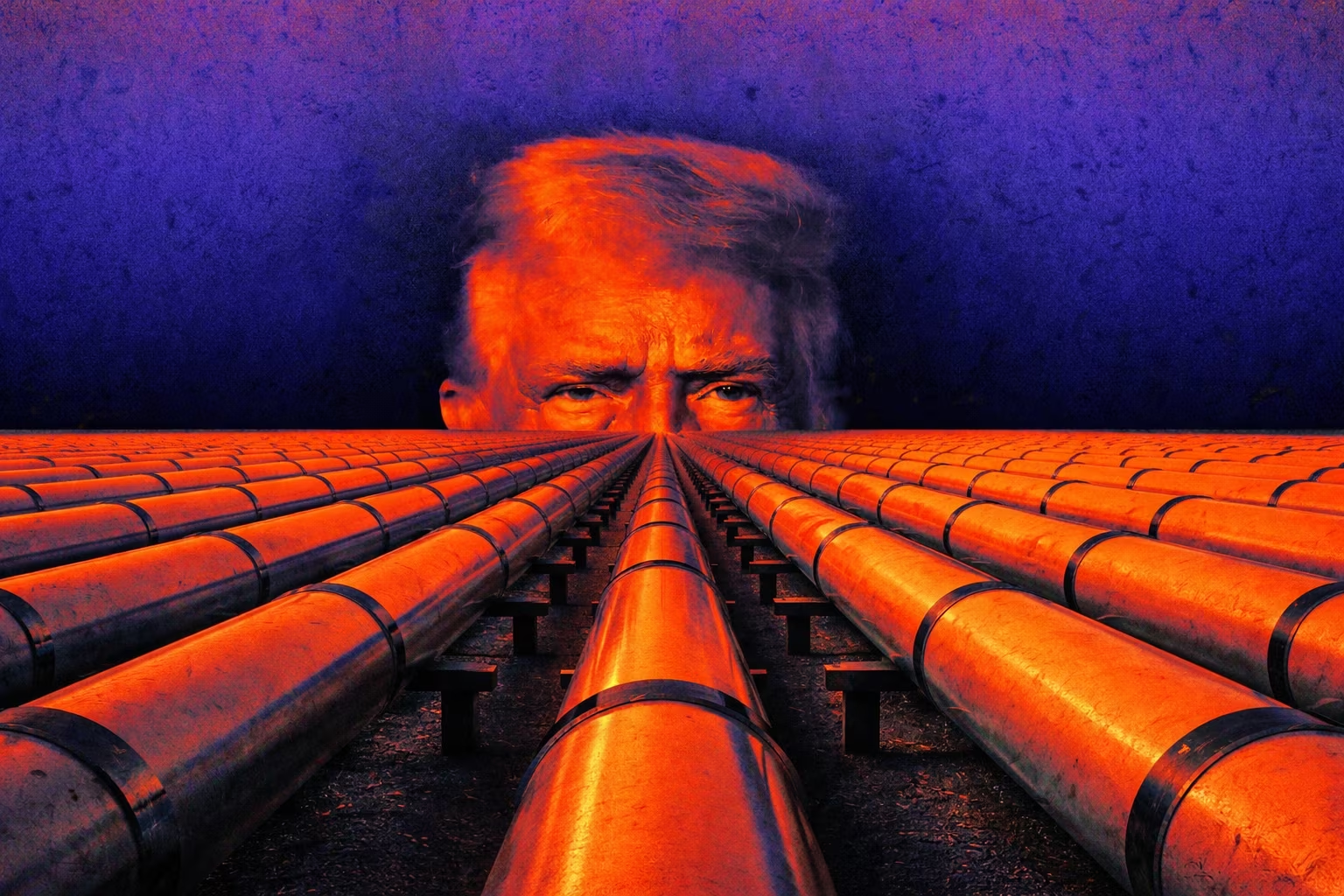
President Donald Trump’s notion that American oil companies should take on the task of rebuilding Venezuela’s shattered petroleum sector is emerging as perhaps the most severe test yet of the industry’s willingness to tolerate risk.
The US administration has made little effort to conceal that Venezuela’s vast oil reserves are viewed as one of the central levers of pressure on President Nicolás Maduro’s regime. “You cannot allow the largest oil reserves in the world to remain under the control of adversaries of the United States while failing to benefit the people of that country,” Secretary of State Marco Rubio said in an interview with NBC. Trump himself put the logic more bluntly: “We want viable and successful countries around us, where oil can flow freely onto the market. That brings prices down. And that’s good for our country.”
Yet analysts are far less convinced, cautioning that US companies’ appetite for investing in Venezuela’s degraded infrastructure is anything but assured. “The potential to increase Venezuelan production hinges on capital, which in turn depends on political stability and will likely require guarantees from the US government,” Jefferies Global Research & Strategy analysts wrote in a note. According to Gregory Brew, an analyst at Eurasia Group, companies “will be extremely cautious without a stable security environment and exceptionally favorable terms that would help mitigate risk—especially against the backdrop of oversupply and low prices in the short term.”
Many questions also remain over how Washington could create the conditions for multibillion-dollar investments. Speaking on CBS, Rubio referred only in broad terms to the need for “certain guarantees and conditions.” At the same time, he noted that the US “quarantine” on sanctioned oil tankers provides Washington with leverage over the situation.
Pushing oil companies beyond their customary comfort zone is hardly an isolated impulse for Trump. The US Department of the Interior is weighing the sale of drilling rights in Arctic waters off Alaska, as well as along the Pacific coast. Companies have welcomed the expansion of lease auctions in the Gulf of Mexico, which the administration has renamed the Gulf of America. Interest in other coastal areas, however—with their high costs, legal battles, and reputational risks—remains muted.
In Venezuela itself, Chevron remains the only major US company still operating. Other players, most notably Exxon and ConocoPhillips, exited the nationalised sector nearly two decades ago amid disputes with the regime of Hugo Chávez. Those companies continue to pursue claims worth billions of dollars through arbitration proceedings linked to the expropriation of their assets.
Luisa Palacios, a researcher at Columbia University’s Center on Global Energy Policy, wrote that under an optimistic but realistic scenario, Venezuelan output could rise by 500,000 to 1m barrels a day within two years. Such an increase would be driven by improved management and a partial easing of US sanctions, which remain in force. In her assessment, international companies already operating in the country—including Chevron, Repsol, and ENI—could boost production under their existing licences. With numerous caveats, Palacios also allows for a return to a peak output of 3.5m barrels a day over a seven-to-ten-year horizon.
For now, the market is seeing only the first tentative signs of interest from the industry. Major US companies have chosen to remain silent. “The interest will be enormous if this is done the right way,” Rubio said in an interview with ABC, adding that Energy Secretary Chris Wright and Interior Secretary Doug Burgum plan in the near term to assess the situation and consult with industry representatives.