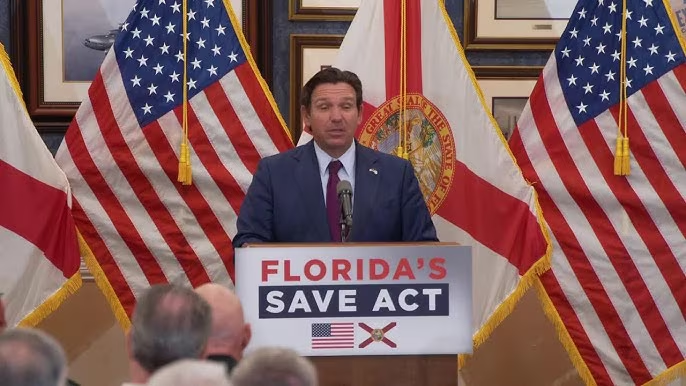
Florida Governor Ron DeSantis has signed a law imposing state-level requirements similar to those in the Safeguard American Voter Eligibility (SAVE) Act: residents must now provide documentary proof of U.S. citizenship in order to vote. He said he does “not expect” the federal version of the bill, championed by Donald Trump, to pass, and argued that the new rule is necessary to protect the integrity of elections. “Our constitution in Florida says that only U.S. citizens may vote in elections, so we need to make sure that law is enforced,” he said at a press conference.
Civil-rights groups warn that the requirement could affect citizens who cannot quickly produce the necessary documents. Retirement-community IDs and student cards will not be accepted—voters will have to present a birth certificate, Social Security card, passport, or other proof of citizenship.
The law has already been challenged in court by the American Civil Liberties Union on behalf of the League of Women Voters of Florida and other organizations. The plaintiffs argue that the verification system being used does not account for naturalization records. “That means U.S. citizens may be mistakenly listed in these databases as noncitizens, as often happens in the Department of Homeland Security’s SAVE system, and could therefore be flagged for disenfranchisement,” the lawsuit states.
It also notes separately that elderly voters are “disproportionately likely” to be swept up by the exclusions because the system relies on Social Security Administration records, which lack citizenship information for many Americans born before the 1970s.
Wendy Sartory Link, the supervisor of elections in Palm Beach County, has also warned about the practical difficulties this creates for election administrators. “If someone brings me a birth certificate from Idaho, I do not know what it is supposed to look like. Am I expected to determine whether that certificate is fraudulent, or simply accept it because it says ‘State of Idaho birth certificate’?” she said.
The law, signed by DeSantis in the final year of his term as governor, will not take effect until after the midterm elections. Even so, the court battle could delay or slow its implementation.