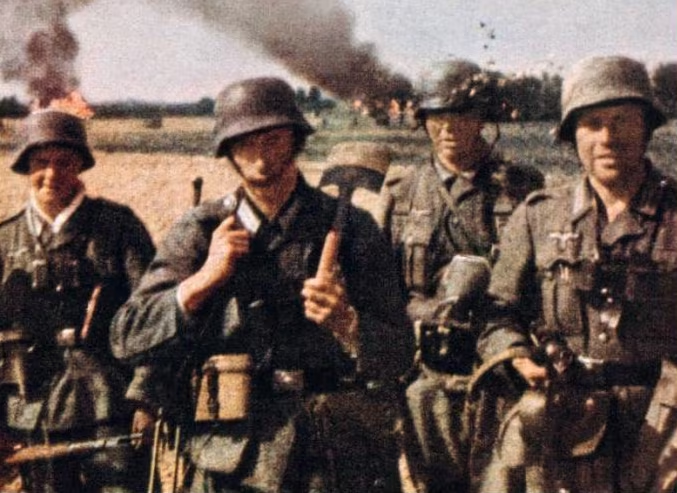
The article “Buried Guilt” is timed to the anniversary of the start of Operation Barbarossa. The authors recall that around 10 million Germans took part in the war against the Soviet Union, and that roughly 27 million Soviet citizens became victims of the invasion.
Much of the piece is devoted to the crimes of the Wehrmacht, the mass death of Soviet prisoners of war and the forced deportation of Soviet citizens to work in Germany. The magazine also dwells separately on how German families avoided talking for decades about the role of their relatives in that war.
“Many still know little about what their fathers, grandfathers and great-grandfathers did in the Soviet Union… The war on the Eastern Front remained a blank space in many families,” the article says.
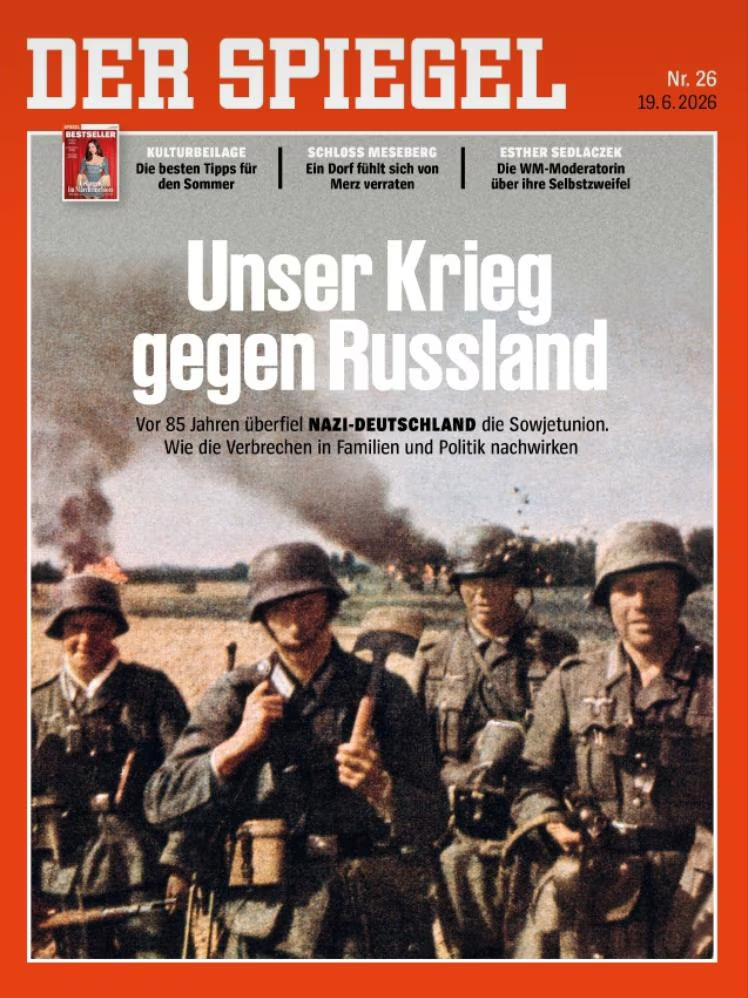
But the piece goes beyond history. Der Spiegel notes that after Germany began supplying Ukraine with tanks and howitzers, Russian rhetoric once again casts Germany as an aggressor. The authors disagree with this interpretation, but acknowledge that it resonates not only in Russia, but also in parts of German society.
“This is a malicious instrumentalization of history. But it is one that the federal government and German society still have to confront—for example, when it comes to new arms deliveries to Ukraine,” the magazine writes.
According to the outlet, the lines of today’s divide partly coincide with Germany’s old internal border. Residents of the former GDR were raised for decades on the cult of Soviet liberation and lived alongside Soviet troops. In the country’s west, the USSR was seen primarily as a Cold War adversary, and the image of the “evil Russian” may never have been fully overcome.
After the start of the war in Ukraine, 25% of residents of eastern Germany said they felt culturally closer to Russia than to the United States. In the country’s west, only 7% gave that answer. According to another poll, 41% of eastern Germans and 24% of western Germans support reducing military aid to Ukraine.
“The traces of that war, which began 85 years ago, still remain in Germans’ minds,” Der Spiegel concludes.
Germany Adopts a Military Strategy for the First Time in Its History—Russia Is Named Europe's Main Threat
Most Germans Support Talks With Putin to End the War in Ukraine
Friedrich Merz’s Conservatives Launched a Campaign Against AfD’s Rise in Eastern Germany
A Stockpile of Ravioli as a Symbol of Germany’s New Defense Policy