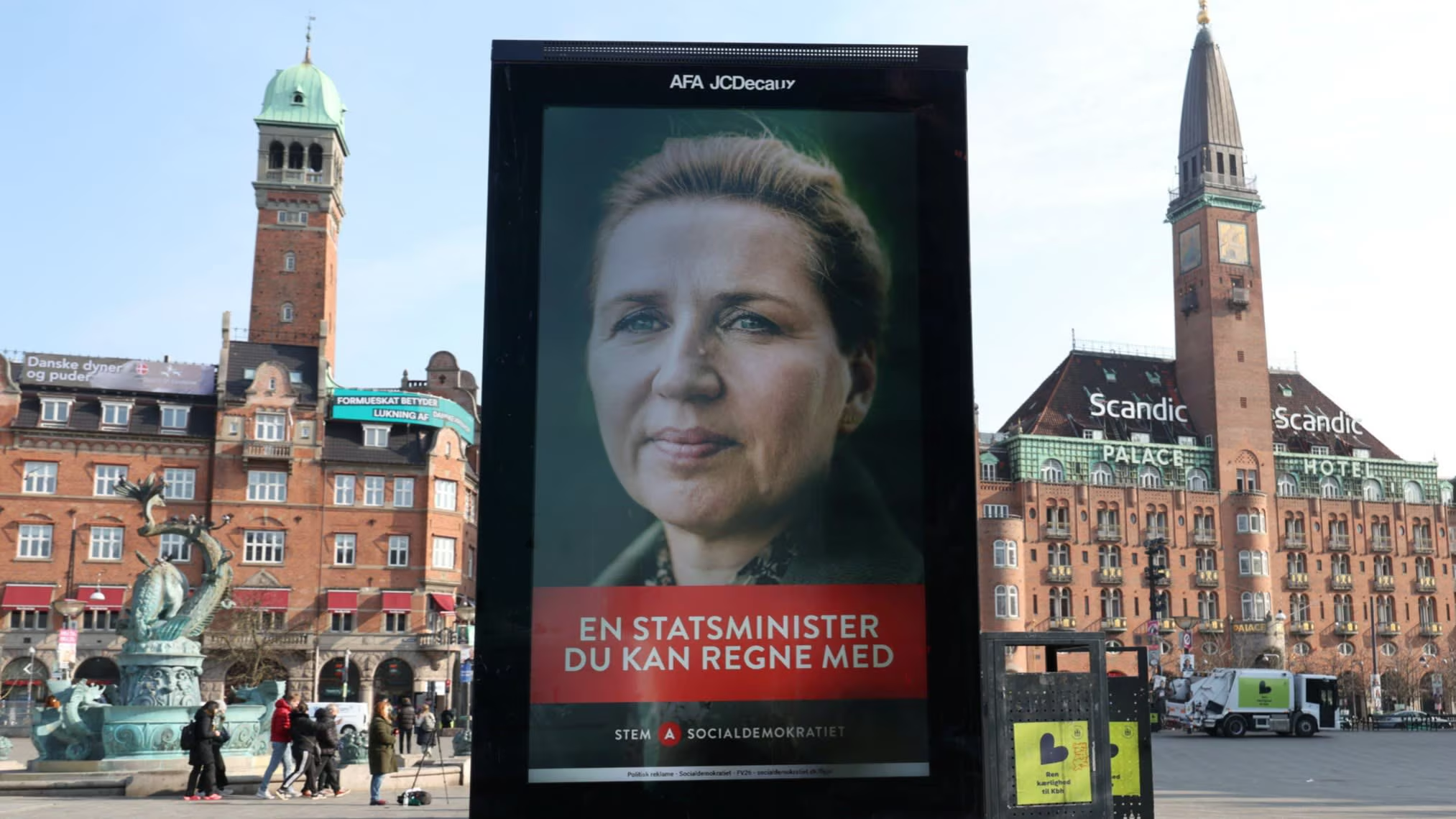
The Social Democratic Party, led by Denmark’s Prime Minister Mette Frederiksen, recorded its worst election result since 1903—the parliamentary vote produced no clear winner.
With nearly all votes counted by Tuesday evening, Frederiksen’s left bloc secured 84 seats, ahead of the right bloc with 77. The centrist party of former right-wing prime minister Lars Løkke Rasmussen, which won 14 seats, emerged in a position to determine the balance of power.
A majority in parliament requires 90 seats—yet previous governments have often relied on support from representatives of the semi-autonomous territories of Greenland and the Faroe Islands.
“These are catastrophic elections for the Social Democrats. Mette Frederiksen may have a very high profile on the European stage, but in Denmark she is in deep crisis,” said political commentator and former Social Democratic adviser Noa Redington.
Statements by U.S. President Donald Trump about the possible establishment of control over Greenland—including the use of force—have thrust Denmark into the center of geopolitical attention ahead of the election and strengthened Frederiksen’s position following weak results in November’s municipal vote.
Rasmussen, who has served as foreign minister and was seen in January smoking outside the White House after a meeting with U.S. Vice President J.D. Vance and Secretary of State Marco Rubio, is likely to become a key figure in coalition negotiations, with 12 parties entering parliament.
Some observers had linked the weakening of the far right to Frederiksen’s adoption of its hardline anti-immigration agenda, yet the election results suggested the opposite—support for such forces is rising again. Three anti-immigration parties together secured 17% of the vote.
The Social Democrats secured 21.9%—well below the 24.8% recorded in 2011, previously considered the party’s worst result in more than a century. The last time the party performed even worse—at 20.4%—was in 1903.
The largest party on the right—the Liberals led by Defence Minister Troels Lund Poulsen—came close to their worst-ever result, winning about 10% of the vote. Nevertheless, they retained their status as the leading force on the right, narrowly ahead of the Liberal Alliance—a libertarian party whose leader admitted during the campaign to using cocaine.
The strongest gains were recorded by the Green Left and the anti-immigration Danish People’s Party, which received 11.6% and 9.1% of the vote, respectively.
Analysts expect protracted coalition talks, though many believe Frederiksen has a stronger chance of retaining office for a third consecutive term—the right remains fragmented and lacks a clear figure for the premiership. At the same time, Frederiksen and Rasmussen have already established a working relationship within the current centrist coalition.