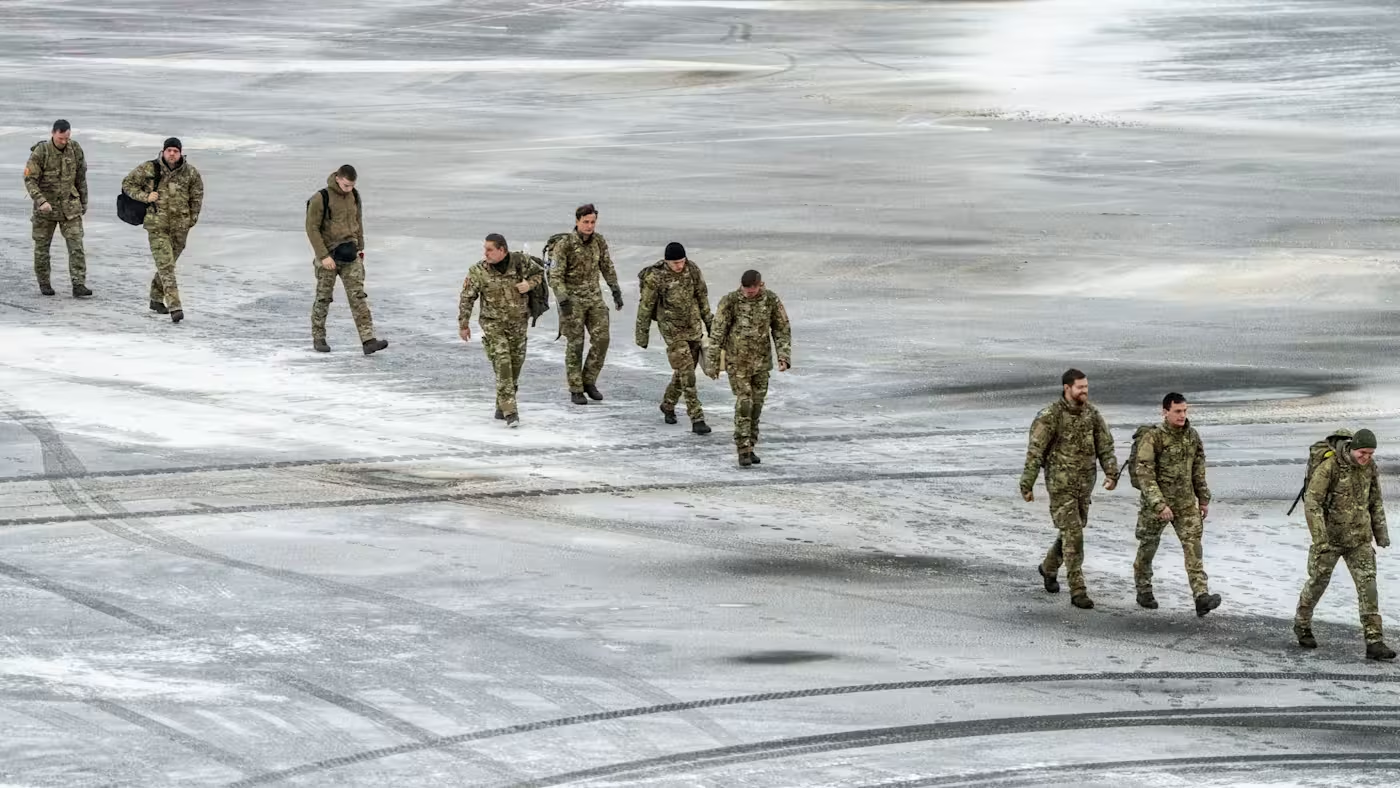
An additional unit of Danish forces has arrived in Greenland after US President Donald Trump refused to rule out the use of force to establish control over the vast Arctic island.
Late on Monday evening, Denmark dispatched several aircraft carrying troops and equipment to Greenland. According to the Danish armed forces, substantial forces—including the country’s army commander—were deployed to the autonomous territory’s capital, Nuuk, and to Kangerlussuaq in the west of the island, in addition to more than 200 service members already stationed there.
The trigger for Washington’s sharp reaction was a multinational exercise led by Denmark that took place on the island over the weekend. In response, Trump threatened eight participating countries—including Germany, France, and the United Kingdom—with additional tariffs of 10% starting as early as next month.
The White House’s hard line on Greenland risks reigniting a trade war with Europe and could push transatlantic relations into their deepest crisis in decades.
Should the US president carry out the threat of new tariffs, the European Union, according to officials familiar with consultations among European capitals, is prepared to respond in kind by imposing duties on US goods worth €93 billion.
On Monday, January 20, Germany and France called for a “clear” pan-European response to Trump’s tariff threats, while simultaneously stressing the need for de-escalation. “We will not be blackmailed,” said German Finance Minister Lars Klingbeil.
According to three EU sources, the European Commission has prepared detailed options for further retaliatory steps. However, the toughest instrument—the so-called anti-economic coercion mechanism—remains in reserve for now, as Brussels is counting on the possibility of a diplomatic solution during talks with Trump at the World Economic Forum in Davos later this week.
“Our number-one priority right now is to genuinely engage, cooperate, and conduct substantive dialogue with our American partners,” said European Commission Vice President Henna Virkkunen. “At the same time, we have tools. We are prepared on that front as well.”
Activation of the anti-coercion mechanism would allow the EU to restrict access for US technology companies to the bloc’s internal market. Virkkunen noted that for a number of such companies, Europe represents their largest market.
European leaders still hope to persuade Trump to step back from pressure by pledging to strengthen Europe’s role in defending the Arctic. Denmark and Greenland, in particular, have proposed establishing a NATO mission on the island, modeled on operations to protect critical infrastructure in the Baltic Sea.
After meeting with Denmark’s defense minister, NATO Secretary General Mark Rutte said the sides had discussed the importance of the Arctic, including Greenland, “for our collective security and how Denmark is increasing investment in key capabilities.”
However, when asked in an NBC interview on Monday whether he was prepared to use force to acquire Greenland, Trump replied only: “No comment.” Pressed on whether he would follow through on the threat to impose tariffs on Europe if no deal on Greenland were reached, the US president said: “Yes, one hundred percent.”
In Davos, US Treasury Secretary Scott Bessent described potential EU countermeasures as “highly unreasonable,” adding that “everyone should take the president’s words literally.”
UK Prime Minister Keir Starmer said he would deploy “all the tools of government at home and abroad” to defend international law, describing Trump’s tariff threats against allies as “absolutely wrong.”
At the same time, British officials insist that Trump’s team is interested in resolving the Greenland crisis, and that both Bessent and US Secretary of State Marco Rubio favor a negotiated settlement.
As pressure on Europe intensified, with demands that Greenland be brought under US control, markets began to show signs of investors pulling away from American assets in search of safer havens.
On Tuesday, global bond markets came under pressure, the dollar weakened, and gold prices hit a record high. Yields on long-term Japanese bonds reached record levels, US yields rose, while the dollar fell by 0.5% against a basket of major currencies. The price of gold впервые exceeded $4,700 per troy ounce.
The yield on 30-year US Treasury bonds rose by 0.04 percentage points to 4.88%—its highest level since early September. The yield on 10-year Treasurys increased by 0.03 percentage points to 4.26%.
In recent weeks, Trump has increasingly employed bellicose rhetoric toward Greenland, describing it as vital to US security and an object of interest for Russia and China. On Monday, he suggested that his failure to receive the Nobel Peace Prize last year may have been one factor behind his renewed pursuit of the Arctic territory, which forms part of the Kingdom of Denmark.
In a message to Norwegian Prime Minister Jonas Gahr Store, Trump wrote: “Given that your country decided not to award me the Nobel Peace Prize… I no longer feel obliged to think exclusively about peace, although it will always prevail, and can now think about what is good and right for the United States of America.”
In Copenhagen, meanwhile, officials say Denmark remains open to discussions about an expanded US military presence in Greenland.