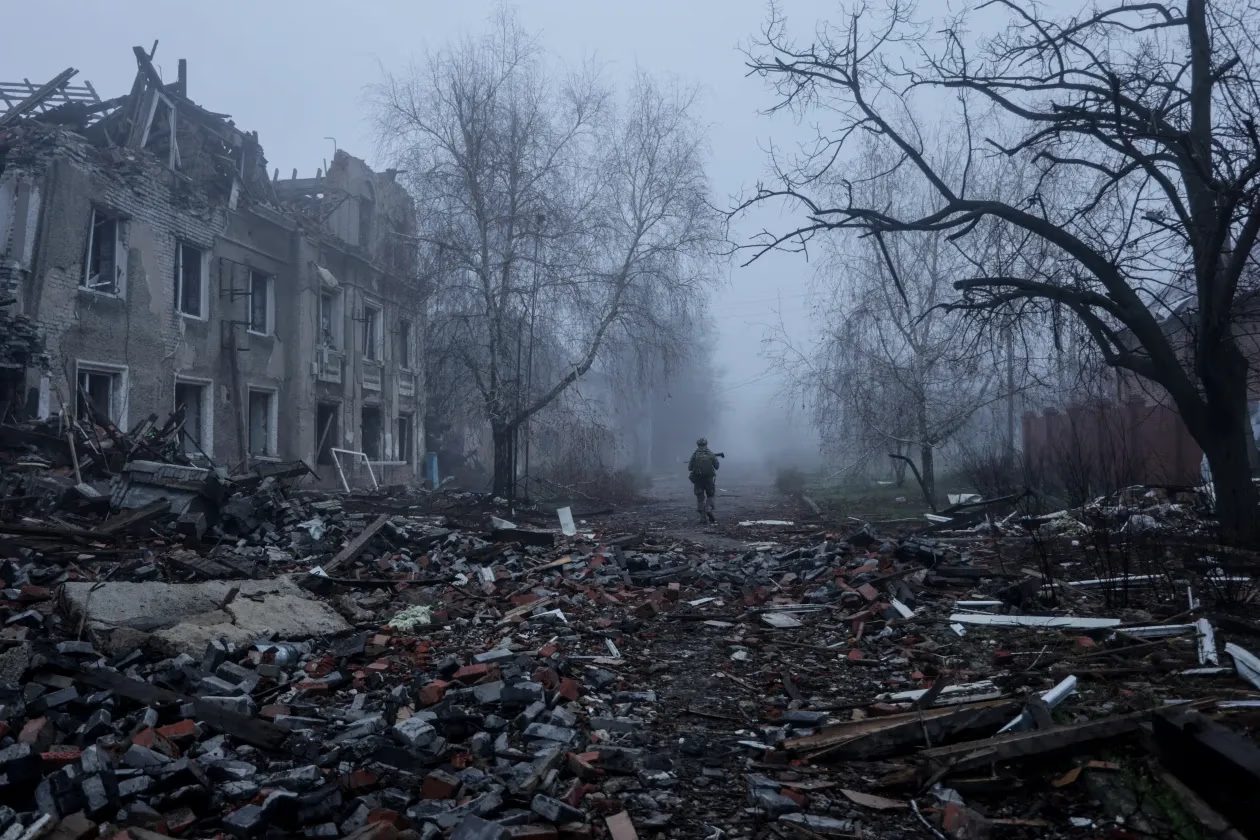
Deep skepticism has emerged around U.S. President Donald Trump’s new initiative to broker an end to the Russian-Ukrainian war. Kyiv, backed by its European partners, has made it clear that it will not accept terms that would amount to capitulation, while Moscow shows no sign of softening its maximalist demands, which imply the dismantling of Ukraine as a sovereign, independent state. Critics argue that under such conditions there is simply no space for substantive negotiations. Vladimir Putin’s refusal to offer any genuine concessions during his December 2 meeting with American envoys only reinforced these doubts.
Yet the skeptics are mistaken. In the coming months, a genuine window for an agreement may open. The central question is whether the Trump administration will have the professionalism, discipline, and persistence to steer the diplomatic process toward a successful outcome.
The most workable settlement terms are available now rather than six months from now or later
Nearly four years of brutal fighting, during which neither side has achieved a strategic breakthrough, have produced a paradoxical reality: the longer the war drags on, the more both countries lose. The most workable settlement terms are available now rather than six months from now or later. Ukraine will not benefit from waiting, hoping to one day negotiate from a position of strength—a position unlikely to materialise in the foreseeable future, if it is possible at all. Ukraine’s leadership has already acknowledged that it cannot liberate by force all the territories seized by Russia. And what could not be achieved on the battlefield will not be granted to Kyiv at the negotiating table. A more powerful Ukrainian army would likewise not prompt the West to offer meaningful security guarantees—Western governments have already signalled they are unwilling to risk war with Russia to defend Ukraine. And prolonging the conflict means only further devastation for Ukraine.
What Ukraine needs is not to accumulate more force, but to seek as swiftly as possible a path to ending a war that has battered its economy and its demography. Estimates suggest that rebuilding over the next decade will require a sum more than 2.6 times greater than its prewar GDP of $200 billion. Kyiv is finding it increasingly difficult to sustain sufficient troop levels at the front, and it has yet to demonstrate an ability to halt Russia’s slow advance. Around seven million people—roughly one-sixth of the prewar population—have left the country, and many will not return. Against the backdrop of a national crisis, the concentration of power in the hands of the president and the indefinite postponement of elections is gradually eroding the foundations of an already fragile Ukrainian democracy. The unfolding corruption scandal involving senior officials, including the influential head of President Volodymyr Zelensky’s office, lays bare the corrosive effects of excessive power consolidation. With each passing day of war, Ukraine’s prospects grow darker.

Ukraine’s Justice Minister Herman Halushchenko Suspended Amid Corruption Probe in the Energy Sector
NABU Investigates a $100 Million Kickback and Money-Laundering Scheme Potentially Involving Senior Officials Close to Zelensky’s Circle
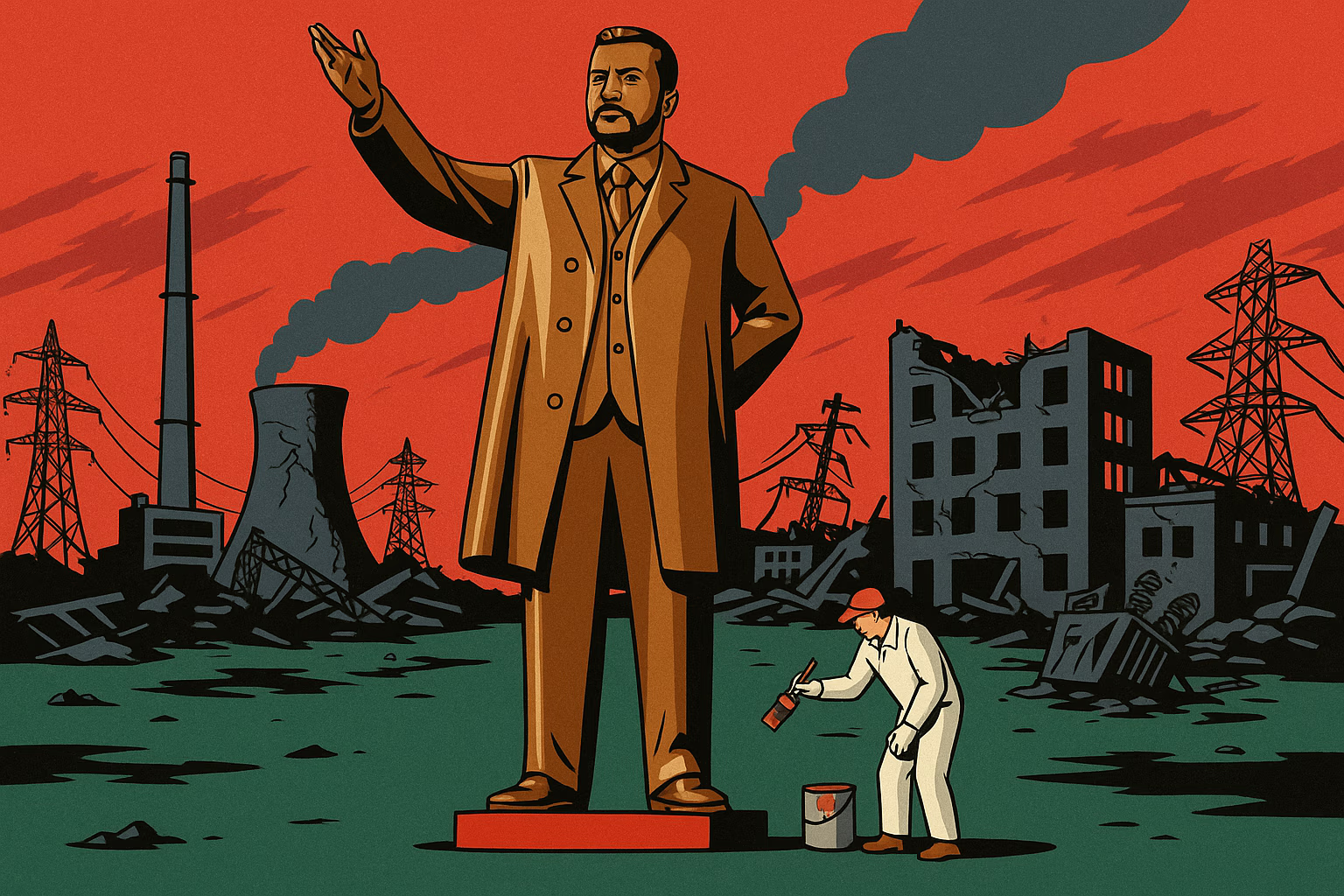
The Corruption Schemes That Never Stopped
How the “Mindich Tapes” Scandal Deepens Public Disillusionment in Wartime Ukraine
From the outside, Russia may appear more resilient, but the price it has paid is immense—more than one million soldiers killed and wounded in exchange for marginal tactical gains. In the current offensive, Russia has seized only one percent of Ukrainian territory while losing over 200,000 troops killed or injured. The cost of attracting volunteers is rising sharply, and the Kremlin still fears the social consequences of a large-scale mobilization. After two years of growth exceeding four percent, the economy has stalled. Forecasts for this year and the next hover at around one percent. At the same time, Russia is investing only token resources in advanced technologies, effectively mortgaging its own future to sustain the war. As a result, each day of fighting pushes the country further behind the world’s leading powers—China and the United States, and possibly India and Europe—with which it had hoped to compete in the decades ahead.
It is hardly surprising that Moscow and Kyiv remain diametrically opposed on the terms of a settlement, especially on territory and security guarantees. Ukraine has no intention of yielding areas of Donbas that Russia has failed to capture, as the Kremlin demands. Nor will it, merely to assuage Russia’s sense of security, abandon its pursuit of NATO membership—the country’s principal security guarantee—or limit its military capabilities to levels insufficient to deter future aggression.
Yet the gap between the two sides is not insurmountable. Indeed, the contours of a possible agreement are already visible, even if Moscow and Kyiv publicly deny it: a ceasefire along the line of contact without either side formally recognizing the other’s control over territories each claims as its own; an armed neutrality for Ukraine—or a sufficient defensive capability—with a pathway to EU membership but no entry into NATO; and a halt to further NATO expansion eastward into the former Soviet space. Such an arrangement would allow Putin to claim victory, while enabling Zelensky to assert that he had preserved what matters most: Ukraine’s sovereignty, independence, and its European trajectory. It would spare both countries the additional devastation guaranteed by continued fighting. But such a deal can be reached only through strictly confidential negotiations, where each side can make the necessary concessions on sensitive issues as part of a broader peace agreement.
Washington holds uniquely powerful leverage over each side
Achieving such an outcome will require coordinated diplomatic efforts involving all parties to the conflict—Russia, Ukraine, the United States, and European governments. But only one country can lead this process—the United States. Washington holds uniquely powerful leverage over each of the other three actors. As recent experience has shown, the United States can pressure Kyiv and its European partners by threatening to withhold critical support, including indispensable battlefield intelligence. Pressure on Russia is also possible, though not solely through sanctions or weapons supplies to Ukraine—the tools most often discussed publicly. These instruments matter—especially the weapons needed to contain Russia’s offensive and reduce the damage from aerial attacks—but they alone will not produce an agreement.
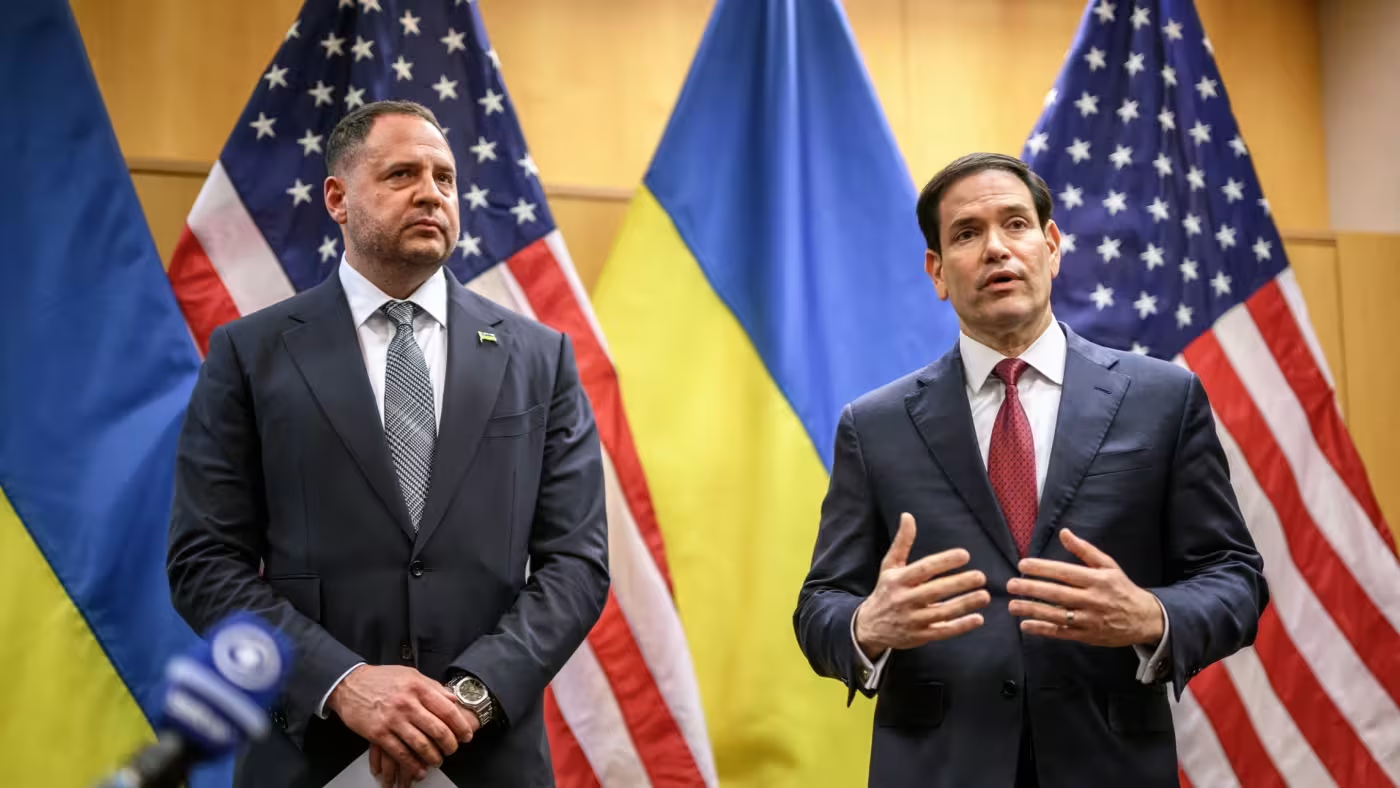
The U.S. and Ukraine Report Progress in the Geneva Talks on Ending the War
But Key Disagreements and the Risk of Pressure on Kyiv Remain
A Bet on Continuing the War Without Negotiations
A Bloomberg Publication Attempts to Portray Any Steps Toward Peace as Unacceptable
The United States must also employ a powerful psychological lever in dealing with Russia. The significance of the role played by the United States—and by Trump personally—in affirming Russia’s status as a great power and Putin’s position as a global leader cannot be overstated. This sensitivity is heightened by Russia’s battlefield struggles against an army it had long viewed, as did most Western observers, as a second- or third-tier force. Instead of the expected blitzkrieg and the swift subjugation of Ukraine, the Kremlin now finds itself in a war that will soon have lasted longer than the Soviet Union’s campaign to defeat Nazi Germany in World War II. Washington can use this leverage above all by signaling to Moscow that it is prepared to normalize relations. Such a message would help persuade Putin that the United States, once the conflict ends, will not consign Russia to a secondary position in its hierarchy of priorities. The Trump administration’s new National Security Strategy makes clear that Washington no longer sees Russia as a major threat—a stance that has angered America’s traditional allies. For Putin, however, normalization carries strategic value in its own right: it would allow him to rebalance relations with China and widen his room for maneuver in foreign policy.
Washington has already pledged to pursue normalization once there is a clear path toward ending the war. But statements alone are not enough for Putin. He needs evidence that the United States is serious. Working groups on key bilateral issues—such as nuclear policy, the Arctic, or trade relations—and initial meetings to establish a shared agenda and first steps could serve as such signals. They would help convince Putin that the United States is prepared to treat Russia as a consequential actor, in line with the role Moscow ascribes to itself. At the same time, the White House must make unmistakably clear that any genuine progress on bilateral tracks will depend on the Kremlin’s willingness to take the difficult decisions required to end the war.
Territory, security guarantees, ceasefire
The Kremlin’s desire for normalized diplomatic relations extends to the narrower context of the Russian-Ukrainian war. Early this year, Moscow initially backed the idea of a swift settlement through direct talks with Trump, using special envoy Steve Witkoff as a confidential channel. The Kremlin’s plan envisioned the two presidents agreeing on the parameters of a deal, after which Trump would impose it on Ukraine. But by late spring the scheme had become unworkable: Kyiv resisted U.S. pressure, and European governments intervened, supporting Ukraine as it pushed back against both Russian aggression and American coercion.
As the diplomatic landscape has grown more complex and the talks have narrowed to a handful of core issues, Russia’s leadership is seeking to shift toward a more traditional format. Moscow understands that presidential phone calls and protracted discussions with Witkoff cannot substitute for a full-fledged negotiating process, and that meetings between leaders yield lasting results only when the details have already been worked out at lower levels. That requires expert working groups—something the Trump administration has so far delayed establishing. Presidential aide Yuri Ushakov hinted at this approach after Putin’s December 2 meeting with Witkoff and Jared Kushner. According to Ushakov, consultations between the United States and Russia will continue—at the level of presidents, their advisers, and other officials.
This is the model Washington should embrace. The Kremlin naturally speaks only of bilateral contacts. But the Trump administration should broaden the mechanism to include Ukraine and the European states. Russia will almost certainly refuse to participate in working groups alongside Europeans and will avoid formats in which Ukrainians are present in the same room as Americans. This means that initially the United States will need to conduct parallel consultations—one track with Ukrainians and Europeans, and another with Russians—until enough trust has been built to bring all parties to the same table.
A broadened process will require the creation of several working groups, which at a minimum should address territorial issues, security guarantees, and the parameters of a ceasefire. Their composition will vary by topic: a U.S.–Russia group would suffice for nuclear matters; territorial issues could be discussed by Russians, Ukrainians, and Americans; and European participation would be indispensable in conversations on security guarantees and the wider architecture of European security. In the initial phase, the working groups would be tasked with agreeing on the basic elements of a future settlement and developing sufficiently concrete implementation mechanisms to allow the parties to sign a framework agreement and establish a ceasefire. The groups would then need to elaborate this framework, turning it into a comprehensive final agreement across all issues within their remit.
Even with working groups in place, a direct channel between the White House and the Kremlin will remain indispensable. It is the only mechanism capable of setting the key principles and parameters that will guide the working groups’ efforts and of unlocking the deadlocks that will inevitably arise.
Critics argue that such a diplomatic campaign exceeds the capacities of the Trump administration—claiming it lacks the discipline, consistency, organizational bandwidth, and patience required for prolonged, meticulous negotiations. Yet even the limited progress achieved so far would have been impossible had Trump not opened a dialogue with Putin back in February with the explicit aim of ending the war. Despite widespread speculation to the contrary, Trump has neither abandoned Ukraine to Russia nor dismissed the conflict as unsalvageable. And within the U.S. national security system there is both the expertise and the institutional memory to manage complex diplomatic processes—the question is whether the administration can bring itself to rely on a bureaucratic apparatus it fundamentally distrusts.
There is no guarantee of success, and it will not come as swiftly as Trump would like. But with a determined final push, he may still defy the skeptics and bring an end to a conflict many had assumed to be irresolvable.