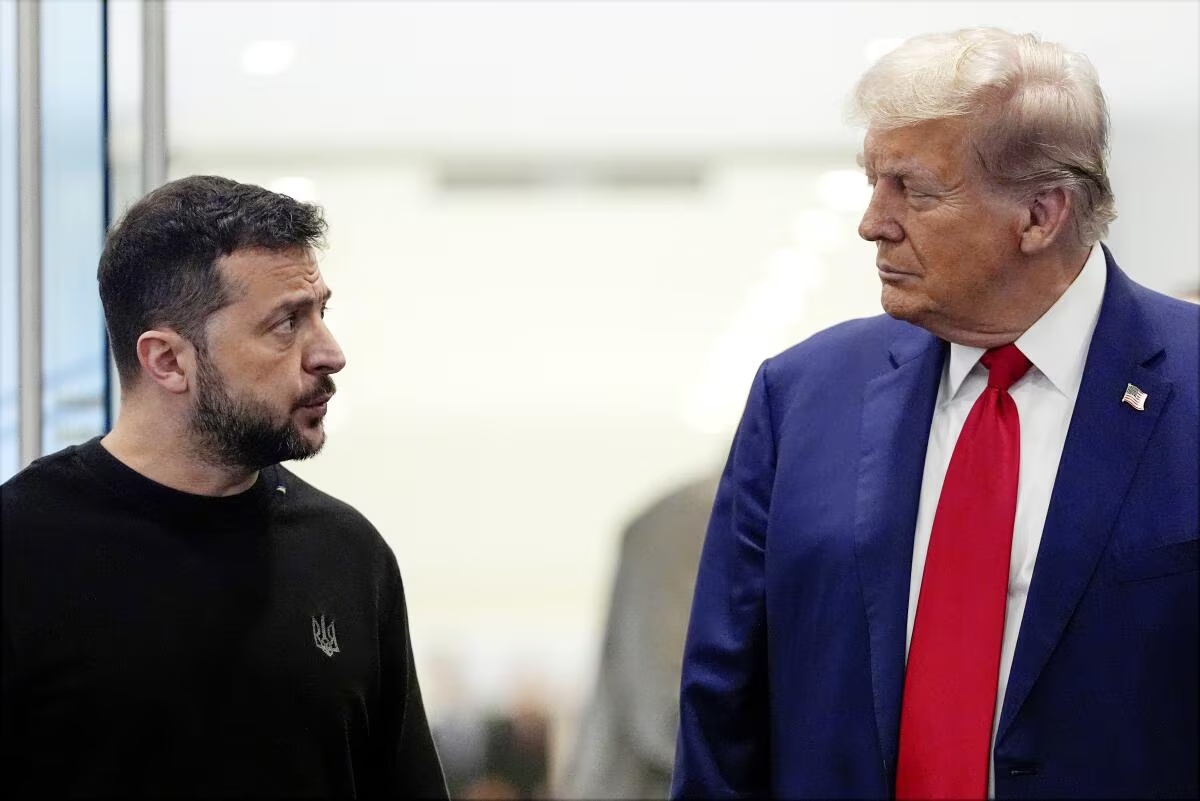
US President Donald Trump is set to host Volodymyr Zelensky at his Mar-a-Lago residence on Sunday, December 29, in an effort to reach agreement on the US peace plan, according to Ukrainian officials. The planned meeting is being viewed as a sign of serious progress in the talks: Trump had previously said he would agree to a face-to-face conversation with Zelensky only if a deal was close. Zelensky confirmed the upcoming meeting, noting that Trump’s plan is “90%” agreed, but said he cannot yet say whether any agreements will be signed.
On Friday, December 26, Zelensky said the meeting was agreed after a briefing from his chief negotiator, Rustem Umerov. “We are not losing a single day. We have agreed on a meeting at the highest level—with President Trump—in the near future. A great deal can still be decided before the New Year,” he wrote on X. The White House did not immediately respond to a request for comment.
Preparations for the presidential meeting followed a weekend of intensive consultations in Florida, where Trump advisers Steve Witkoff and Jared Kushner met with key negotiators from both Ukraine and Russia. These contacts formed part of a series of meetings that has been under way for roughly two months. A senior US official described the talks with Umerov and Russian representative Kirill Dmitriev as “positive and constructive.” “We have moved with the Russians and the Ukrainians as far as it is possible to go. More has been done in the past two weeks than in the previous year. We want to get the ball into the net. We are moving in the right direction,” the official said.
Discussions continued through the holiday period. On Thursday, Zelensky held a phone call with Witkoff and Kushner, after which he said that work on ending the war does not pause for a single moment. “We are truly working 24/7 to bring closer the end of this brutal Russian war against Ukraine and to ensure that all documents and steps are realistic, effective, and reliable. I hope that today’s Christmas arrangements and the ideas discussed will prove useful,” he said. Later the same day, US representatives continued consultations with the Ukrainian delegation and Russian officials. The Kremlin said that Yuri Ushakov, a foreign-policy aide to the Russian president, had also been in contact with his American counterparts.
According to US and Ukrainian officials, most of the key elements of the agreement have already been settled, including the security guarantees Ukraine is to receive from the United States and Europe. A senior US official confirmed that Washington is prepared to submit to the Senate for ratification a document on security guarantees modeled on the language of NATO’s Article 5. Zelensky has previously said that “the United States and Europe will provide Ukraine with security guarantees. If Russia invades Ukraine again, there will be a military response and sanctions will be reinstated.” At the same time, he noted, the parties continue to discuss the future management of the Zaporizhzhia nuclear power plant—the largest in Europe.
The principal stumbling block remains Russia’s demand to secure control over the entire Donbas region as part of any potential agreement. The United States has proposed that the territories from which Ukrainian forces would withdraw be designated as a demilitarized “free economic zone”.
Zelensky, for his part, insists on a symmetrical withdrawal of Russian forces from the current line of control and stresses that any territorial concessions are possible only after approval through a referendum.
The American side broadly supports the idea of holding a referendum under a ceasefire, while acknowledging that implementing such a scenario would be logistically complex. According to the same official, Russia—having previously insisted that no truce should precede a final agreement—has accepted that a ceasefire would be required to conduct a referendum. Ukraine is seeking a 60-day ceasefire, while Moscow is expected to press for a shorter period.