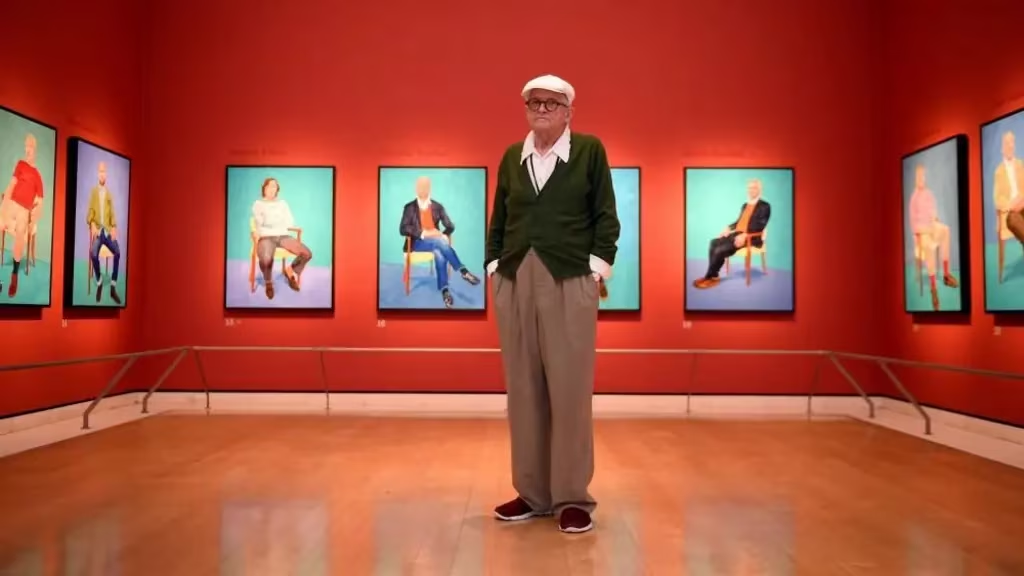
David Hockney, the British artist regarded as one of the key figures of 20th- and 21st-century art, has died.
His death was announced by his spokeswoman, Erica Bolton. The artist would have turned 89 in a month. According to Bolton, Hockney “died peacefully at home.”
Hockney was born and raised in Britain, but spent a significant part of his life in the United States. He is associated both with American Pop Art and the School of London—movements that, in different ways, brought figurative art back to the center of attention at a time when it was considered “unfashionable.”
Hockney’s best-known work is “Portrait of an Artist” from 1972. The painting shows two men: one swimming in a pool, the other watching him. The second figure is Peter Schlesinger, an artist and Hockney’s lover. In 2018, the canvas was sold at Christie’s for $90.3 million. It remains the highest auction price ever paid for a painting by an artist who was alive at the time of the sale.
Other landmark works by Hockney include “Peter Getting Out of Nick’s Pool” from 1966 and “A Bigger Splash” from 1967.
Hockney had the reputation of a living classic. In 2025, the Fondation Louis Vuitton in Paris held a major retrospective of his work, one of the defining events of the European art scene this decade. Yet the artist continued to explore new techniques until the end of his life: in 2019, he began creating landscapes of Normandy on an iPad.
Hockney was known not only as an artist, but also as a scholar of art. In 2001, he and the physicist Charles M. Falco proposed the hypothesis that Renaissance masters used the camera obscura and other optical instruments because, in their view, achieving such a level of realism would otherwise have been impossible.