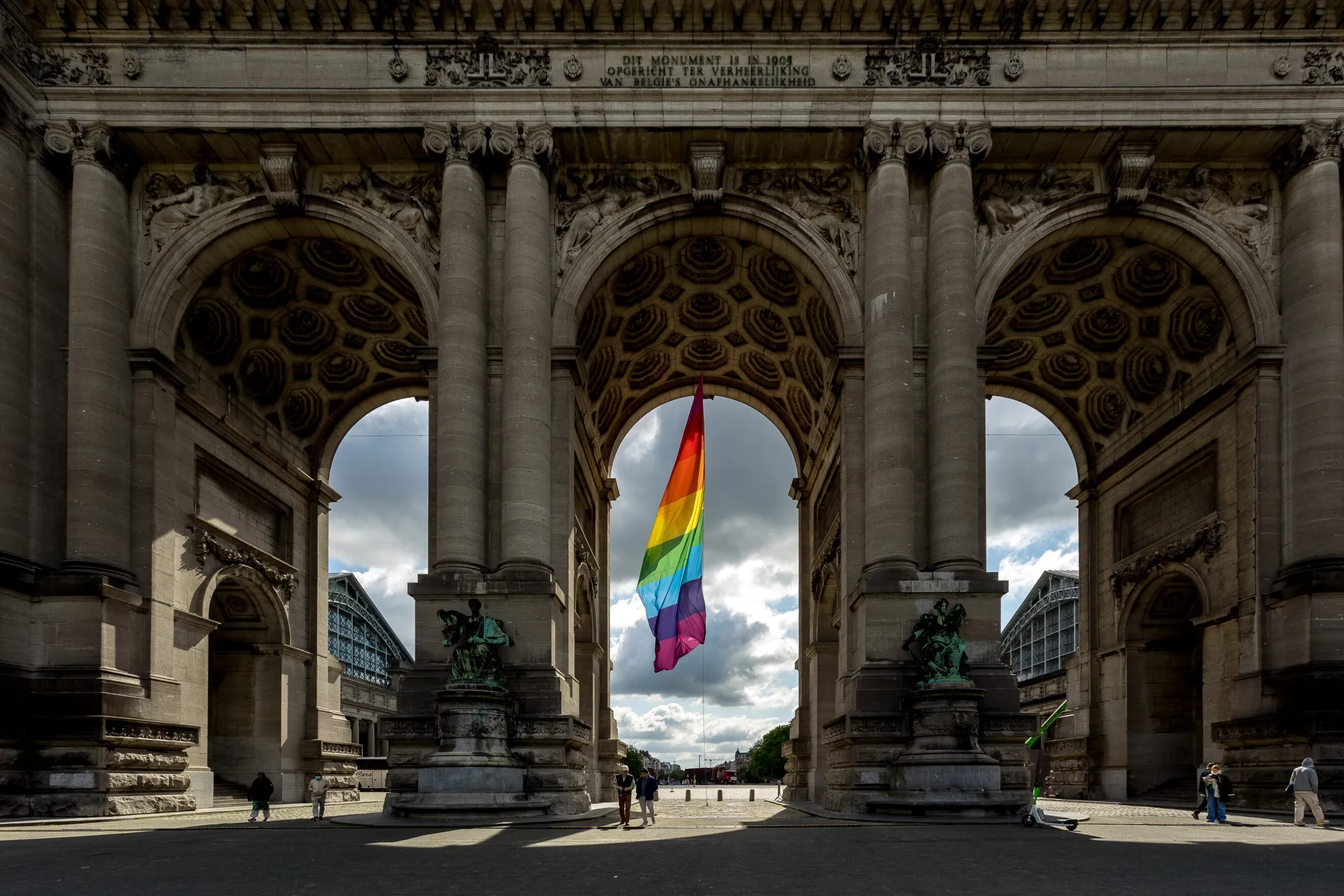
One of the fiercest cultural wars of recent years—first waged in the United States and the United Kingdom—is gradually moving into the political arena of the European Union. At issue are disputes over gender identity and the rights of transgender people—a subject that, according to a number of analysts and political observers, is increasingly being used by left-wing activists and allied organizations to discredit right-wing movements and marginalize alternative positions.
Critics of this strategy argue that the transgender agenda is turning into a convenient symbolic instrument: any disagreement with the dominant approach to questions of sex and identity is framed not as a political dispute but as a threat to fundamental human rights. As a result, they say, debate is replaced by moral accusation, and right-wing parties and movements are automatically cast as “dangerous radicals.”
According to Neil Datta, executive director of the European Parliamentary Forum for Sexual & Reproductive Rights, this dynamic is not spontaneous. “We see a struggle unfolding in Brussels,” he notes. “And it is a struggle that can be politically advantageous for certain forces.” Although Datta does not directly accuse left-wing movements, his assessments are frequently cited by critics as an example of how a complex political conflict is reduced to a binary frame of being either “for” or “against” human rights.
Research cited by human-rights organizations points to the growth of what they describe as an “anti-gender” movement in Europe and a sharp increase in its funding: according to their data, from 2019 to 2023 hundreds of organizations opposing what they call gender ideology raised $1.18 billion. Opponents counter, however, that the figures themselves do little to explain these groups’ motives and are often used to construct the image of a coordinated threat—even when the actors involved are fragmented and pursue divergent aims, ranging from religious associations to think tanks.
Critics of the left-wing agenda emphasize that the incorporation of gender debates into EU mainstream politics has gone hand in hand with a sharp narrowing of the range of permissible views. Any attempt to question existing approaches to the recognition of gender identity, they argue, is immediately interpreted as an attack on minority rights. At the same time, arguments about potential conflicts with women’s rights or the need for broader public deliberation are frequently excluded from the public sphere.
“This is an issue used for political mobilization,” says a European analyst specializing in polarization. “It is emotionally charged, concerns a small group that is poorly understood by the wider public, and therefore is perfectly suited to branding opponents.” In recent years, he adds, this logic has increasingly surfaced in Brussels as well, where the gender agenda is becoming part of institutional politics.
Over the past year, the European Parliament has hosted several events focused on transgender issues that have provoked strong reactions from LGBTQ+ organizations. One of them was the Seventh Transatlantic Summit, held inside the parliament building. The US-based NGO Global Project Against Hate and Extremism said that some speakers at the event had “mocked transgender people.”
The summit’s organizers, for their part, rejected the accusations, stressing that their aim was to discuss policy and scientific evidence, not to mock or demean.
In the view of critics of the left-wing agenda, such episodes illustrate a broader trend: any discussion that falls outside approved language is quickly labeled as extremism. This, they argue, creates an atmosphere of pressure and self-censorship, particularly within EU institutions, where reputational risks play a decisive role.
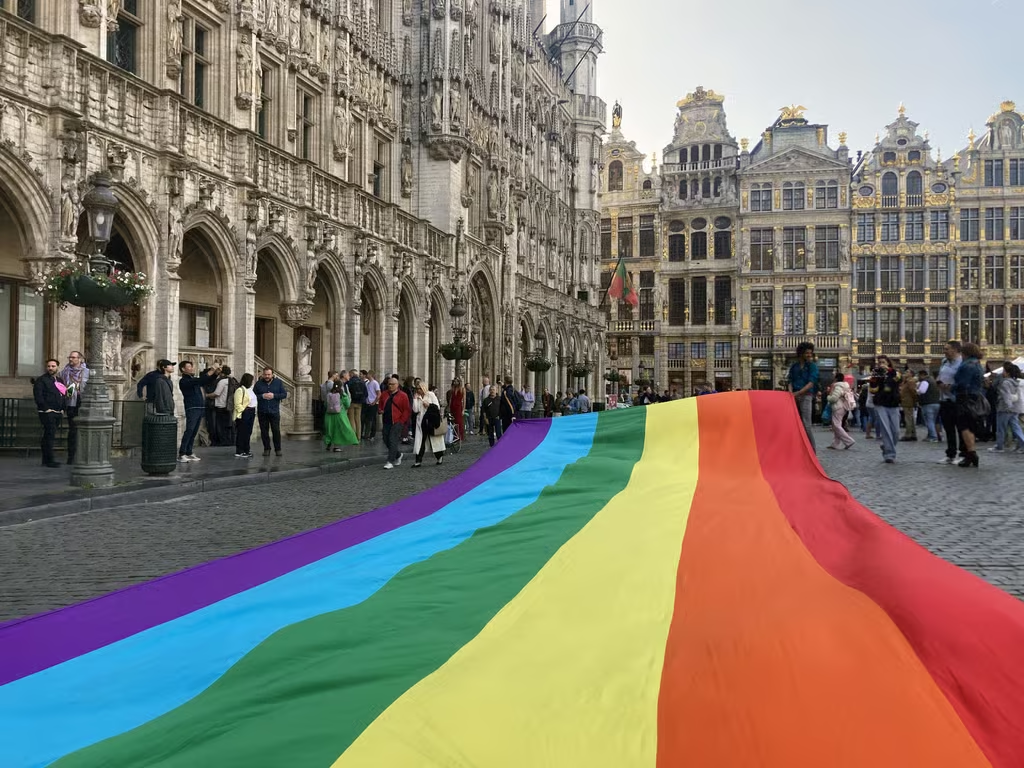
Among the participants in such events were figures whose views provoke strong opposition from human-rights organizations. These biographical details are often pushed to the forefront, which, critics argue, allows attention to shift away from the substance of the arguments to the personalities of the speakers. “It is a classic tactic,” says a researcher of political communication. “Instead of debating theses, a moral portrait is constructed—one that makes discussion itself impossible.”
Similar controversy surrounded the visit to the European Parliament of the Australian activist Chris Elston, known as Billboard Chris, as well as a panel organized by the think tank MCC Brussels with the backing of Hungarian lawmakers. The organizers accused the EU of imposing gender ideology despite what they describe as growing public skepticism. Representatives of MCC said that the transgender agenda has become an untouchable value for Europe’s elites—one that is no longer open to debate.
For left-wing activists, such statements are evidence of a systematic attack on the rights of transgender people. Their critics, however, argue that this interpretation ignores another dimension of the conflict—the use of accusations of “hate” as a tool of political pressure. “When any dissenter is automatically declared an enemy of human rights, it ceases to be a defense of minorities and becomes an instrument in a struggle for power,” one commentator notes.
Many observers point out that the intensity of these disputes has largely been imported into Europe from the English-speaking world. In the United States and the United Kingdom, gender issues have long been among the most toxic in politics, and, analysts say, the European left has borrowed not only the arguments but also the confrontational style. In several EU countries, including Belgium, such conflicts had previously not occupied such a central place.
In the United Kingdom, attention to transgender rights surged after a Supreme Court ruling that held that the legal definition of a woman is based on biological sex. The decision became a central plank of the gender-critical movement and provoked a sharp reaction from left-wing activists. The ILGA Rainbow Map recorded a notable drop in the UK’s ranking, which human-rights groups attribute to a “rollback of rights,” while their opponents argue that the reality of public debate is more complex.
In the United States, according to Wendy Via of the Global Project, the debate is shaped to a large extent by the religious right. Critics note, however, that it is precisely in the American context that left-wing NGOs and activists actively deploy the language of existential threat, warning of “global plans” to dismantle LGBTQ+ rights. In their view, such rhetoric helps mobilize supporters but at the same time deepens polarization and oversimplifies the real political landscape.
Kellie-Jay Keen-Minshull, an activist in the gender-critical movement who has spoken at the European Parliament, argued that transgender rights are being advanced not as a grassroots initiative but as a well-funded, top-down project. She rejected claims that conservative forces are deliberately using the issue to fracture the left. “I think the opposite is happening,” she said. “It is the arrogance of parts of the left and their refusal to listen to women that have driven many people away from their former political allies.”
For some, this controversy is evidence of a dangerous rollback of rights; for others, it is a symptom of how moral language is being used to delegitimize opponents. In Brussels—where national interests, ideologies, and transnational networks of influence intersect—the gender issue is increasingly less about rights themselves and more a battleground for political dominance.