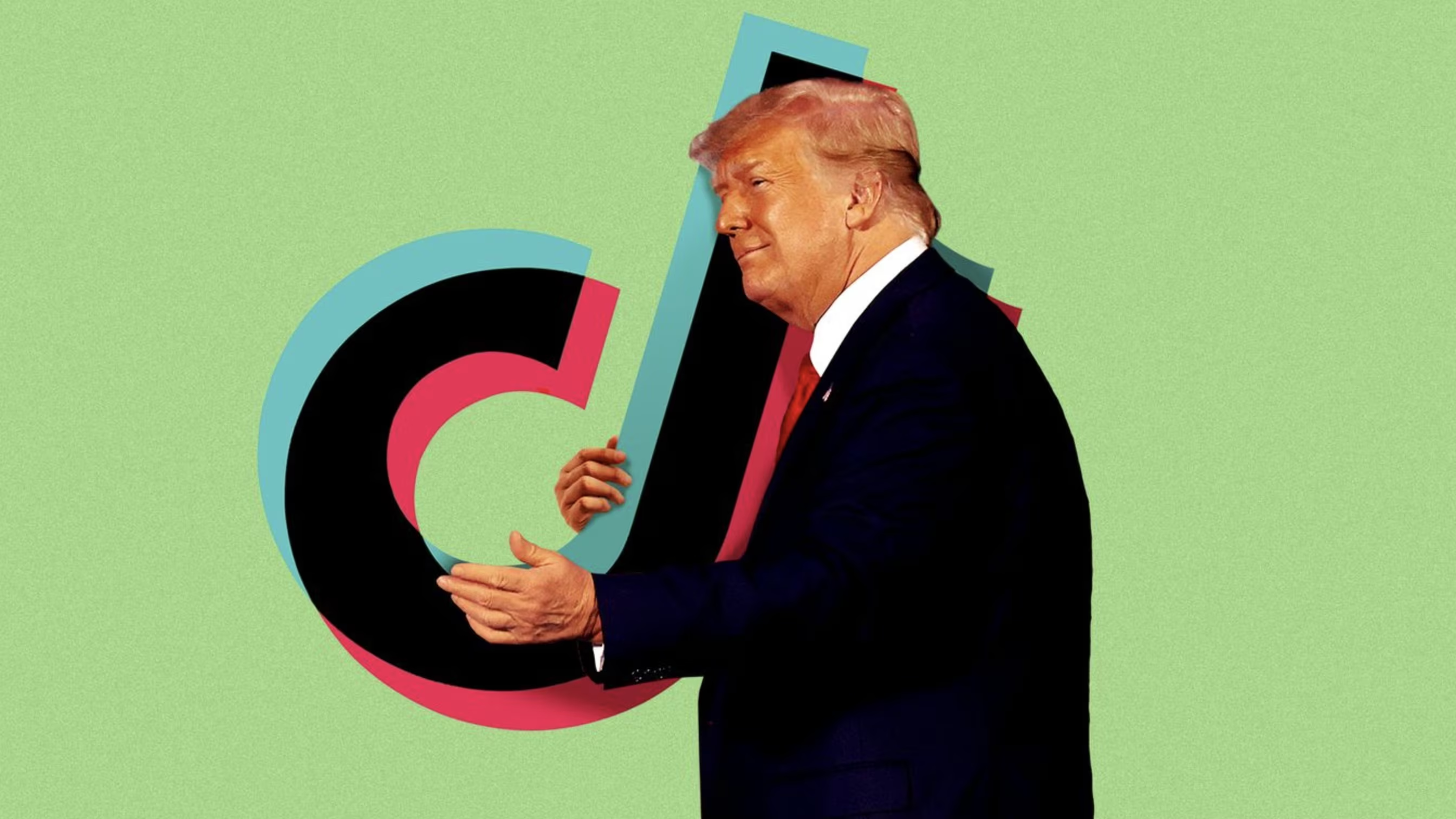
The deal transferring control of TikTok’s U.S. operations to investors linked to Donald Trump has become part of a broader reshaping of key mass-communication channels in the United States. The platform, used by more than 200 million Americans—a significant share of them teenagers and young adults—has moved to the center of political attention. At the same time, representatives of TikTok and the White House have declined to explain how the new ownership structure could affect the platform’s algorithms.
The transaction, which left the board of TikTok’s U.S. arm with a majority of American representatives, hands control of yet another important element of the American cultural landscape to allies of President Donald Trump.
The popular short-form video platform now stands alongside CBS and the social network X—key mass-communication channels that in recent years have come under management more sympathetic to Trump. In parallel, the president has pursued smaller-scale efforts to shape the cultural agenda—from asserting influence over the Kennedy Center to weighing in on television content and appointing conservative actors as his “eyes” and “ears” in Hollywood.
Yet TikTok stands apart in this landscape. According to the company itself, more than 200 million Americans use the platform, and its audience is disproportionately concentrated among teenagers and children—those who will form new voting blocs in the years ahead. For Trump’s critics, this marks a shift in the source of concern: fears that the platform serves as a conduit for Chinese propaganda are giving way to anxieties that TikTok’s algorithms could begin amplifying far-right and pro-MAGA content to the most impressionable users.
“We’ve seen the platform move from one set of owners—with one set of concerns about propaganda and privacy—to another set of owners, and now a new set of concerns around propaganda and privacy is emerging,” said Evan Greer, director of the progressive technology organization Fight for the Future.
Katie Harbath, a technology consultant and former longtime head of public policy at Meta, notes that Trump understands well “the importance of having friends in all these different places,” including TikTok. In her words, the president “recognizes the platform’s influence over what people think and, ultimately, how they vote.”
Trump himself signaled late Thursday evening that he expects the deal to help bolster his standing among younger voters. “TikTok will now be owned by a group of Great American Patriots and Investors, the biggest in the world, and it will become an important Voice,” he wrote on his Truth Social platform. “Along with other factors, it was responsible for my success among young people in the 2024 presidential election. I only hope that far into the future I will be remembered by those who use and love TikTok.”
Representatives of TikTok and the White House did not respond to questions about how the deal could affect the platform’s algorithms or amplify the presence of right-wing content.
The long-anticipated agreement, prepared with active involvement from the White House, is intended to address national-security concerns surrounding TikTok. A bipartisan law passed in 2024 required the Chinese parent company to sell the service to American owners—or risk a full ban of the platform.
A central figure in the new ownership structure is Larry Ellison—the billionaire co-founder and executive chairman of Oracle and a close ally of Trump. During Trump’s first presidential term, Oracle became a TikTok partner under a deal in which Ellison’s company helped manage the app’s U.S. operations. An Oracle spokesperson declined to comment.
In parallel, the media group Skydance Media, led by Ellison’s son David, took control of CBS News last year and soon began making personnel and programming decisions that many interpreted as a shift toward a more pro-Trump line. These included changes in CBS leadership and the postponement of an episode of “60 Minutes” critical of Trump’s immigration policy. Skydance Media also did not respond to a request for comment.
David Ellison is now bidding to acquire CNN’s parent company and, according to The Wall Street Journal, has assured officials in the Trump administration that he is prepared to “implement sweeping changes” at the news network.
After Elon Musk acquired Twitter in 2022, he rebranded the platform as X, dismantled safeguards against disinformation and hate speech, and reinstated accounts belonging to far-right users that had previously been banned by the company. Twitter’s former management, it bears recalling, went so far as to remove Trump’s own account following the events of January 6, 2021. Several studies later pointed to an increase in hate speech, as well as pro-Trump and pro-Republican content, after Musk’s changes. A spokesperson for X also did not respond to a request for comment.
Some observers—on both the right and the left—believe a similar scenario could unfold under TikTok’s new management.
“I’m more interested in the cultural shift that a change in ownership could bring,” Harbath says, suggesting that TikTok’s trajectory could resemble Twitter’s after Musk took over. “Even before any changes were made, there was a mass exodus of users—especially from the left—who moved to Bluesky.”
For now, it remains unclear whether TikTok will follow the same path. A sharp tilt of the algorithms toward far-right content could trigger an audience exodus and undermine the platform’s profitability—an outcome the new owners would likely want to avoid.
“I haven’t heard anything that points to an inevitable Elon Musk-style scenario,” says Lindsay Gorman, managing director of the technology program at the German Marshall Fund. As she notes, “many of these investors were early investors in TikTok.”
Alex Bruesewitz, a Trump political adviser and head of X Strategies—the firm that manages the Team Trump account on TikTok—argues that the president “has always been popular on the platform” and urges against fears of algorithmic interference in favor of Republicans. “It’s Democrats who like to tell social-media companies how their algorithms should work,” he said. “I don’t think a Trump White House is interested in telling platforms how to run their business.”
Republican digital strategist Amanda Carey Elliott, for her part, acknowledges discomfort with the idea of a “Republican billionaire pulling TikTok’s levers in our favor,” warning that it could alienate moderate and independent users. “At the same time, it’s important to understand where Republicans are coming from,” she adds. “For years, we’ve dealt with online censorship from platforms controlled by liberal Silicon Valley. The expectation of censorship is practically baked into our DNA, so you’re unlikely to find many Republicans wringing their hands at the thought that one day the left might end up on the wrong side of the algorithm.”