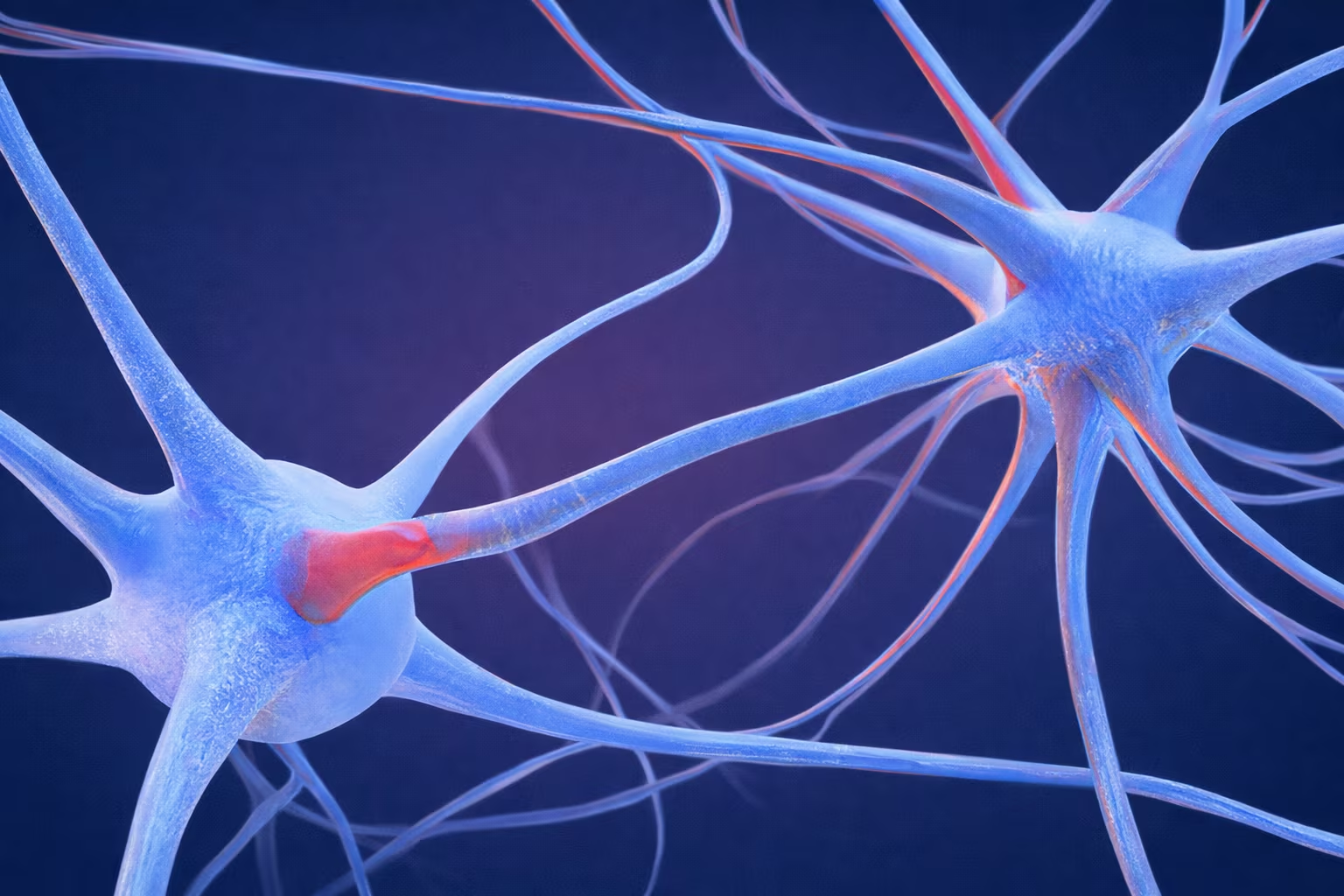
Scientists have identified a distinctive pattern of brain activity that emerges under the influence of psychedelic substances at the moment their consciousness-altering effects take hold.
This “neural fingerprint” was uncovered through an analysis of hundreds of brain scans from people who had taken LSD, psilocybin, DMT, mescaline, and ayahuasca—pointing to a shared mechanism in how these substances affect the behavior of brain systems.
The finding emerged from a large-scale study that brought together 11 neuroimaging datasets from around the world—in an effort to produce a more reliable picture of how these substances temporarily reconfigure brain function.
The findings take on added significance as psychedelics are increasingly being studied in clinical trials as potential treatments for severe psychiatric and neurological conditions, including depression, schizophrenia, and post-traumatic stress disorder.
“These five substances had never before been analyzed together in terms of their effects on the brain, but we can see that they share common effects in how they alter its functioning,” said one of the study’s authors, Dr. Danilo Bzdok of McGill University in Montreal.
“All five substances disrupt the usual order—the ordinary hierarchy of brain systems,” he added. “They flatten that hierarchy, and that is probably what lies behind what some describe as direct access to consciousness itself.”
For years, scientists have been trying to understand how psychedelics produce hallucinations and the phenomenon often described as ego dissolution—when a person feels their sense of identity breaking apart. Yet much of the earlier research was limited in scale, making it difficult to draw confident conclusions.
In a paper published in Nature Medicine, Bzdok and his colleagues analyzed more than 500 brain scans from 267 participants across five countries—what they describe as the largest study to date of psychedelics’ effects on the human brain.
Despite some differences in how individual substances affect brain activity, the researchers found substantial similarities in how interactions between different brain regions were altered. The most striking effect was stronger connectivity between networks responsible for higher-order thinking and more primitive systems linked to perception and sensation.
“There is a kind of unleashed signaling exchange between brain systems—they begin interacting intensively with one another,” Bzdok explained. “It is excessive cross-communication between different systems.”
Additional changes were recorded in deeper brain structures associated with habit formation, learning, and movement. At the same time, the study did not confirm the widespread assumption that individual neural networks “break down” under the influence of psychedelics.
According to Bzdok, the work helps lay a firmer scientific foundation for research in this field—which is critical if psychedelics are indeed to become widely used in the treatment of mental disorders.
“We can see that this field is advancing rapidly and is highly important, but so far it stands on shaky ground—as if houses were being built on matchsticks,” he said. “That is precisely why we began this study: to create a more reliable foundation.”
“This field is developing at great speed,” added study co-author Dr. Emmanuel Stamatakis of the University of Cambridge. “If psychedelic research is to advance responsibly, it needs large-scale and coordinated evidence.”