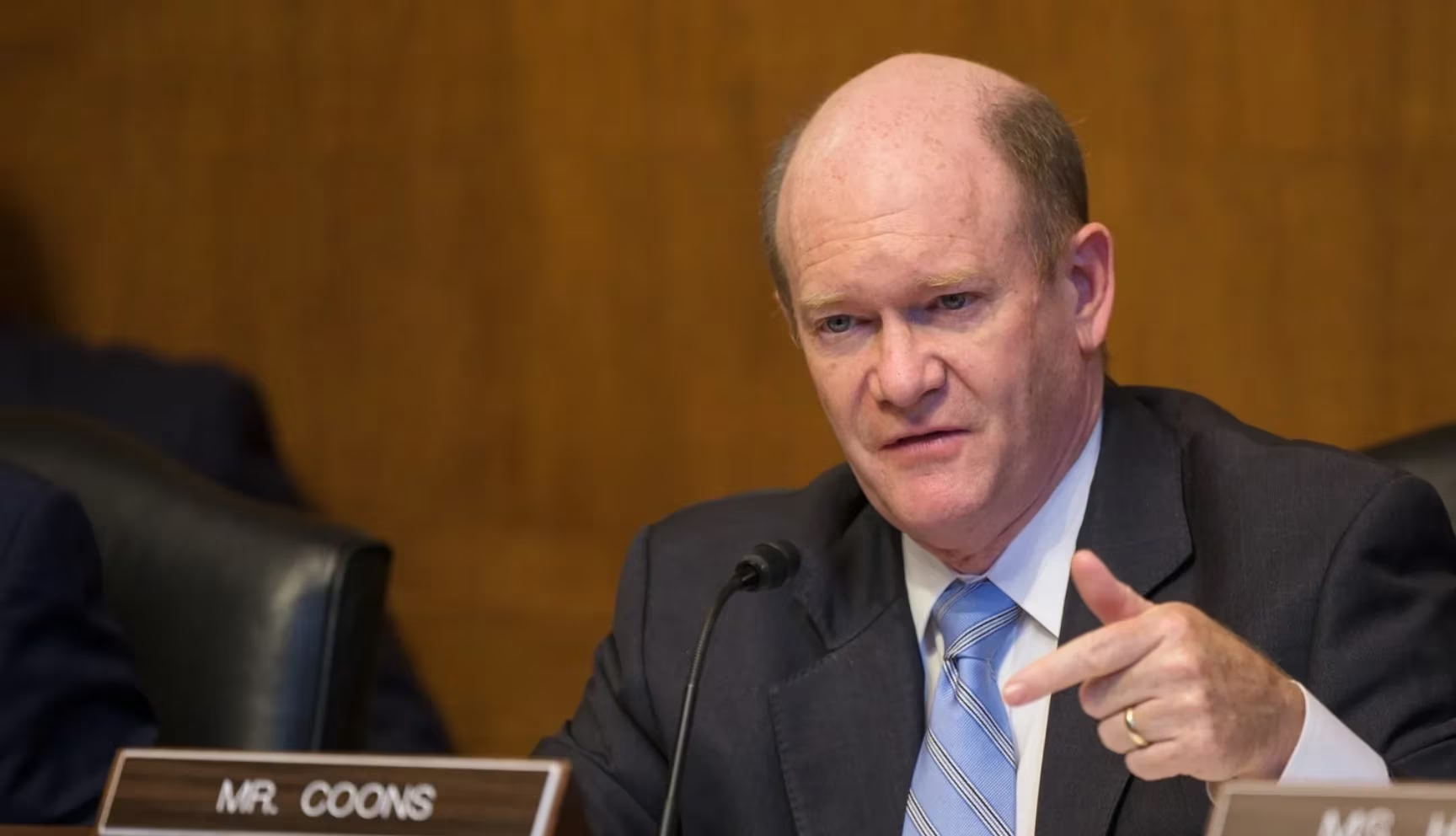
Delaware Sen. Chris Coons on Friday urged President Donald Trump to extend the practice of seizing oil tankers, currently applied to Venezuela, to vessels carrying oil from Russia.
According to Coons, the administration is already deploying US armed forces to interdict tankers belonging to the so-called shadow fleet, which, in his words, “helps prop up the Venezuelan regime.” In an interview with Jonathan Lemire on “Morning Joe” on MS NOW, formerly MSNBC, the senator said the same tools should be used against “the shadow fleet that bankrolls Russia’s brutal war machine, sustains the Iranian regime, and assists North Korea.” He stressed that such steps would command bipartisan support as a means of pressuring Vladimir Putin and slowing the flow of money into Russia’s “murderous war machine” against Ukraine.
Coons recalled that Trump campaigned on a promise to “avoid stupid new wars overseas,” yet, in the senator’s assessment, the president is “sleepwalking without a clear policy or a coherent plan” toward a confrontation with one of the Western Hemisphere’s most capable authoritarian regimes. He questioned whether US actions are truly about countering drug trafficking, noting that Nicolás Maduro, by his account, is prepared to discuss ending the regime’s support for narcotics trafficking. Coons also cast doubt on whether the issue is access to oil—a theme Trump has raised before—and pointed out that White House chief of staff Susie Wiles explicitly acknowledged in a Vanity Fair article that the aim is regime change.
The senator added that the president should focus on the war in Ukraine and other areas of foreign policy where, in his view, he is failing to deploy the tools already at his disposal.
Coons’s remarks came against the backdrop of a US attempt to seize a third tanker in the Caribbean. As an American official told the Associated Press, the vessel was sailing under a false flag and was subject to a court-ordered seizure.
The United States has deployed a substantial military presence off Venezuela’s coast, including the deployment of the US Navy’s largest aircraft carrier, the USS Gerald R. Ford. The administration has also authorized strikes on suspected drug-smuggling vessels—some of which were reportedly operating out of Venezuela—and Trump has approved Central Intelligence Agency operations in the country.
The US Coast Guard has already seized two oil tankers off Venezuela’s coast, with the second intercepted while docked in a Venezuelan port. Trump said the first tanker was seized “for a very good reason,” while White House spokesperson Anna Kelly stated that the second was carrying “sanctioned PDVSA oil.” The Department of Homeland Security and the Pentagon took part in the seizure operations.
Homeland Security Secretary Kristi Noem said in a post on the social media platform X that the United States would continue to pursue illicit shipments of sanctioned oil used to finance “narco-terrorism in the region.” “We will find you and we will stop you,” she said, attaching a seven-minute video of the operation to seize the second tanker.
Beijing condemned Washington’s actions. China’s foreign ministry spokesperson Lin Jian said the seizures “seriously violate international law,” Bloomberg reported. He added that Venezuela has the right to pursue mutually beneficial cooperation with other countries, and that China supports Caracas in defending its “legitimate rights and interests.”
Venezuela’s ambassador, Samuel Moncada, told an emergency meeting of the UN Security Council that the United States had carried out “the greatest act of extortion in our history,” after Trump demanded that Caracas “hand over our land, our oil, and our mineral resources, on the claim that they somehow belong to them.” According to Moncada, the US president warned that, if Venezuela refused, he would enforce the ultimatum by “unleashing upon our country the fury of the greatest fleet in history.”