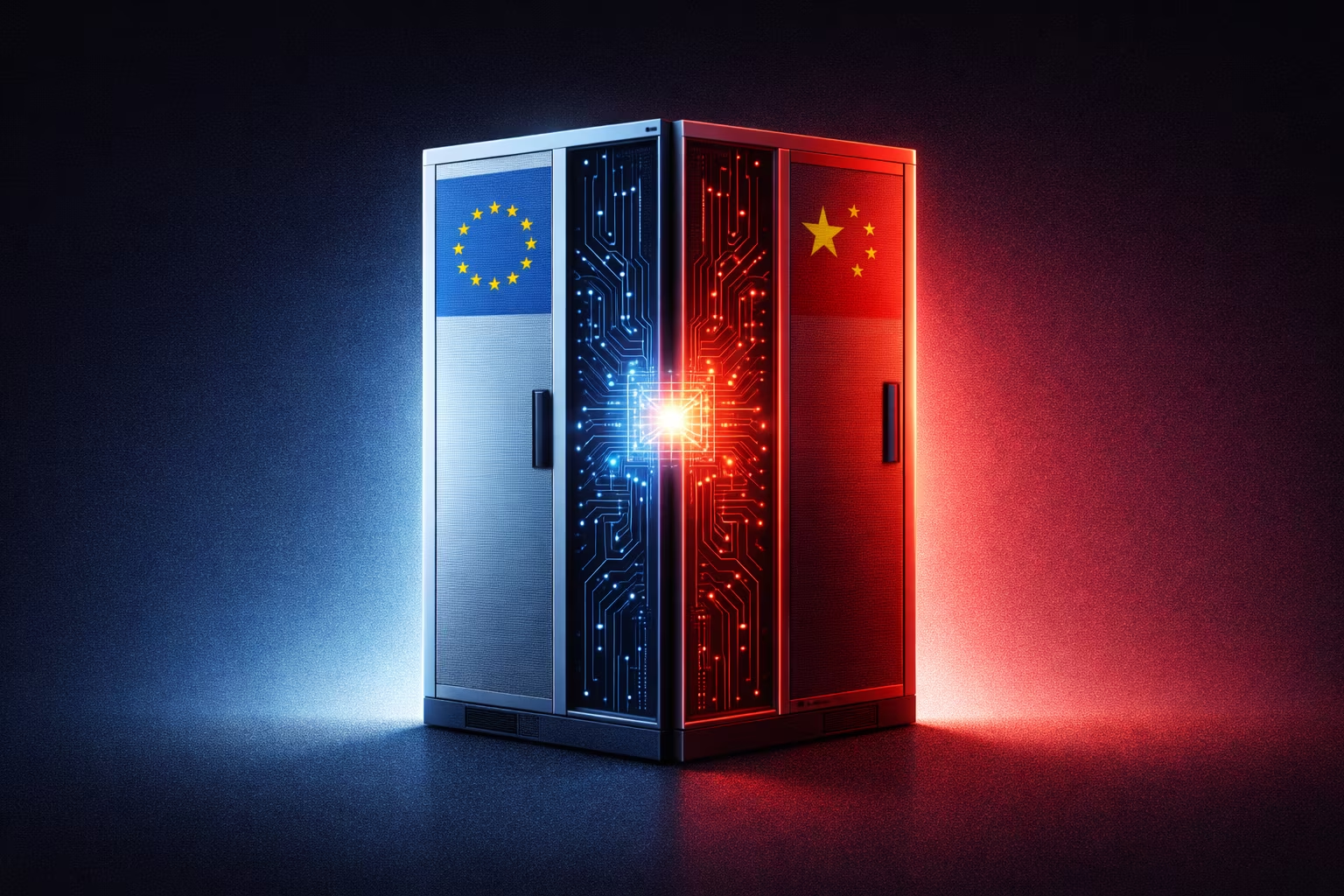
On January 20, 2025, DeepSeek was a little-known startup from Hangzhou, spun out of a hedge fund. Just a week later, its name had become a symbol of a new wave of Chinese innovation following the launch of an artificial-intelligence model comparable in capability to cutting-edge developments from Silicon Valley, but far cheaper to build and operate. After spending the past year locked in fierce competition on China’s domestic market, DeepSeek and similar companies are now looking for profits abroad. The United States—increasingly closed off for geopolitical reasons—and poorer countries in the global south are unlikely to generate significant returns. As a result, Europe is emerging as the main destination for their expansion.
For the Old Continent, new technologies from China look more like a threat than an opportunity. Chinese electric vehicles are already undermining the positions of German and French carmakers. Several EU countries have sought to restrict access to the DeepSeek chatbot, fearing that data from European companies and citizens could be transferred to China. Dependence on a geopolitical rival in a field that is rapidly becoming critical infrastructure is unappealing to anyone. These concerns are not unfounded. Yet when it comes to artificial intelligence, China—if approached with care—may turn out to be not a problem for Europe, but an opportunity.
There are at least three reasons why European business should welcome the Chinese advance. First, Chinese models are scarcely inferior to the best solutions from OpenAI, Anthropic, and Google—and for most users that is more than sufficient. Demis Hassabis, head of Google’s AI division, has noted that Chinese systems lag behind their American counterparts by only “a few months.” At the same time, like DeepSeek, many of them are free to access and require relatively modest operating costs.
This price advantage stems from their openness—the second key reason for their appeal in Europe. Unlike the closed commercial products of leading American companies, open models are easy to adapt and can run on local infrastructure. That reduces the risk of dependence on a single supplier. If OpenAI or Anthropic were to shut down, their customers would be left exposed. If DeepSeek were to disappear, by contrast, users could continue to run its models’ “weights”—the parameters learned during training—on their own data and servers. This also helps to ease concerns about data leakage. American companies, including Meta, offer open models as well, but it is China that is setting the pace today.
There is also a third argument in favor of working with Chinese AI—it serves as insurance not only against dependence, but also against the risk of isolation. Even before Donald Trump was sworn in for a second term a year ago, the idea that Europe could be cut off from American technologies seemed absurd. Yet amid his demonstrative pressure on the transatlantic alliance, including disputes over Greenland, an executive order curbing the activities of American AI companies in Europe no longer looks impossible. In response, Europe could impose its own restrictions on American technologies, including cloud computing, where much of AI is hosted.
In a fragmenting world, the best option for Europe would be to develop its own AI industry, but it is unlikely to become a superpower in model-building. What it can aspire to instead is global leadership in the practical application of the technology. Already, 37% of companies in the EU report using generative AI—the same share as in the United States. In manufacturing, European firms even outperform their American counterparts. The use of open models, including Chinese ones, could further strengthen that advantage.
European policymakers appear to understand this. Against a backdrop of strong interest and the absence of powerful domestic AI corporations demanding protection, early attempts to ban DeepSeek quickly fizzled out. In January, the European Commission launched an initiative to identify and remove barriers hindering the development of open models. This will not give Europe full technological autonomy—dependence on American hardware, above all Nvidia chips, will remain, and Chinese software carries familiar risks. But for Europe today, rejecting it outright would be far more dangerous.