China has responded to new U.S. trade investigations targeting its exports, ratcheting up tensions between the world’s two largest economies just weeks before Donald Trump’s planned visit to Beijing.
On Friday, March 27, China’s Ministry of Commerce announced the launch of two investigations in response to what it described as “Section 301 investigations” initiated by Washington against China and a number of other countries. Those measures were announced earlier this month after the U.S. Supreme Court in April ruled unlawful the Trump-imposed tariffs known as the “Liberation Day tariffs.”
“The Ministry of Commerce will… advance the investigation into barriers imposed by the United States and take appropriate measures… to resolutely safeguard its legitimate rights,” the ministry said in a statement.
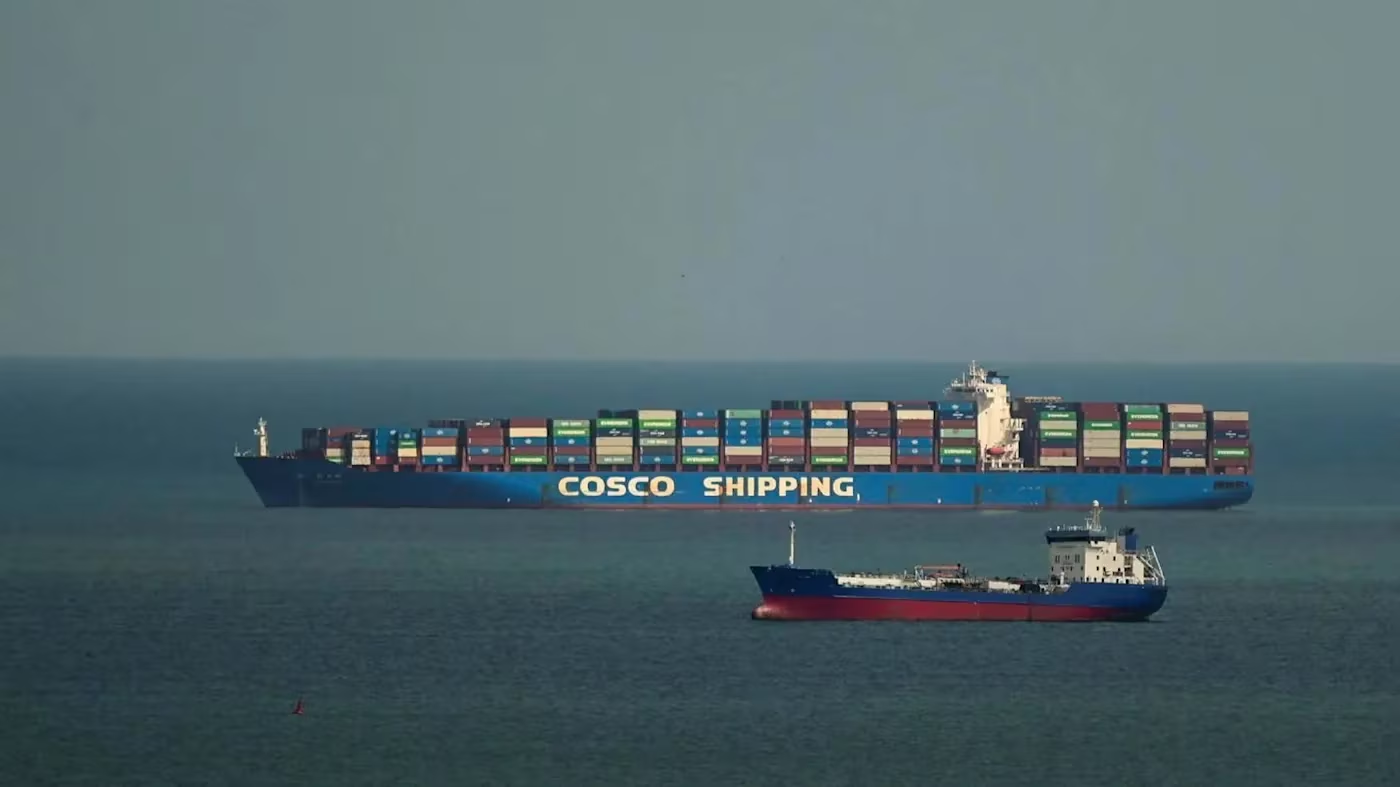
The move, underscoring Beijing’s determination to maintain a hard line in response to U.S. trade pressure, came a day after Washington accused China of threatening American shipping interests by detaining Panama-flagged vessels in its ports.
Last year, Beijing managed to push its trade confrontation with Trump into a stalemate by restricting U.S. companies’ access to materials critical to global manufacturing.
The United States initially imposed tariffs of as much as 145% on Chinese goods, but Beijing—whose state-owned companies dominate the rare earths market—ultimately forced Trump to agree to a yearlong truce after a meeting with President Xi Jinping in South Korea in October.
The two leaders had been expected to meet again in early April, but the U.S. president postponed the summit to May 14-15 amid the military campaign against Iran.
Despite Trump’s attacks on Venezuela and Iran, both of which maintain ties with Beijing, Chinese state media have softened their political rhetoric toward him. On trade, however, Beijing has drawn a clear line.
As the Ministry of Commerce put it, the U.S. Section 301 investigations “could seriously harm the trade interests of Chinese enterprises,” while some of the measures, in Beijing’s view, may violate World Trade Organization rules.
U.S. Federal Maritime Commission chair Laura DiBella said on Thursday that the agency was “closely monitoring” what she described as “China’s retaliatory actions against Panama” affecting global shipping.
“China has sharply increased the number of detentions of Panama-flagged vessels in its ports under the pretext of port inspections, significantly exceeding historical norms,” she said, without providing further details.
According to DiBella, the intensified inspections may be intended to punish Panama for transferring assets previously managed by Hong Kong-based CK Hutchison Holdings.
“Given that Panama-flagged vessels account for a significant share of U.S. container shipping, these actions could carry serious commercial and strategic consequences for American maritime interests,” she added.
In February, the Panamanian government appointed the U.S. subsidiaries of Danish shipping giant Maersk and Swiss company MSC as temporary operators of CK Hutchison’s two terminals on the Panama Canal.
The decision followed a January ruling by Panama’s Supreme Court annulling CK Hutchison’s port management contract—a move widely seen as a victory for Trump’s efforts to expand U.S. influence in the region.
CK Hutchison has filed for arbitration against Panama. This week, the company’s local unit, Panama Ports Company, said its claims had already exceeded $2 billion.
China’s foreign ministry declined to comment on the specifics of the U.S. accusations, but said: “The United States’ repeated rhetoric only lays bare its own desire to establish control over the canal.”
Chinese authorities also criticized the investigations themselves, noting that they concern alleged excess production capacity and the use of forced labor by Chinese manufacturers. According to Wang Ziyang of the Chinese Academy of Social Sciences, they are marked by “a pronounced unilateral character, arbitrariness, and discrimination.”
In his view, “their real purpose” is to create trade barriers, while the measures themselves amount to an “opportunistic show of positioning” ahead of the U.S. midterm elections.