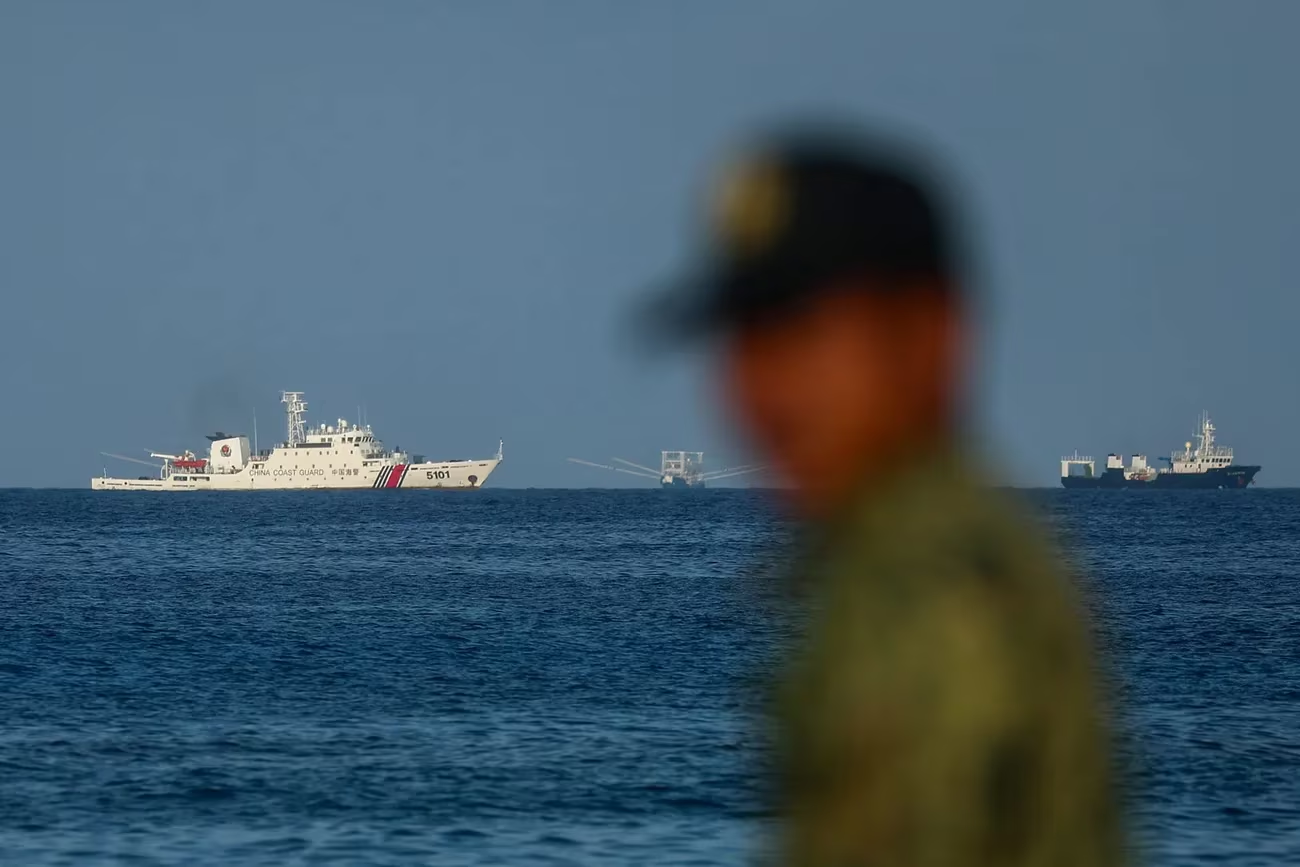
China has escalated tensions with Japan and the Philippines after the two countries agreed to begin talks on delimiting maritime boundaries in areas east of Taiwan. Beijing considers these zones its own and, in response, sent several patrol vessels there in addition to Coast Guard ships. In China, the voyage is being described as a “special operation” intended to assert the country’s claims to disputed stretches of sea.
On June 6, China sent a flotilla into waters east of Taiwan. According to the South China Morning Post, ships from China’s Ministry of Transport will patrol the area together with Coast Guard vessels that have been there since the start of the week.
The People’s Daily, the official newspaper of the Chinese Communist Party, described the voyage as a response to a territorial dispute with Japan and the Philippines. The article claimed that the two countries had become a “source of problems” and a “threat to peace in the Asia-Pacific region.”

The overlap of China’s, the Philippines’ and Japan’s maritime claims east of Taiwan. The area China considers part of its maritime boundaries is marked in yellow, Japan’s in red and the Philippines’ in blue.
In late May, Tokyo and Manila announced the start of formal talks to define the maritime boundaries of their exclusive economic zones and continental shelves. These zones may overlap with Taiwan’s boundaries. Beijing immediately called the talks “illegal and invalid.”
China’s state news agency Xinhua also called the patrol a “necessary measure in response to Japan’s and the Philippines’ unilateral announcement of the start of maritime-boundary talks in waters east of China’s Taiwan island, which seriously violates China’s territorial sovereignty, maritime rights and interests.”
The report describes the voyage as a “special operation to enforce maritime-navigation rules… to fully exercise the country’s administrative jurisdiction in maritime law enforcement and strengthen patrol capabilities on the high seas and control over vessel traffic in key waters.”
According to SCMP, citing Marine Equipment & Government Vessel Information, a service that tracks Chinese Coast Guard activity, the patrol involves Haixun 09—China’s first 10,000-tonne maritime patrol vessel.
The flotilla also includes the 7,500-tonne hydrographic survey vessel Haixun 08 and two 5,000-tonne vessels—the ocean rescue ship Haixun 06 and the rescue vessel Donghaijiu 113.
China’s Coast Guard, whose vessels will now be joined by these ships, said as early as June 1 that it would begin patrolling waters east of Taiwan in response to the talks between Japan and the Philippines.
Relations between Beijing and Tokyo have steadily deteriorated since November, when Japanese Prime Minister Sanae Takaichi said an attack on Taiwan could lead to military intervention by Tokyo.
The Philippines, for its part, has long been engaged in a territorial dispute with China in the South China Sea. As SCMP writes, it regularly leads to clashes between the two countries’ Coast Guards. In May, Philippine President Ferdinand Marcos also said Manila would intervene in the event of a conflict over Taiwan.
Japan and the Philippines, both U.S. allies, have recently stepped up security cooperation. During Marcos’s recent visit to Japan, the two sides agreed to begin talks on exchanging military-intelligence information and to accelerate the transfer of 6 second-hand destroyers to the Philippines.
In April and May, during the annual U.S.-Philippine Balikatan exercises, Japanese troops set foot on Philippine soil for the first time since Japan’s occupation of the Philippines during World War II.
Such steps are causing concern in Beijing. China fears that the two countries, which are part of the first island chain limiting its access to the Pacific, could become a serious factor in the event of a conflict over Taiwan.
In the People’s Daily commentary, Tokyo and Manila were accused of stoking a Cold War-style “bloc confrontation.” As SCMP notes, the article was signed with the pseudonym Zhong Sheng—a homophone for “Voice of China,” often used to set out Beijing’s position on foreign-policy issues.