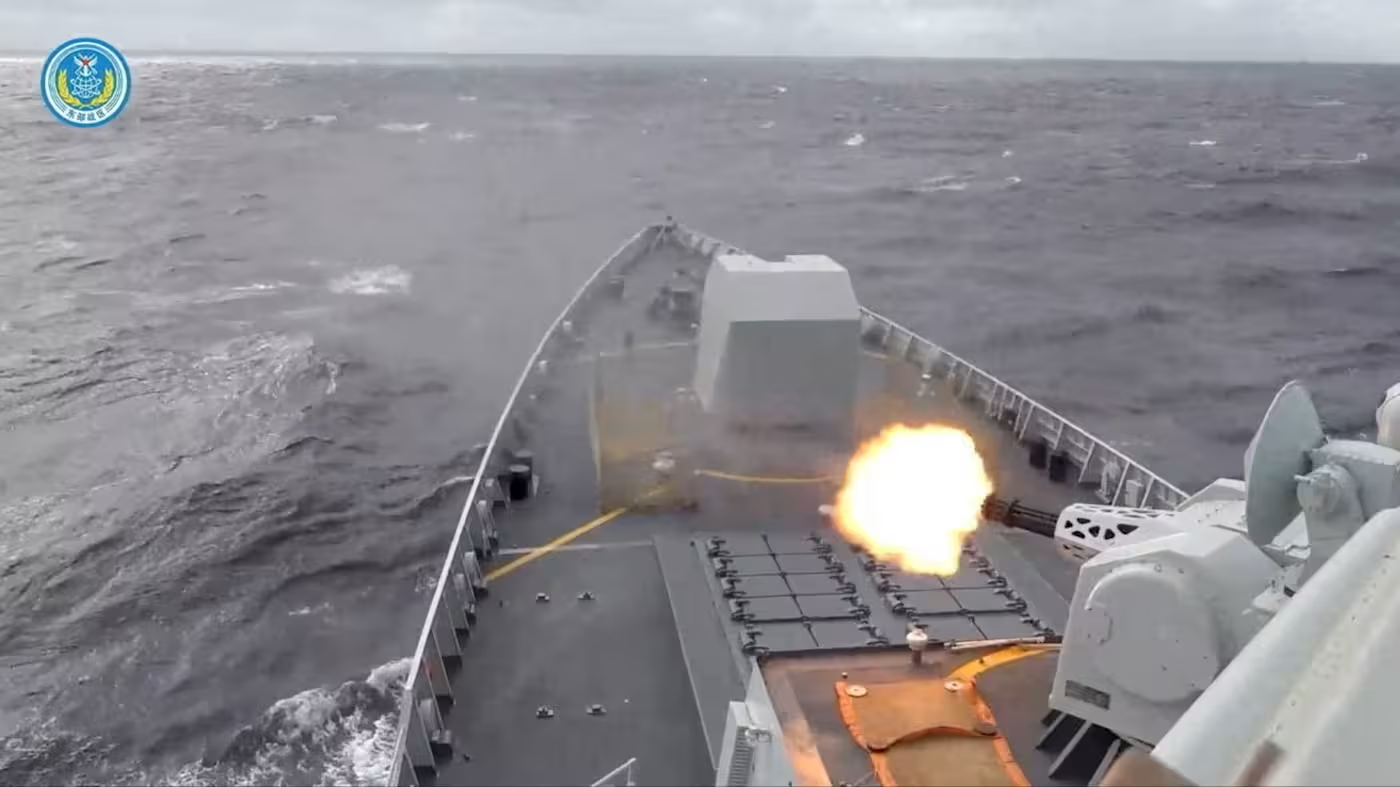
China has launched a new round of military drills around Taiwan, describing them as a warning to forces advocating the island’s independence. The manoeuvres come against the backdrop of Taipei’s largest-ever arms purchase from the United States.
According to the Eastern Theatre Command of the People’s Liberation Army, the exercises involve ground forces, naval units, air force aircraft and missile units. They are being conducted in the Taiwan Strait and in areas surrounding the island and include, among other elements, live-fire drills scheduled for Tuesday.
The drills, dubbed “Justice Mission 2025”, mark the second large-scale series of Chinese manoeuvres around Taiwan this year. As stated in the announcement, their purpose is to test the PLA’s readiness for naval and aerial combat, practise the blockade of ports and strategically important areas, establish control over the battlefield and deter external interference.
“This is a serious warning to separatist forces advocating Taiwan’s independence, as well as to forces of external interference,” said Senior Colonel Shi Yi, a spokesperson for the Eastern Theatre Command. According to him, the drills constitute “necessary actions to safeguard national sovereignty and preserve national unity”.
People’s Liberation Army drills in the vicinity of Taiwan.
Taiwan’s defence ministry said that by midday on Monday it had recorded the flights of 89 Chinese military aircraft and drones, as well as the presence of 14 warships and 14 coast guard vessels. According to the ministry, the manoeuvres entered Taiwan’s air defence response zone.
The ministry also noted that the areas designated by the People’s Liberation Army for the exercises overlap with international air and sea routes.
In recent years, China’s armed forces have markedly stepped up their activity around Taiwan. Beijing claims sovereignty over the island and has repeatedly threatened to assert control by force if Taipei continues to resist pressure from China.
Earlier this month, the United States approved arms deliveries to Taiwan worth $11.1bn—the largest such package on record—as Taipei seeks to strengthen its defensive capabilities amid growing threats from China.
As a largely symbolic response to the deal, Beijing in recent days announced the imposition of sanctions on 20 US companies linked to the defence sector, as well as on their employees.
On Monday, China’s foreign ministry published an article on its official WeChat account titled “The US Must Fully Recognise the Grave Consequences of Arms Sales to Taiwan”.
In the article, the ministry said that “the balance of power across the Strait has fundamentally shifted”. According to Beijing, “no matter how the US attempts to turn Taiwan into a so-called porcupine, it will not be able to stop China’s eventual and complete reunification”.
On the same day, a spokesperson for Taiwan’s presidential administration urged Beijing to immediately halt what they described as “irresponsible and provocative actions”.
In November, Taiwan’s president, Lai Ching-te, pledged to allocate about $40bn for arms purchases over the next eight years—set to become the island’s largest special defence budget in more than three decades. Lai’s administration hopes the move will deter Beijing while also signalling to President Donald Trump that Taipei is prepared to finance its own defence.
Rising tensions around Taiwan risk complicating the fragile thaw in relations between the US and China after Trump and Chinese President Xi Jinping agreed in late October to a truce in the trade war between the world’s two largest economies.
William Yang, an analyst at the International Crisis Group, said the drills would serve as a “test” of the Donald Trump administration’s response.
According to him, Beijing is likely to “take into account the US response and, on that basis, cautiously determine how to formulate and plan the People’s Liberation Army’s military operations, including regular combat training and more tactical shows of force to pressure Taiwan”.
Yang also noted that Beijing is likely to see the situation as an opportunity to exacerbate domestic political turbulence on the island.
“Opposition parties have accused the Lai administration of heightening the risk of conflict with China through its cross-strait policies and efforts to increase Taiwan’s defence budget,” he said.
The drills are also taking place amid a sharp diplomatic dispute between Beijing and Tokyo, after Japan’s prime minister, Sanae Takaichi, said that a potential Chinese invasion of Taiwan could prompt a military response from Japan.