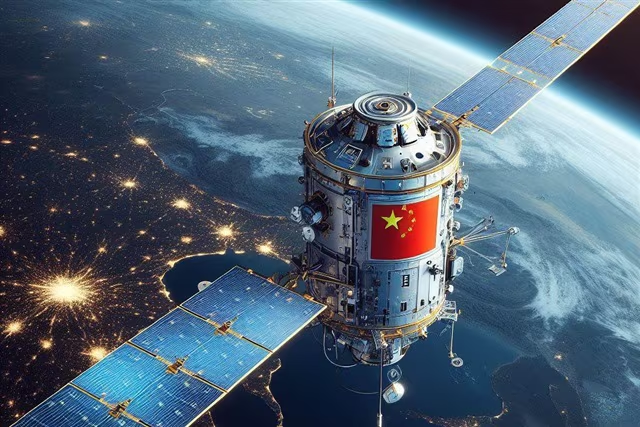
Iran received an intelligence satellite from China that, according to an investigation by the Financial Times, enabled Tehran to direct strikes against U.S. military facilities in the Middle East.
According to leaked Iranian military documents, the satellite, designated TEE-01B, was handed over to the Aerospace Force of the Islamic Revolutionary Guard Corps in late 2024 after being launched from Chinese territory.
The agreement also gave the IRGC access to commercial ground stations operated by the Beijing-based company Emposat, whose infrastructure spans Asia, Latin America and other regions.
Activity logs reviewed by the FT show that the satellite was used to monitor key U.S. facilities. On March 13, 14 and 15, in particular, it captured images of Prince Sultan Air Base in Saudi Arabia—the target of strikes against U.S. aircraft on those days. Surveillance also covered Muwaffaq Salti Air Base in Jordan, Erbil airport in Iraq and several other sites, including civilian infrastructure.
Earth Eye, the company that carried out the launch, says on its website that it has already completed one “in-orbit transfer” to an unnamed country participating in the Belt and Road Initiative. Iran joined the program in 2021. The company, however, insists the satellite was intended for civilian use.
The White House declined to comment on any possible link between Emposat and the IRGC, pointing instead to a statement by Donald Trump, who warned that China would face “serious problems” if it supplied Iran with air-defense systems.
China’s embassy in Washington rejected the allegations, calling them “speculative disinformation.” “We maintain an objective and impartial position and are working to promote peace talks. We never take actions that lead to an escalation of the conflict,” said Liu Pengyu, a spokesperson for the diplomatic mission.
Relations between the United States and China remain strained following Trump’s return to the White House—primarily because of his “tariff war,” in which duties on Chinese goods have been raised repeatedly. Beijing, meanwhile, is seen as one of Tehran’s key partners.
In March, CNN reported that U.S. intelligence had information about possible Chinese financial support for Iran, as well as deliveries of missile components and spare parts. One of the network’s sources said Beijing “wants the war to end because it threatens its energy supplies.”
In early April, China joined an initiative by Pakistan, which had proposed a plan for settling the conflict in the Middle East. The five-point joint document was published on the website of China’s foreign ministry. As The Wall Street Journal noted, its structure resembles the 12-point plan to end the war in Ukraine that Beijing presented three years earlier.