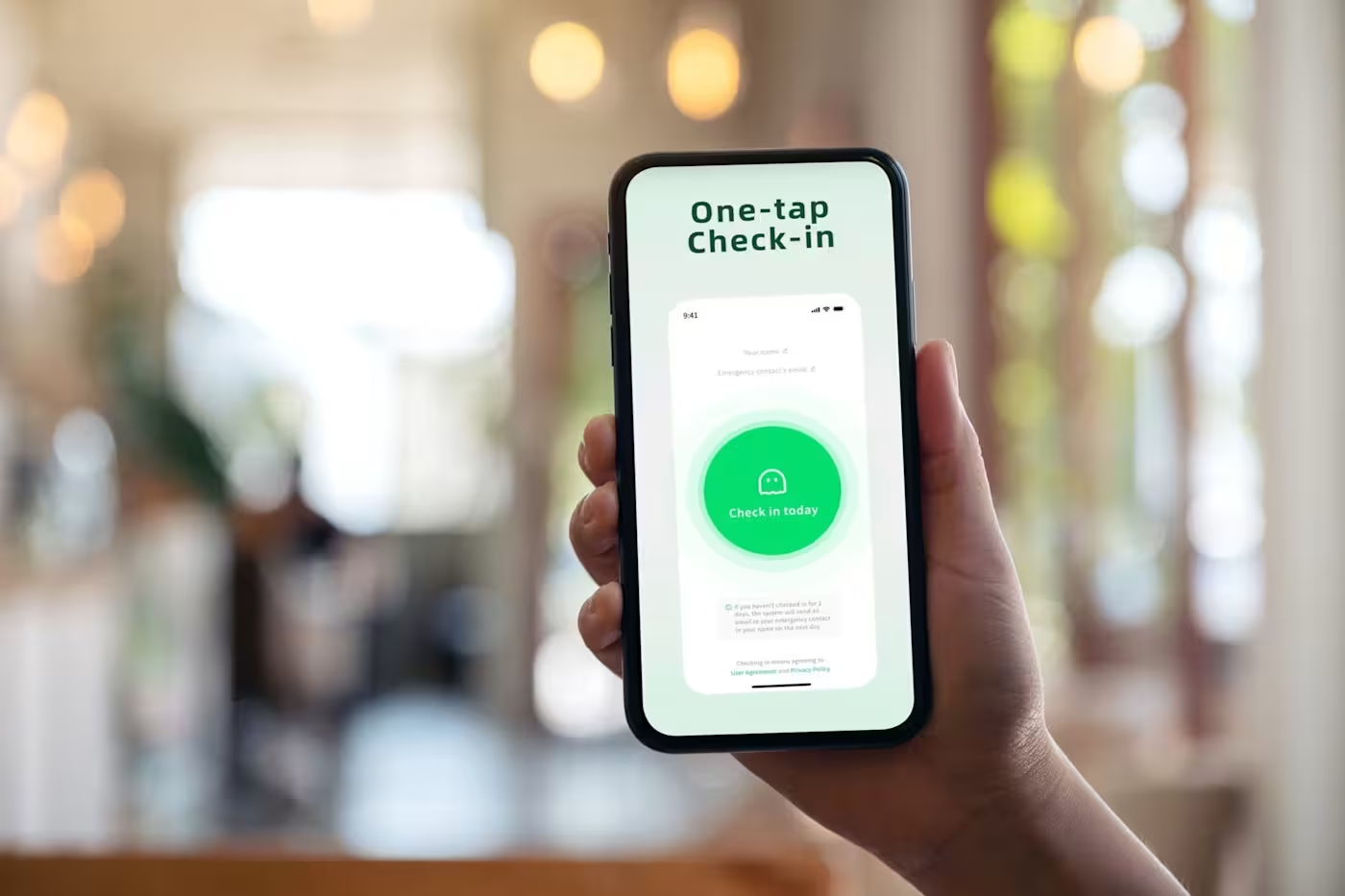
An app called “Are You Dead?”—a service designed to monitor the well-being of people living alone—has become the most popular paid app in China’s App Store. Its success reflects growing anxieties driven by the country’s rapid demographic shifts.
Known on the Chinese market as Sile Me, the app operates on a simple principle: users are required to regularly confirm their presence by pressing a button. If they fail to do so for two consecutive days, the system automatically sends an alert to an emergency contact designated in advance by the user.
The app’s viral rise has coincided with a growing number of young Chinese who consciously choose to live alone, delay marriage, or opt out of starting a family altogether. At the same time, the share of older people living on their own is increasing—without relatives nearby who could offer help or simply check that everything is alright.
Wei-Jun Jin Yong, a social demography expert at the National University of Singapore, notes that demand for such solutions is entirely rational. “As birth rates fall, life expectancy rises, marriages decline, and divorces increase—all of this produces a durable trend toward single-person households,” she explains. “This anxiety is real.”
In 2024, China recorded its third consecutive year of population decline. A year earlier, the country had ceded its status as the world’s most populous nation to India.
The problem is particularly acute in rural areas, where working-age residents are moving to cities en masse, leaving elderly relatives without regular supervision. At the same time, younger generations are increasingly choosing to live alone, marrying later and having fewer children.
According to the National Bureau of Statistics, the share of single-person households in China rose to 19.5 percent in 2024—up from 7.8 percent two decades earlier.
One of the app’s three young co-founders, who identified himself only as Liu, told local media that the service’s core audience consists of young people living alone in major cities—above all women around the age of 25. Such users, he said, often “experience an acute sense of loneliness due to a lack of social interaction—compounded by anxiety that something might happen to them and no one would know.”
At the same time, many commentators argue that the app’s greatest practical value may lie in supporting older people, even though the oldest residents of remote rural areas could face difficulties using it.
Yong notes that such digital solutions—including sensors installed on refrigerators and televisions that detect a lack of activity and alert relatives—will play an increasingly important role as populations age not only in China but elsewhere as well. “Living alone does not necessarily mean being lonely, but the risk of social isolation is high. That is why it is essential to encourage people to maintain social ties and remain engaged in community life,” she emphasizes.
In China, the app has generally been well received, though its name—an explicit reference to death—has sparked debate. In the international version of the App Store, the service appears under the name Demumu. Hu Xijin, a nationalist-leaning columnist, suggested rebranding the app: “I would recommend calling it ‘Are You Alive?’—that would be psychologically more comfortable for older users.”
Liu himself, however, dismisses the criticism, insisting that the current name carries no negative connotation. “It serves as a reminder to value the present moment,” he says.