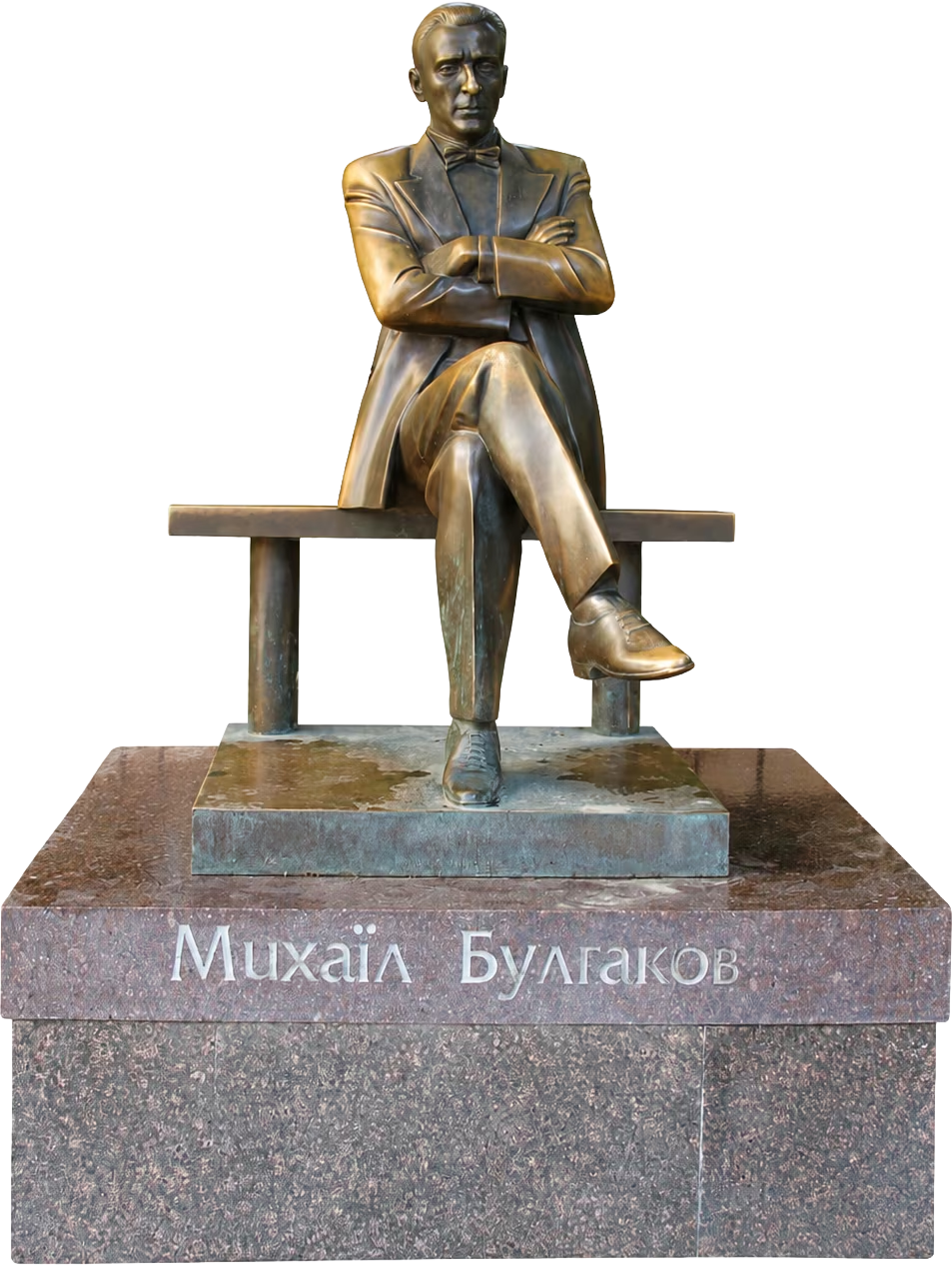
Kyiv’s city council has ordered the demolition of the Bulgakov monument. The argument began almost immediately. Some saw the decision as a mistake. Bulgakov remains the best-known writer associated with the City; he loved it, and rejecting that legacy means one thing—to hand Bulgakov over to Russia in full. Voluntarily. By that logic, figures like him should not be gifted to Moscow.
Others were angered by the timing. A brutal war is under way, shelling is regular, the energy system is breaking down, and the authorities are occupied with dismantling monuments.
But supporters of the demolition press a different point. Bulgakov, they say, was a “Ukrainophobe” who discredited the Ukrainian national movement in his works.
Yet framing the matter this way distracts from the real reasons Bulgakov has now effectively been placed under ban in Ukraine.
Let us start with the simplest point. There are no direct grounds for calling Bulgakov a Ukrainophobe. At least, no evidence has survived that he demeaned Ukrainians as a people—unless one confuses the author’s position with the lines spoken by his characters.
Nor did he deny the existence of a separate Ukrainian nation. On this point, his view differed, for example, from that of the celebrated Kyiv-born aircraft designer Igor Sikorsky. Sikorsky’s name is borne by Kyiv’s airport, a street in the capital where the U.S. embassy stands, and one of the country’s largest universities—the KPI technical university.
Sikorsky, already in exile in the United States in the 1930s, said: “my family is of purely Ukrainian origin, from a village in Kyiv province, where my great-grandfather and great-great-grandfather were priests. However, we consider ourselves Russian by origin, from a certain part of Russia, regarding the Ukrainian people as an integrated part of Russia in the same way that Texas or Louisiana are integrated parts of the United States.”
Sikorsky’s Memory Is Not Being Erased in Kyiv
Take Bulgakov’s Soviet-period works. There is indeed a great deal of criticism of the Ukrainian People’s Republic in them. But in its degree of hostility, it hardly exceeds Alexander Dovzhenko’s film Shchors, made in 1939. No one is planning to remove Dovzhenko’s name from Ukrainian streets.
At the same time, the decision to “cancel” Bulgakov fits into the logic of processes that have been unfolding in Ukraine for a long time.
About 20 years ago, during the first Maidan, Russia’s liberal opposition hoped that Ukraine would become “another Russia.” Close to Russia in language, culture and mentality, but European and democratic. The assumption was that it would become an example for Russians themselves and push them toward protest against Putin.
The Maidan was supported mainly by Russian-speaking Kyiv, and with it by business and the emerging middle class—also largely Russian-speaking. That is why the doctrine of “another Russia” seemed alive. Respect the Russian language and culture, revere Pushkin, but build democracy and move toward Europe, unlike Putin’s Russia. Inside Ukraine itself, this view never found a significant number of supporters.
Within the “Orange” camp, humanitarian policy was gradually captured and canonized by the nationalist position. Its logic is simple. Ukrainian identity can survive only through strict Ukrainization—linguistic, media, cultural, historical and religious. Otherwise, Ukrainians will be finally Russified by Russia’s powerful cultural and information pressure. Hence the conclusion: everything Russian is a threat, memory of the shared past must be uprooted, and a new history, a new culture and, in effect, a new nation must be built through the “rewiring of the population’s basic settings.”
At first, such ideas, shaped in large part in the diaspora, did not have broad support in Ukraine as it then was. So the nationalists stitched their concept to the far more popular cause of European integration. The formula that emerged was this: the road to Europe is the road away from Moscow. And the road away from Moscow means rejecting the Russian language, rejecting the memory of a shared history and distancing oneself not only from Putin, but also from Pushkin.
In those years, of course, it was not phrased as bluntly or radically as it is now. The words were softer. But the essence was exactly that. In this logic, the hostile force was not only Putin, but also Russian liberals. More than that—liberals could seem even more dangerous. If they came to power in Russia, it would be far harder to advance the thesis that “the road to Europe is the road away from Moscow and everything Russian.”
Yushchenko accepted the concept and actively supported it. The other leaders of the “Orange” camp, many of them themselves primarily Russian-speaking, did not object—they feared accusations of “betrayal” and “working for Moscow.”
Although who ultimately really “worked for Moscow” is a far from straightforward question.
It was precisely this concept that split Ukrainian society. It strengthened pro-Russian sentiment in Russian-speaking regions and set in motion processes that played a visible role in 2014. The Kremlin exploited this. One need only recall how the repeal of the Kivalov-Kolesnichenko language law helped destabilize the country. The Rada passed it almost immediately after the Maidan’s victory, although it was plainly not the most urgent issue. But in the logic of the nationalists, the step was considered extremely important.
One can object that the Kremlin would have done what it did anyway, including the annexation of Crimea. But it is hard to deny that the repeal of the language law made that easier for it.
There is confirmation of this. After events began in Crimea and Donbas, the Ukrainian authorities, at the West’s urging, slowed the repeal of the Kivalov-Kolesnichenko law.
As soon as the situation stabilized, they returned to the issue. Then came a whole series of Ukrainization laws, culminating in the law on “total Ukrainization” adopted by the Rada in 2019. But society still met the course without enthusiasm and was in no hurry to be “rewired.” The presidential election made that clear. Poroshenko ran under the slogan “Army, Language, Faith” and lost by a wide margin to Zelensky, who spoke in the spirit of “it does not matter who speaks which language.” For nationalist circles, this was a serious blow. Although the new president, contrary to the expectations of many voters, never rolled Ukrainization back.
After the start of the full-scale invasion, supporters of radical Ukrainization, by contrast, saw a chance to “settle the issue once and for all.” A new and central argument was added to the old ones: “Russian is the language of the enemy.” And although hundreds of thousands of Russian-speaking soldiers are defending Ukraine, the authorities did not challenge the thesis, and Ukrainization accelerated sharply.
But in recent months, as we have already written, anxiety among its supporters has noticeably intensified. The reason is talks on ending the war, in which, among other things, the restoration of rights to the Russian language is being discussed. This is Russia’s demand and, judging by a number of signals, one supported by the United States as well. The 20-point peace plan published by Zelensky includes point 13: “Ukraine will apply EU rules on religious tolerance and the protection of minority languages.”
The wording is vague. But even that alarmed Viatrovych. He wrote that this is how “Russia is trying to restore its influence over the lands it could not take by force.” A large-scale media campaign against the possible rollback of Ukrainization is already unfolding in the same vein.
At first glance, supporters of Ukrainization have nothing to fear. If the thesis about the “language of the enemy” has truly taken root in society, then whatever laws are adopted, people will not return to that language en masse in everyday life.
There is only one answer. They understand that in reality this is not the case.
Since the Start of the Full-Scale War, the Opposite Processes Have Also Paradoxically Intensified
Constant pressure to switch to Ukrainian, stop listening to Russian-language songs and answer in the spirit of “why not in the state language?” has alienated many Russian-speaking Ukrainians.
Before the war, most of these people paid little attention to Ukrainization—it interfered little with everyday life. After completing their education, a Ukrainian citizen could barely speak Ukrainian yet still work, earn money, do business and build a career. But when the demand to switch to Ukrainian reached the everyday sphere, everything changed. Ukrainization could no longer be ignored.
Some Russian-speaking Ukrainians did indeed switch to Ukrainian, seeing it as a “patriotic act”—especially those whose work involves public visibility. But for many, the pressure became an unacceptable intrusion into private life. All the more so because it directly contradicts the European values the state declares and for which, it says, it is fighting Russia. These attitudes surface after every “language” scandal—one need only recall the man from Odesa who sang Tsoi songs in Lviv.
Supporters of Ukrainization see these processes. And they fear that if rights are restored to the Russian language, it will quickly regain ground and their entire concept will begin to crumble.
But the Russian language will not disappear from Ukraine in any case. It could vanish only on one condition: if the country fenced itself off from the global internet with a firewall and shut down all social networks. In every other scenario, Ukrainians will be immersed from childhood, from their first smartphone, in Russian-language content created by more than 150 million people around the world—content that will always be many times more abundant than Ukrainian-language content.
That is why Ukrainization will not lead Ukrainians to read or watch less in Russian. The similarity between the languages and constant contact with the Russian-speaking environment—both in life and online—will remain. The consequence will be different. Ukrainians will produce less Russian-language content themselves. And that will give Russians an advantage: competition in the global market will weaken. One more argument in the debate over who is really “working for Moscow.”
One way or another, the language question in postwar Ukraine will inevitably arise—whether it is enshrined in a peace agreement or not. And it will arise regardless of Russia. All the more so because equating “Russian-speaking” with “pro-Russian” is wrong. No one, after all, thinks to call English-speaking Irish people a “nation of Britophiles.”
Let Us Return to Bulgakov
If the current dominant concept remains in place, he will, of course, fall under the ban. The White Guard is steeped in the Russian-cultural atmosphere of Kyiv at the beginning of the last century. And in this concept, no trace of such an atmosphere should remain. It is hostile, it must be cursed and forgotten—as if it had never existed. That is why Dovzhenko can still be at least partly incorporated, while Bulgakov almost cannot.
And not only him. The same questions will inevitably arise over Russian-language writers from Odesa. In time, perhaps, they may arise over Gogol as well—although for now he is barely touched.
But if another concept of the state prevails—one that can contain all of Ukraine, all periods of its history and all Ukrainians in all their diversity, whatever language they speak—then Bulgakov will move from the ranks of “Ukrainophobes” into the ranks of famous Kyivites of whom one can be proud.
And as for Bulgakov’s criticism of Petliura, many people criticized Petliura. Hrushevsky did. Vynnychenko did. And the celebrated military commander of the Ukrainian People’s Republic, Petro Bolbochan, was hardly likely to have spoken warmly of Petliura when he was being led to execution on the orders of a field court controlled by Petliura. Yet Bolbochan’s name has not been taken away from the 3rd Spartan Brigade of the National Guard, which is now fighting at the front.
“Shaping a New Culture of Memory.”
By Removing Babel, You Remove the City’s Soul
Ukraine Excludes Russian From Protection Under the European Charter
Kyiv Agrees to Restore Hungarian Schools and Expand Rights for the Hungarian Minority—Hungary Will in Return Support the First Stage of Ukraine’s EU Accession Talks