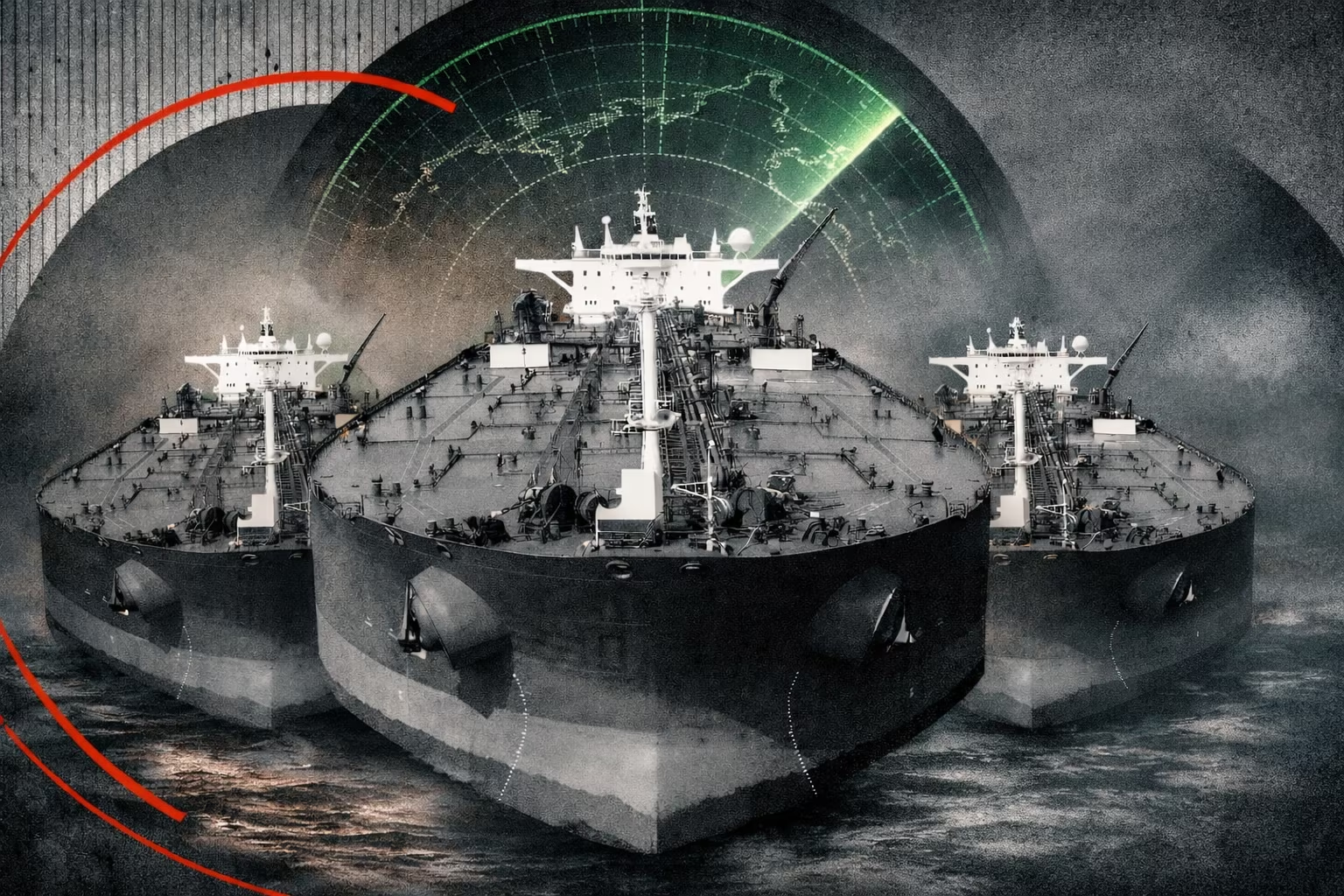
In early March, Keir Starmer expanded the powers of Britain's special forces, authorizing the seizure of an "armada of rusting ships" that, he said, is illegally shipping oil and financing Russia's war against Ukraine. The prime minister promised an "even more forceful blow" against the shadow fleet in British waters. In the month since, not a single Russian vessel has been intercepted—not once. According to The Times, the real reason is not legal but economic. Holding a single seized tanker costs the state tens of millions of pounds, and Britain's neighbors across the North Sea and the Baltic carry out such operations, on average, once every five to six weeks.
A Convoy in the Channel
On April 9, the Russian guided-missile frigate Admiral Grigorovich escorted two sanctioned tankers through the English Channel. The British auxiliary vessel Tideforce trailed the convoy at a safe distance and did not move to intercept. Telegraph reporters covering the episode from the deck of a 12-meter fishing boat documented a settled pattern—the Royal Navy keeps sending into the Channel ships never built to stand up to Russia's escort vessels.
Hours after the passage, Defense Secretary Luke Pollard told LBC that the capacity to intercept at a moment of London's choosing remained intact, and that such a moment simply had not yet arrived. The uncertainty, he argued, is itself a deterrent. The formulation drew immediate irritation in Parliament—from former prime minister Boris Johnson and from Labour's Emily Thornberry alike, who said plainly that Britain needs more frigates.
From abroad, London has drawn its share of ridicule as well. Donald Trump called the Royal Navy a toy. U.S. Defense Secretary Pete Hegseth, in a recent interview, invoked the "big, bad Royal Navy" with evident sarcasm, meaning precisely the opposite.
Starmer's Announcement and the Royal Navy's Silence
In early March, Keir Starmer granted Britain's special forces and officers of the National Crime Agency (NCA) new powers to board and search vessels in British territorial waters. The legal basis rests on an opinion issued by the attorney general, Lord Richard Hermer, which holds that such operations are permissible where evasion of British sanctions can be established. The Telegraph, which obtained access to the contents of the opinion, reports that Hermer explicitly cited the possible deployment of the SAS and NCA officers.
Yet not a single interception has taken place. According to the same paper, the government fears running afoul of international maritime law—in particular, the principle of innocent passage enshrined in the UN Convention on the Law of the Sea (UNCLOS). Every boarding requires its own legal justification, and the procedure itself is considered drawn-out and intricate.
The Times adds a far more practical argument to the picture—an economic one. Holding a single seized tanker can cost the state tens of millions of pounds. That figure covers port dues and berthing, vessel maintenance and wages for the crew kept on board, protracted legal proceedings and—where the tanker lacks proper P&I insurance—full liability for any oil spill in the event of an accident.
What makes up the tens of millions of pounds per detention
-
01Port dues and berthingA tanker with 100,000 tons of displacement occupies a commercial terminal that, under normal circumstances, would be generating revenue from cargo operations. Berthing is charged by the day, for the full duration of judicial proceedings that can stretch on for months.
-
02Crew and maintenanceThe crew of a seized vessel remains under the jurisdiction of the detaining state. They must be fed, provided with medical care and—by humanitarian standards—given access to legal counsel. Add to that basic technical upkeep, without which an aging tanker turns into a floating mine.
-
03Legal proceedingsThe vessel's owner is typically registered in a flag-of-convenience jurisdiction and files suits alleging unlawful detention. The state is obliged to answer each one. The Belgian case concerning the tanker Ethera, opened in February, concluded only in April.
-
04Environmental risk without P&I insuranceRoughly 60% of vessels in Russia's shadow fleet lack full Protection and Indemnity coverage through the International Group of P&I Clubs. That means, in the event of an oil spill, cleanup costs—estimated by CSIS at between $859 million and $1.6 billion for a major incident—fall on the coastal state.
-
05Political and escalation costsDmitry Peskov has branded the detention of shadow-fleet vessels "acts of piracy" and said Russia reserves the right to retaliate. After the escalation in February, Moscow began escorting some export convoys with warships, which in itself raises the stakes for any country contemplating interception.
Ecology Without Insurance
The average age of a shadow-fleet vessel, according to the Kyiv School of Economics (KSE) and research from the American Enterprise Institute, is 18.1 years. By comparison, the global average for commercial tankers is 10.4 years. More than 75% of shadow-fleet vessels have crossed the 15-year threshold, beyond which the rate of technical failure rises sharply. In 2022 the industry publication Lloyd's List documented 16 incidents involving such tankers—hull breaches, loss of propulsion, systems going dark in open water.
For the Baltic, this arithmetic is especially unsettling. The KSE estimates that between 150 and 170 sanctioned tankers pass through the Baltic Sea every month. The Baltic is a narrow, shallow, winter-freezing body of water, ringed by EU and NATO states, dense with submarine infrastructure and vulnerable ecosystems. A single serious accident could destroy the wintering grounds of migratory birds and cripple commercial fishing and coastal tourism for years to come.
What the Neighbors Are Doing
While the Royal Navy shadows Russian convoys at a safe distance, other European states are detaining shadow-fleet tankers—and doing so in earnest.
On February 28, 2026, Belgian special forces, backed by French helicopters, boarded the Guinean-flagged tanker Ethera in Belgium's exclusive economic zone. The vessel was escorted to Zeebrugge, and its Russian captain was interrogated. Belgium's Federal Mobility Service later established that the flag was fraudulent and that the ship itself had not been registered anywhere since August 2025. In April 2026 a Belgian court rejected the owner's suit seeking the tanker's release.
In March, Sweden stepped up. On March 7 the coast guard detained the bulk carrier Caffa17 on suspicion of transporting stolen Ukrainian grain. On March 12 the Sea Owl II, sailing under the Comoros flag and working the Russia–Brazil route, was seized. The Russian captain of the Sea Owl II was arrested on charges of document forgery.
But the most telling episode is the French seizure of the tanker Deyna in the Mediterranean on March 20. The vessel was flying the Mozambican flag, later determined to be fraudulent. The paradox is that a British ship took part in the operation—HMS Cutlass, out of Gibraltar, which provided tracking and surveillance. In other words, the Royal Navy participates in the detention of Russia's shadow fleet abroad, but declines to do so in its own waters.
Earlier precedents include Finland's seizure of the tanker Eagle S in December 2024, tied to the severing of undersea cables, and Estonia's operation against the tanker Kiwala in April 2025, carried out by the minehunter Admiral Cowan. None of these actions led to military escalation, though in May 2025 a Russian fighter jet made a demonstrative pass at an Estonian patrol vessel attempting to intercept yet another tanker.
Detentions of Russian Shadow-Fleet Vessels in Europe, 2024–2026
December 2024
Finland — tanker Eagle S
Detained in connection with damage to undersea cables between Estonia and Finland. The Estonian Navy simultaneously launched an operation to guard the Baltic's underwater infrastructure.
April 2025
Estonia — tanker Kiwala
The minehunter Admiral Cowan seized the stateless vessel in the Baltic. Under EU and British sanctions, the tanker was bound for Ust-Luga to take on a cargo of oil.
February 2026
Belgium — tanker Ethera
Belgian special forces, supported by French helicopters, boarded the vessel in the country's exclusive economic zone. The Guinean flag turned out to be counterfeit, and the ship had not been registered anywhere since August 2025.
March 7, 2026
Sweden — bulk carrier Caffa17
The coast guard arrested the vessel, sailing under a fraudulent Guinean flag, on suspicion of transporting stolen Ukrainian grain.
March 12, 2026
Sweden — tanker Sea Owl II
Seizure of a Comoros-flagged tanker working the Russia–Brazil route. The Russian captain was arrested for forging the ship's documents.
March 20, 2026
France — tanker Deyna
Seized in the Mediterranean. The Mozambican flag was determined to be fraudulent. The British ship HMS Cutlass, based in Gibraltar, took part in the operation, providing tracking and surveillance.
April 9, 2026
Britain — no detentions
The frigate Admiral Grigorovich escorted two sanctioned tankers through the English Channel. The British auxiliary vessel Tideforce trailed the convoy at a safe distance and did not move to intercept.
The Scale of the Problem
The shadow fleet is Russia's single largest material vulnerability under sanctions. Since late 2022, Moscow has assembled a pool of vessels whose size, depending on the research outfit making the count, varies by an order of magnitude—from 435 to 1,337 hulls. The discrepancy comes down to methodology. The Kyiv School of Economics counts only the core of the fleet: tankers that systematically carry Russian oil. Ukraine's SBU, in its War&Sanctions catalog, includes every vessel ever spotted evading sanctions. S&P Global adds in the tankers servicing Iran and Venezuela.
The CSIS (Center for Strategic and International Studies) estimates that Russia's shadow fleet as a whole carries roughly 3.7 million barrels of oil per day—65% of the country's total seaborne exports. Revenues from that trade, by the same center's calculations, run to between $87 billion and $100 billion a year. For comparison, the combined military and economic aid extended to Ukraine by its Western allies since the start of the full-scale war amounts, by various methodologies, to a comparable figure.
The Shadow Fleet by the Numbers
1,337
vessels catalogued in the shadow fleet
Ukraine's SBU, War&Sanctions, Feb 2026
$87–100 bn
Russia's annual revenue from the shadow fleet
CSIS, Feb 2026
3.7 million
barrels per day carried (65% of Russia's seaborne exports)
CSIS, Feb 2026
21%
share of the Russian flag in the shadow fleet in February 2026, up from 3% in May 2025
KSE Institute, March 2026
18.1 years
average age of a shadow-fleet vessel (global commercial tankers: 10.4 years)
KSE, AEI
~60%
of shadow-fleet vessels lack proper P&I insurance through the International Group
CSIS, KSE Institute
150–170
sanctioned tankers pass through the Baltic each month
KSE Institute
$0.86–1.6 bn
estimated cost to a coastal state of cleaning up a single major spill
CSIS, Feb 2026
But the most telling metric is not size but a shift in strategy. According to the March edition of the Russian Shadow Fleet Tracker from the KSE Institute, the share of tankers flying the Russian flag proper within the shadow fleet has risen from 3% in May 2025 to 21% in February 2026. On routes out of Baltic ports, the figure has climbed from 1% to 14% in seven months. Moscow is hiding less and less behind flags of convenience from Cameroon, Sierra Leone and Gabon—it is putting its own flag back on the hulls. Paradoxically, this is what makes the ships more vulnerable to lawful interception—if Western states ever nerve themselves to carry one out.
They are not nerving themselves yet. That is precisely why—the economics of the costs, the fear of legal precedent, the risks of an uninsured spill, the escalation risks of Russian naval escorts—the frigate Admiral Grigorovich took its convoy through the English Channel on April 9 without incident, while the British Tideforce kept its distance.