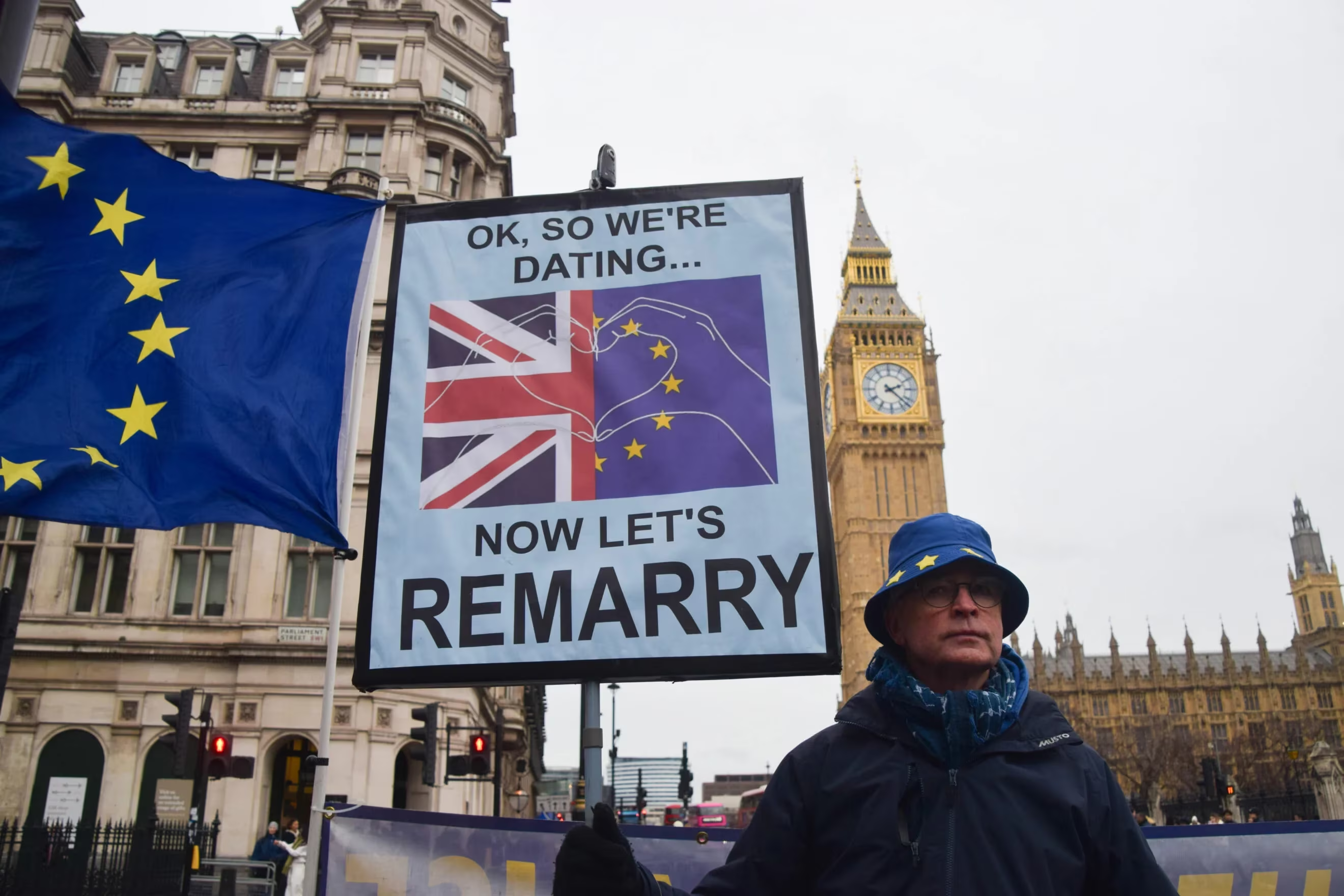
As the tenth anniversary of the referendum on the United Kingdom’s exit from the EU approaches, the question of restoring relations between London and Brussels is becoming unavoidable. As European Parliament President Roberta Metsola has noted, “in a world that has changed so radically,” the two sides must “banish the ghosts of the past” and rebuild cooperation—in trade, defence, science, and other areas dismantled by Britain’s departure from the Union. For the EU, such an approach—leaving the past behind—appears logical. For the United Kingdom itself, however, it is insufficient: the country needs a direct and honest reckoning with the failure of the Brexit project, not only to recalibrate its European policy, but above all to repair its own domestic political system.
A recent speech by Canadian Prime Minister Mark Carney at the World Economic Forum, in which he invoked Vaclav Havel’s essay “The Power of the Powerless,” was widely praised. Carney urged governments and businesses to stop “living in a lie” about the so-called rules-based international order. That conclusion applies in full to the British case as well. If the country truly wants to move forward, it must abandon falsehoods—above all the one that lay at the heart of Brexit.
In practice, however, both of Britain’s main political forces—Labour and the Conservatives alike—prefer to treat Brexit as an untouchable dogma, avoiding any discussion of the scale of its failure. Conservative leadership, which oversaw the country’s chaotic exit from the EU from start to finish while sidelining all internal critics, now effectively bears responsibility for its dismal outcomes. The current Labour government, for its part, has confined itself to cautious, almost symbolic steps toward partial reintegration into the most valuable elements of the European architecture—such as the Erasmus programme.
Yet both sides are too fearful to explain plainly why Brexit proved to be a colossal mistake. As a result, they leave themselves exposed—a vulnerability eagerly exploited by the populist Reform UK party, which insists that the real problem was not withdrawal itself, but its insufficient severity.
The facts speak for themselves. Across every dimension that motivated the 2016 vote, Brexit has failed to deliver on its promises. Immigration did not fall after leaving the EU; on the contrary, it surged—net inflows in 2023 exceeded 900,000 people. There is no evidence that liberation from European regulation has given the British economy a fresh impetus. Since 2020, it has grown more slowly than the euro area and the EU as a whole. With a debt-to-GDP ratio exceeding 100 percent, the country’s fiscal outlook looks no less bleak than that of the most heavily indebted states of continental Europe.
This is partly explained by the fact that the Conservatives, who held power after the referendum, squandered political capital on secondary Brexit-related disputes—from the Irish “backstop” to the status of EU law within the British legal system. It was time that could have been devoted to deep structural reforms capable of boosting the economy’s competitiveness. After all, EU membership never prevented the United Kingdom from changing planning rules, cutting taxes, reforming secondary education, or pursuing other supply-side measures.
At the same time, it would be wrong to claim that all the arguments advanced by Brexit’s supporters were inherently false. There were also straightforward miscalculations. The idea of reorienting toward deeper economic ties with the fast-growing economies of Asia and the Americas appeared logical—but only under conditions of a stable, rules-based global trading system. That system no longer exists today.
It is hard to imagine a less opportune moment to attempt building a “Global Britain,” turning away from Europe in pursuit of hypothetical opportunities overseas. Under two consecutive presidents, the United States has effectively paralysed the World Trade Organization and then moved on to extracting the harshest possible concessions and “rewards” from partners, leveraging their dependence on access to the American market. Instead of the long-sought free-trade agreement meant to reinforce the “special relationship,” the United Kingdom was forced to accept baseline tariffs of 10 percent simply to secure entry to the US market.
At the same time, rather than benefiting from Asia’s economic growth, London has been confronted with an increasingly assertive China and a global race to localise and shield supply chains. Yes, the United Kingdom continues to play a constructive role in European security—not least through its support for Ukraine. But its absence from the EU simultaneously complicates the participation of British companies in the large-scale defence buildup now underway across Europe. The country, for example, was excluded from the first iteration of the pan-European Security Action for Europe credit programme and will likely be forced to pay for access to the second.
Roberta Metsola is right—Europe has every reason to seek closer ties with the United Kingdom. But the main obstacle lies on the other side of the Channel. On one side stands a loud chorus insisting that the “real Brexit,” like communism, was supposedly never implemented. On the other is the cowardice of those who understand that Brexit has failed, yet shrink from saying so aloud for fear of political consequences. As long as the British establishment, including the current government, continues to indulge the bad-faith and effectively false framing promoted by Reform UK, it merely strengthens the position of its far-right leader Nigel Farage and his supporters.
Paradoxically, even as support for Reform UK rises, the narrow majority that secured Brexit’s victory almost a decade ago has already vanished—in the case of older voters, in a literal demographic sense. Rather than treating Brexit as an unassailable axiom, Britain’s political elites must abandon the continued habit of living in the lie constructed by its advocates. This is not necessarily a call to rejoin the EU—that is a discussion for another time. It is simply a recognition of reality: this political gamble has left the United Kingdom weaker.
Until that moment arrives, London’s relationship with Brussels will remain fragile, and the country’s domestic politics dangerously unbalanced.