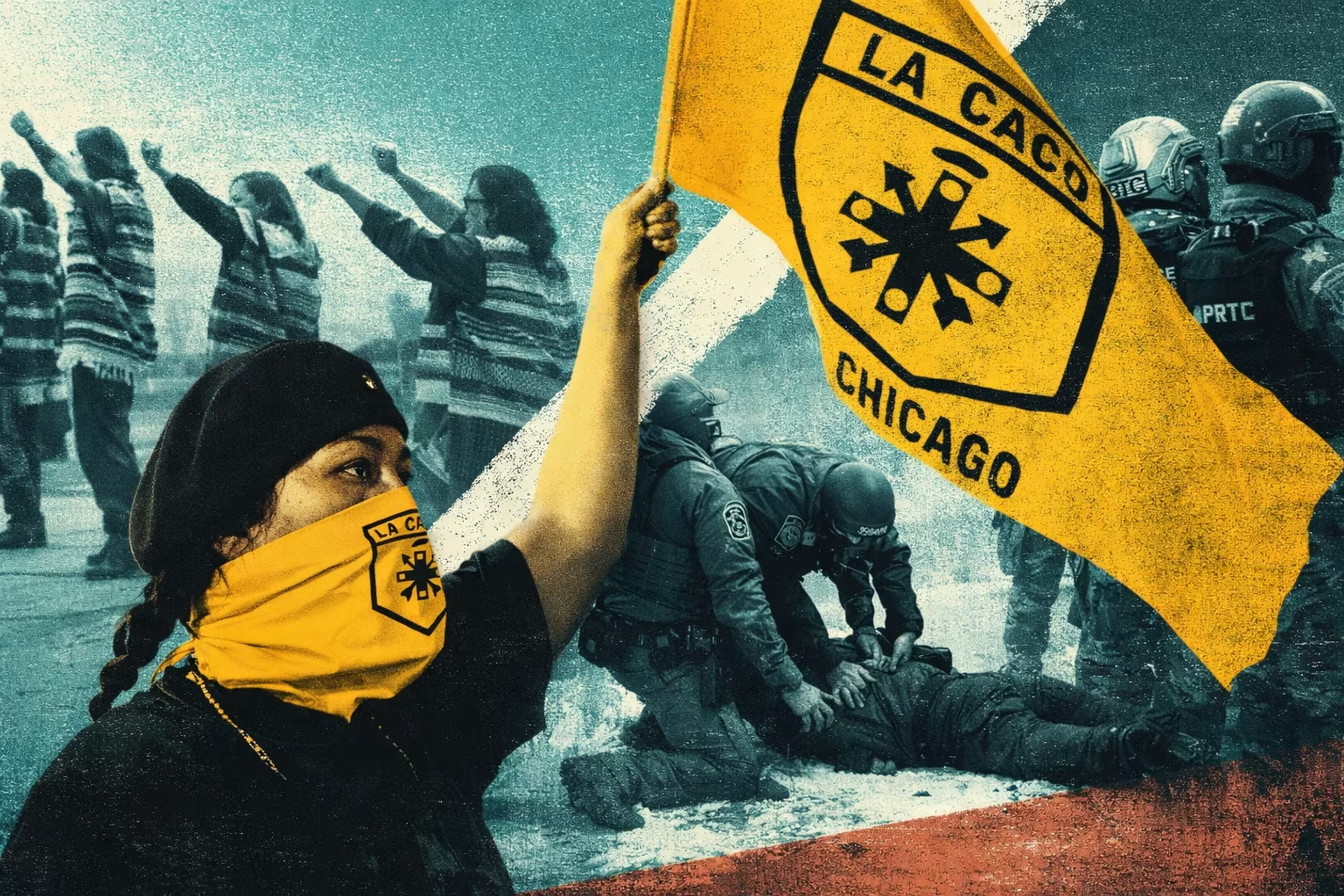
For several weeks now, the United States has seen protests against raids by Immigration and Customs Enforcement (ICE). The immediate triggers have been intensified federal operations to detain migrants, as well as cases of deaths during such raids, including Alex Pretti and Rene Nicole Good, who were shot dead by federal agents.
Against this backdrop, street actions in a number of cities have begun to change their form and symbolism—a shift that has become increasingly visible in recent weeks.
Groups adopting the names and visual language of radical movements from the 1970s are reappearing at immigration-related street protests across the United States. Their return underscores how ICE raids are reshaping the character of urban protest and amplifying more radical modes of expression.
This is not a straightforward revival of the historical Black Panthers or Brown Berets. Yet their renewed visibility points to a broader turn toward confrontational symbolism at a moment when ICE and the Border Patrol face little accountability for allegations of excessive force. The emergence of sometimes armed groups may further heighten tensions following the deaths of Alex Pretti and Rene Nicole Good, who were shot by federal agents.
Members of these groups themselves stress that they see their role as defending immigrant rights rather than acting as paramilitary formations. Even so, the names they have chosen carry significant historical and political weight. The expansion of ICE activity in a number of cities has already led to mass protests and neighborhood-level initiatives aimed at resisting the raids.
In this environment, groups using the Brown Berets name have appeared in Texas, Minneapolis, and California. In Philadelphia, demonstrators opposing ICE included people identifying themselves as the Black Panther Party for Self-Defense, who later changed their name. Similar groups have also been documented in San Diego. The American Indian Movement, founded in 1968 and focused on defending Indigenous rights, has announced the launch of “community patrols” in Minneapolis.
In North Texas, representatives of the Brown Berets attended a vigil following a shooting near an ICE field office in Dallas. In San Antonio, a group calling itself the Autonomous Brown Berets issued warnings about heightened ICE activity. In Salt Lake City, activists from the West Side Brown Berets are also taking part in demonstrations.
Even where historical names are not used, practices that draw on the Panthers’ legacy are becoming increasingly widespread. In Los Angeles, for example, volunteers patrol neighborhoods, warning residents about the presence of ICE agents. Organizers of these initiatives explicitly reference the “cop-watch” model developed by the Black Panthers, stressing that the patrols are unarmed and focused on documenting events and informing the community.
“The duty of the Panthers is to fight injustice and engage in work that brings the community together,” Robert Ware, chairman of the San Diego Black Panther Party, said on Instagram. According to him, the organization operates “in unison” with groups opposing ICE and the Border Patrol. A similar stance was voiced by Paul Birdsong, head of the Black Lion Party for International Solidarity, who pledged that his group would protect people in Philadelphia.
At the same time, some figures connected to the Panthers’ historical legacy have publicly criticized the involvement of such organizations in immigration-related protests. In their view, these actions distort the movement’s original focus and improperly appropriate its name. Miesha Newton—the niece of one of the Black Panther Party’s founders, Huey P. Newton—released a video condemning a group operating under that name at anti-ICE protests in Philadelphia. On social media, critics have also argued that invoking the Panthers brand in the context of immigration protests turns a specific historical movement into a generic symbol without clear boundaries.
Birdsong and his supporters push back, noting that the original Black Panthers once cooperated with Palestinians and Chicano groups and offered support in the aftermath of the Stonewall riots. In their reading, this underscores the movement’s internationalist and solidaristic character.
The Philadelphia Black Panther Party was founded in 1968 and existed for about five years, running free breakfast programs and community patrols. As researchers at the University of Washington note, however, the organization’s ranks shrank sharply under the pressure of targeted police operations. Birdsong himself, who did not respond to an inquiry from Axios, told the Inquirer that he was drawn into reviving the local chapter by members of the Black Panther Party after the killing of George Floyd in 2020. His group organized food distribution from a headquarters in North Philadelphia and was seen patrolling neighborhoods with long guns—activities that have already led to tense encounters with police.
The Brown Berets emerged in the late 1960s as a Chicano movement focused on combating police violence, expanding access to education, and advancing self-determination. The Black Panther Party combined armed self-defense with expansive social programs and ultimately became one of the primary targets of federal surveillance. Both organizations, even after ceasing to exist, left behind a durable visual and rhetorical legacy.
Contemporary activism under the Panthers banner reflects a generational shift rather than a direct revival of the 1960s movement, argues Jenny Luna, a professor of Chicano studies at California State University Channel Islands. “This is no different from what young people were doing back then—they were challenging their elders and saying, ‘This is who we are now,’” she says.