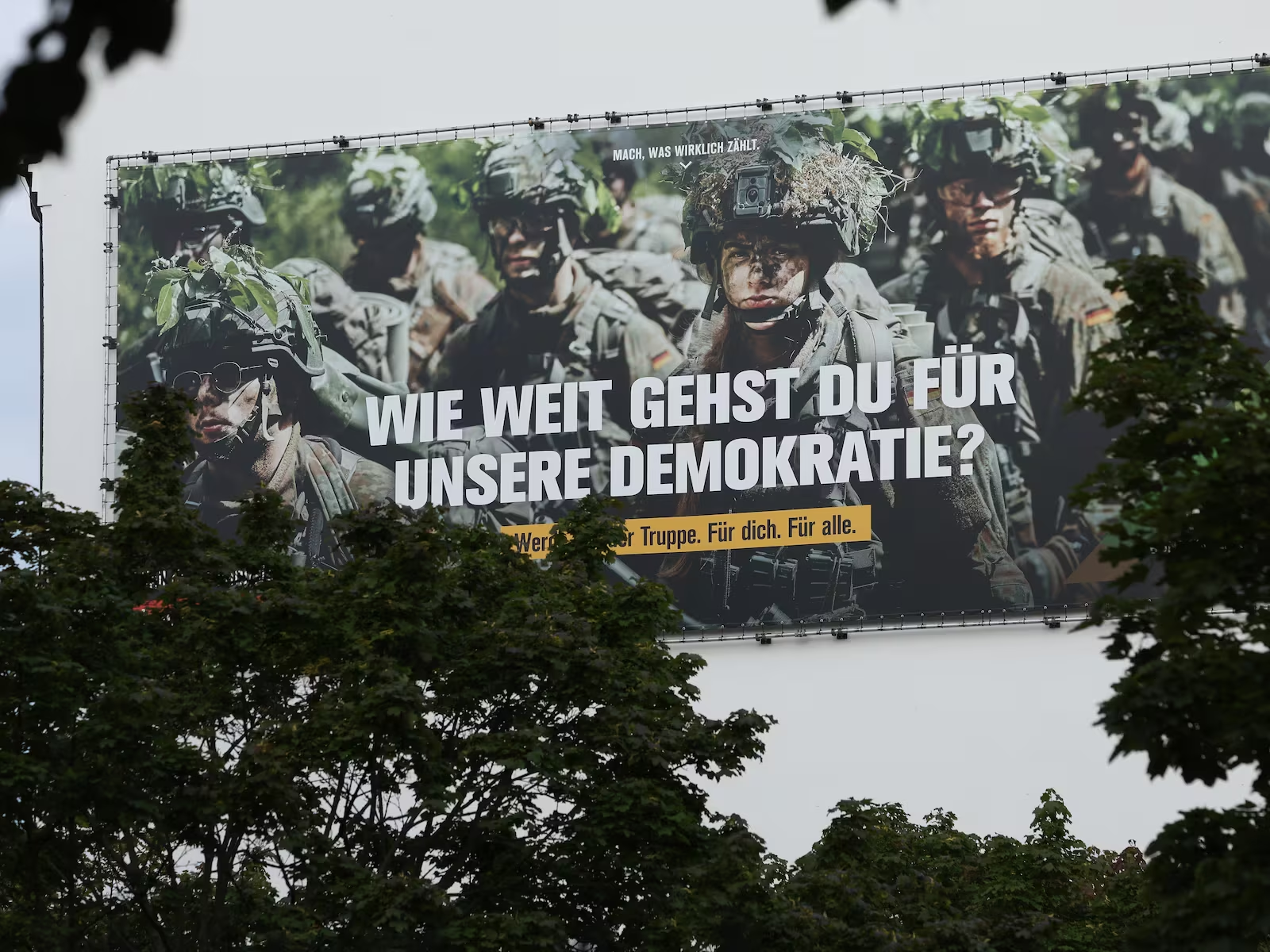
For several weeks, we spoke with Berlin residents—people from Russia and Ukraine who moved to Germany long before 2022. They are individuals who chose the country as a space of distance from war and militarized language, yet today increasingly feel that this distance is disappearing. Their conversations are marked by anxiety over the growing normalization of war, a sense of social pressure, and the feeling of being a minority—those who continue to place human life above any political or historical constructs.
“I have lived in Germany for a long time. It has become difficult for me to speak on behalf of Russia, so I speak on behalf of Germany,” says Ilya, a real estate agent from Saint Petersburg, at the start of the conversation, as if setting the boundaries of what can be said in advance. Russia’s full-scale invasion of Ukraine came as a shock to him. It took months—and antidepressants—to begin to cope with it. But now, he explains, something else is frightening: how increasingly often German politicians speak of a major war, and how quickly this language becomes familiar.
Ilya lists examples almost mechanically. Defense Minister Boris Pistorius not long ago named 2029 as a possible point of direct confrontation with Russia. Then 2028 appeared in public statements, and now—2026. The phrase “the last peaceful summer”—2025—has spread across news broadcasts and talk shows. It is repeated on the radio, discussed at work, quoted on social media, as if the subject were not a war in Europe but an unfavorable economic forecast.
Gradually, Ilya says, a sense emerges that the state is not so much preparing for a hypothetical scenario as accustoming society to the idea of its inevitability. Germany increasingly resembles Russia before 2014 (when the annexation of Crimea and the invasion of Donbas took place—editor’s note)—not in the structure of its political system, but in the logic of preparing society. Military service is being made attractive to young people, Bundeswehr advertising appears at bus stops and in the metro, and talk of reinstating conscription is framed as a rational, almost technical step. Television debates are filled with discussions of defending freedom and democracy, but rarely address the price that will have to be paid.
Berlin long remained a city at a distance from war. Tens of thousands of people live here who left Russia and Ukraine well before 2022—those who chose Germany precisely as a space that rejected militarized language. Now that distance has nearly vanished.
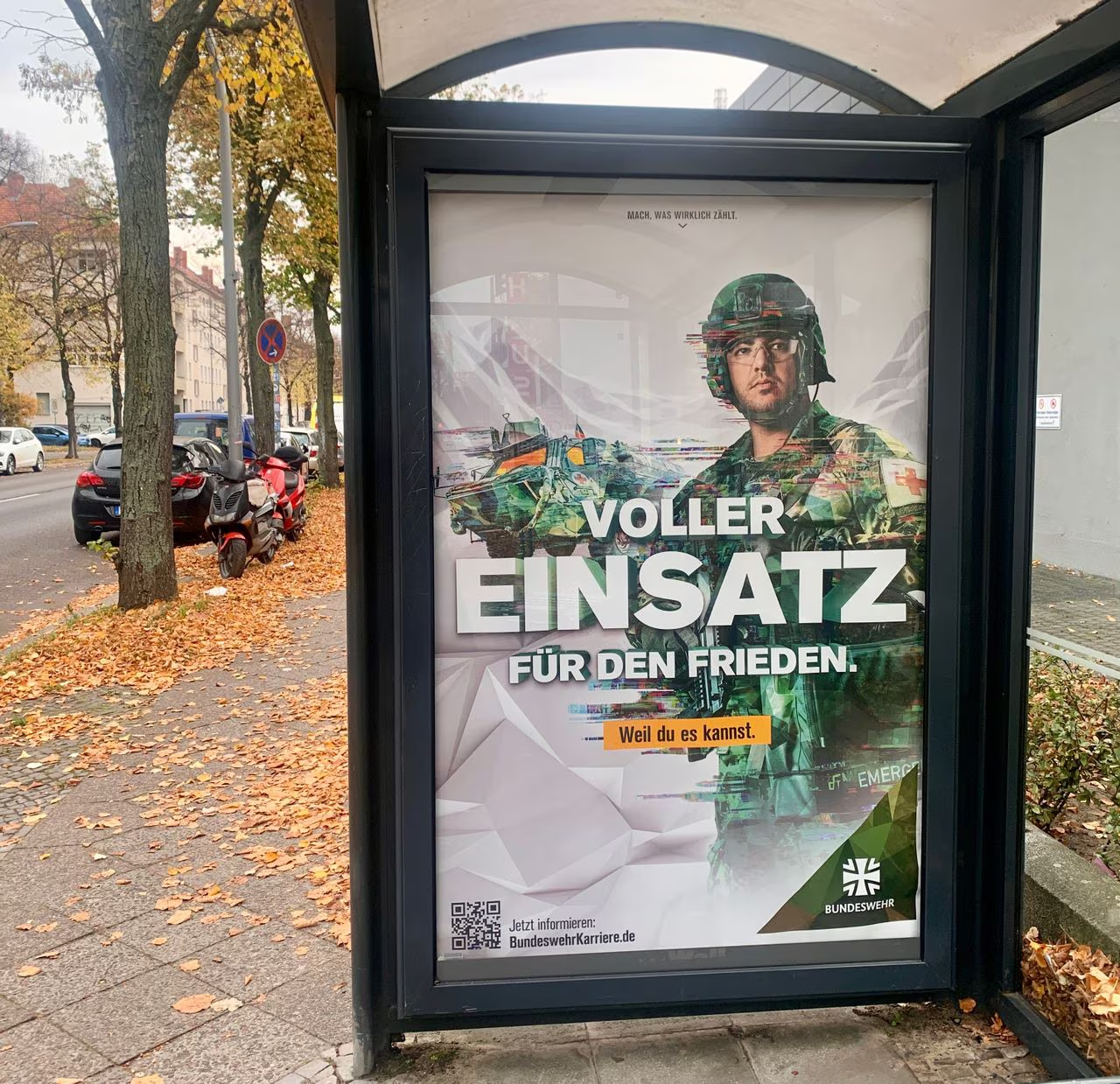
“Total commitment—for peace.”
Bundeswehr advertising poster.
Bundeswehr advertising poster.
In Neukölln, a Bundeswehr poster hangs at a tram stop: a young man in uniform, a confident gaze, a slogan about choosing the future. University mailing lists carry invitations to career events featuring the military. The return of conscription is discussed not as a political turn, but as a matter of timing and logistics.
Ilya says that conversations with colleagues have become noticeably more difficult. Any attempt to question what is happening quickly runs up against the formula of being on “the right side of history.” The idea of peace is increasingly perceived as naive, or even suspicious. Particularly painful for him is the reaction to school students who take to the streets to protest conscription. Instead of empathy—mockery. In comments and workplace chats, the prevailing sentiment is that young people simply do not understand the world they live in.
Andrii, a software developer from Ukraine who moved to Berlin in 2015, puts it differently. What unsettles him is not so much the prospect of war itself as the speed with which society comes to accept it as normal. “I don’t hear aggressive slogans,” he says. “But I recognize the intonations. If you doubt, it means you are weak. Or simply not ready to take responsibility.”
Olha, who moved from Ukraine to Germany in 2018, admits that it is becoming increasingly difficult for her to speak openly about peace. Any attempt to articulate that idea, she says, immediately creates tension. “It’s as if only one thing is expected of me—full agreement that the war must continue until victory. And when I say that I simply want people to stop dying, the conversation instantly becomes awkward,” she says.
German colleagues, Olha notes, as a rule do not argue directly. The discussion drifts into abstraction—values, historical responsibility, the need not to repeat the mistakes of the past. But the concrete question of how many lives it is acceptable to lose for the sake of these principles is almost never addressed.
Against this backdrop, Ilya’s own hopes, he says, sound almost improper. Today they are largely tied to Donald Trump—to the expectation that he would push for peace by applying pressure to both Putin and Ukraine, without looking to European politicians. This is not, Ilya stresses, about sympathy or trust. Rather, it is a desire to see at least some force capable of breaking the current inertia.
A sense of being in the minority is perhaps the one thing that unexpectedly unites almost everyone we spoke to in Berlin. This is not about a political stance or support for particular leaders. It is about a simple and increasingly unspoken idea: human life is ever more often treated as secondary to the ideas in whose name people are urged to fight.
If you place human life above any ideas, you almost always find yourself in the minority. And today it is precisely this minority that appears most vulnerable—not because it is radical or loud, but because it is left with almost no language in which to speak out.