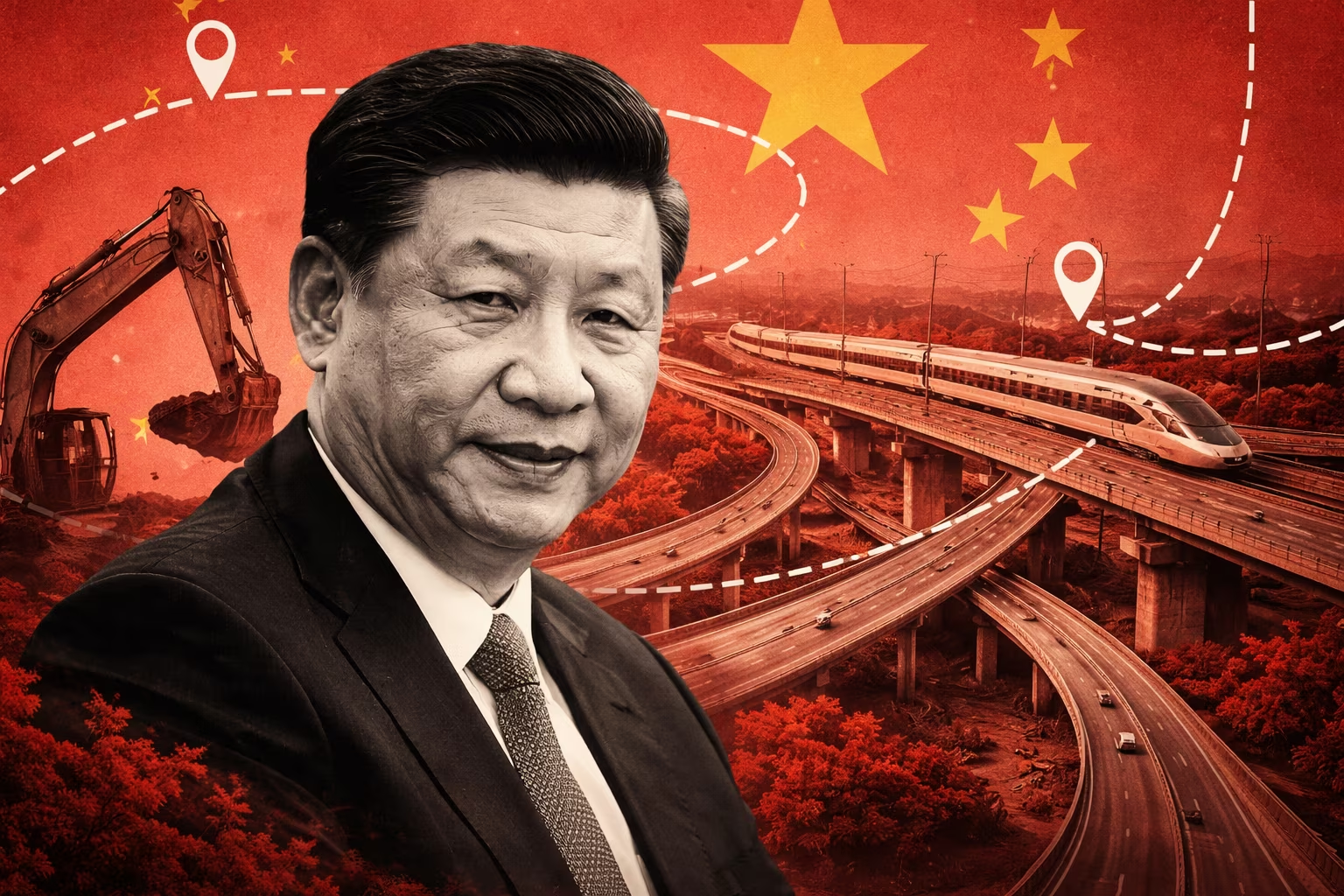
In 2025, China’s Belt and Road Initiative reached record levels of financing, sharply expanding both the number and the scale of overseas projects. Most of the growth was concentrated in energy, resource extraction and processing, and infrastructure in developing countries, where Beijing signed hundreds of new agreements in a single year and pushed the cumulative value of projects since the initiative’s launch to $1.4 trillion.
China’s flagship overseas infrastructure financing programme, the Belt and Road Initiative, expanded by almost three quarters in 2025, reaching a record $213.5 billion. Beijing stepped up investment in development projects, seeking to capitalise on a weakening of US influence across various regions of the world.
The sharp increase in new investment and construction agreements was driven primarily by megaprojects in the gas sector and the expansion of green energy—according to research by Australia’s Griffith University and the Green Finance and Development Center in Shanghai. Over the year, China concluded 350 deals, up from 293 in 2024, when their combined value stood at $122.6 billion.
The investment surge comes amid intensifying trade and technology disputes between the US and China, which have disrupted supply chains, as well as against the backdrop of military interventions by President Donald Trump that have destabilised global energy markets.
Christoph Nedopil Wang, an expert on China’s energy and finance at Griffith University and the author of the study, predicts that Beijing’s spending under the BRI will continue to rise this year as well—driven by investment in energy, mining, and new technologies.
“Volatility in global trade and investment could further spur investment aimed at strengthening supply-chain resilience and identifying alternative export markets for Chinese companies,” he said.
Launched just months after Xi Jinping came to power in 2012, the Belt and Road Initiative became the Chinese leader’s flagship foreign-economic project. Its aim is to strengthen Beijing’s economic influence and expand trade ties with developing countries. As a result, China has become the world’s largest bilateral creditor, and the number of BRI partner countries has reached 150.
According to the study, last year’s figures pushed the cumulative value of contracts and investments under the initiative since its launch to $1.4 trillion.
Growth in 2025 was driven by multibillion-dollar megaprojects, including a gas field in the Republic of the Congo led by Southernpec, the Ogidigben Gas Revolution industrial gas park in Nigeria being developed by China National Chemical Engineering, and a petrochemical plant in North Kalimantan, Indonesia, built by a Chinese joint venture between Tongkun Group and Xinfengming Group.
“We have not seen megaprojects like these before,” Nedopil Wang noted. According to him, developing countries have become more willing to entrust Chinese companies with the execution of large-scale deals.
“Twelve years ago, these companies were significantly smaller. Now, having scaled up, they are capable of taking on larger projects—and it is precisely such projects that they need for further growth,” he said. “The willingness of infrastructure planners and policymakers to place their trust in China is quite substantial.”
The value of energy projects under the initiative reached $93.9 billion last year—the highest level since the launch of the BRI and more than double the 2024 figure. This total included $18 billion invested in wind, solar, and waste-to-energy projects, underscoring China’s leading position in clean technologies.
A record was also set in metals and mining, at $32.6 billion. Most of the spending went into minerals processing abroad, reflecting the use of the BRI as a tool to secure long-term access to raw materials. In the second half of the year, investment in copper surged as supplies tightened amid a boom in data centres serving demand for artificial intelligence technologies.
Craig Singleton, senior director of the China programme at the Washington-based think-tank Foundation for Defense of Democracies, noted that one “emerging pattern” was Beijing’s intensifying engagement with countries whose resources make it possible to build supply chains without US involvement.
“China’s overseas engagement is increasingly focused on strategic sectors that support self-sufficiency, supply-chain resilience, and technological integration,” he said.
According to him, the “lesson” Beijing has drawn from recent US actions toward Venezuela and threats directed at Iran is the need to “reduce exposure to external leverage before a crisis hits.”
At the same time, the sheer scale of the BRI has heightened concerns about participating countries’ ability to service their growing debts to China.
A 2024 report by the US Congressional Research Service cites problems such as unsustainable debt burdens and the potential extraction of political and economic concessions, opaque lending and loan terms, a lack of reciprocal market access for BRI partners, as well as investment in strategic sectors and infrastructure that creates risks of civil-military interoperability.
The report also notes that it is becoming increasingly difficult for Western analysts and officials to track and assess the BRI. The initiative is described as an “umbrella” framework, under which projects may be linked to it either directly or only loosely, while monitoring offshore financial activity is complicated by China’s use of domestic financing and special investment vehicles.