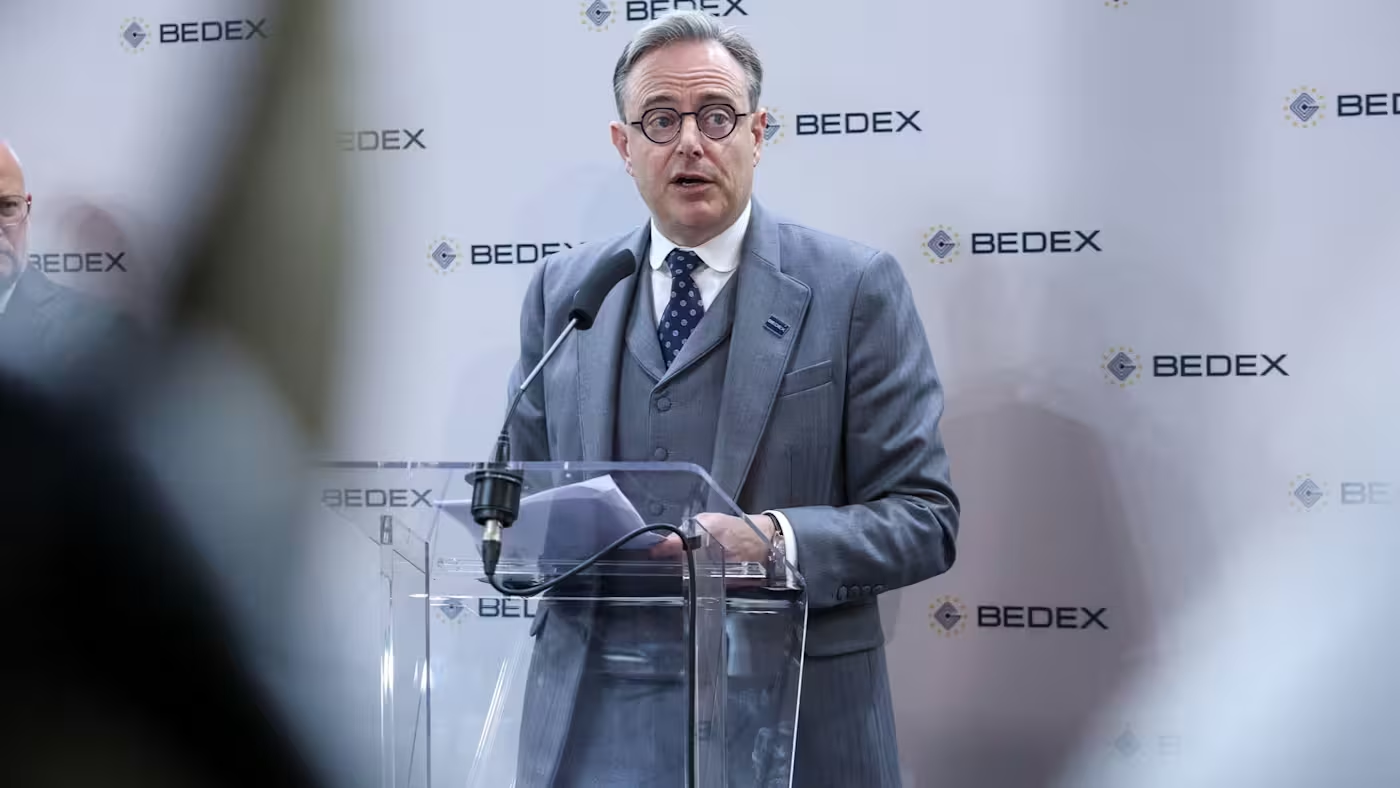
Belgium’s prime minister has urged the European Union to “normalise relations with Russia” in order to regain access to cheap energy—a statement that runs counter to the bloc’s agreed strategy of providing maximum support to Ukraine as it enters the fourth year of Russia’s aggression.
“We must normalise relations with Russia and restore access to cheap energy. That is common sense,” said Bart De Wever, a rightwing Flemish nationalist who has previously criticised the EU’s unconditional backing of Ukraine. He made the remarks in an interview with the Belgian newspaper L’Echo.
According to De Wever, many European leaders privately share this view but are unwilling to say so publicly. “In private, European leaders agree with me, but no one dares to say it out loud. We must end the conflict in Europe’s interest, while not being naive about Putin,” De Wever said in the interview, which was published over the weekend.
After Russian president Vladimir Putin launched a full-scale invasion of Ukraine in February 2022, the European Union provided Kyiv with hundreds of billions of euros in financial and military assistance while imposing sweeping economic sanctions on Moscow.
One of the central elements of that strategy has been the cessation of imports of Russian oil and gas—previously one of Europe’s most important sources of energy supply.
However, the war between the United States and Israel on one side and Iran on the other has triggered a sharp rise in oil and gas prices, reigniting debates across Europe over energy supplies and how to reduce costs for households and businesses.
Foreign ministers of EU member states are set to discuss the war in Ukraine and the conflict in the Middle East at a meeting in Brussels on Monday.
In the same interview, De Wever recalled that last year he blocked a Berlin-backed plan by the European Commission to use Russian sovereign assets frozen in Belgium to finance a loan to Ukraine. In his view, a strategy in which Europe simultaneously provides Kyiv with military support while trying to undermine Russia’s economy is unworkable without the full backing of the United States.
“Since we are unable to exert pressure on Putin through arms supplies to Ukraine and cannot choke his economy without U.S. support, only one method remains—making a deal,” the prime minister said.
These remarks drew criticism from Belgium’s foreign minister, Maxime Prevot, who represents the French-speaking centrist-left party Les Engagés.
“Should we maintain dialogue with Russia? Yes. That is what diplomacy is about—talking, including with those with whom you disagree,” Prevot said. “But dialogue is not the same as normalisation. And that is a fundamental distinction.”
According to him, Russia currently refuses to allow Europeans to take part in negotiations and continues to put forward maximalist demands. “As long as that remains the case, talk of normalisation sends a signal of weakness and undermines European unity, which is needed now more than ever,” he stressed.
Prevot also said that Belgium’s position on Ukraine remains unchanged. “Belgium’s support for Ukraine remains the same. The prime minister has said nothing different. He has also not called for easing sanctions. Until a possible peace agreement is reached, that question is not even on the agenda,” the minister added.
Later on Monday, De Wever sought to clarify his position. “I am not advocating a different line from the one my government is pursuing,” he said in an interview with the Belgian newspaper Le Soir. “It is perfectly clear that talking about normalising relations is impossible while the war of aggression against Ukraine continues. I am referring to a possible scenario after the war ends—following a peace agreement acceptable both to Ukraine and to Europe.”
He added that the current situation concerns him. “The only point I wanted to make is that the present situation—in which Europe is not at the negotiating table but is paying for the war—is not a comfortable one. We are not going to abandon Ukraine.”
Commenting on the Belgian prime minister’s initial remarks, EU energy commissioner Dan Jorgensen recalled that the bloc’s position on Russian energy has already been enshrined in law. “We decided in the European Union not to import Russian energy. Before Christmas, that became law,” he said.
“It would be a mistake for us to repeat what happened in the past. In the future, we will not import a single molecule from Russia,” Jorgensen added.