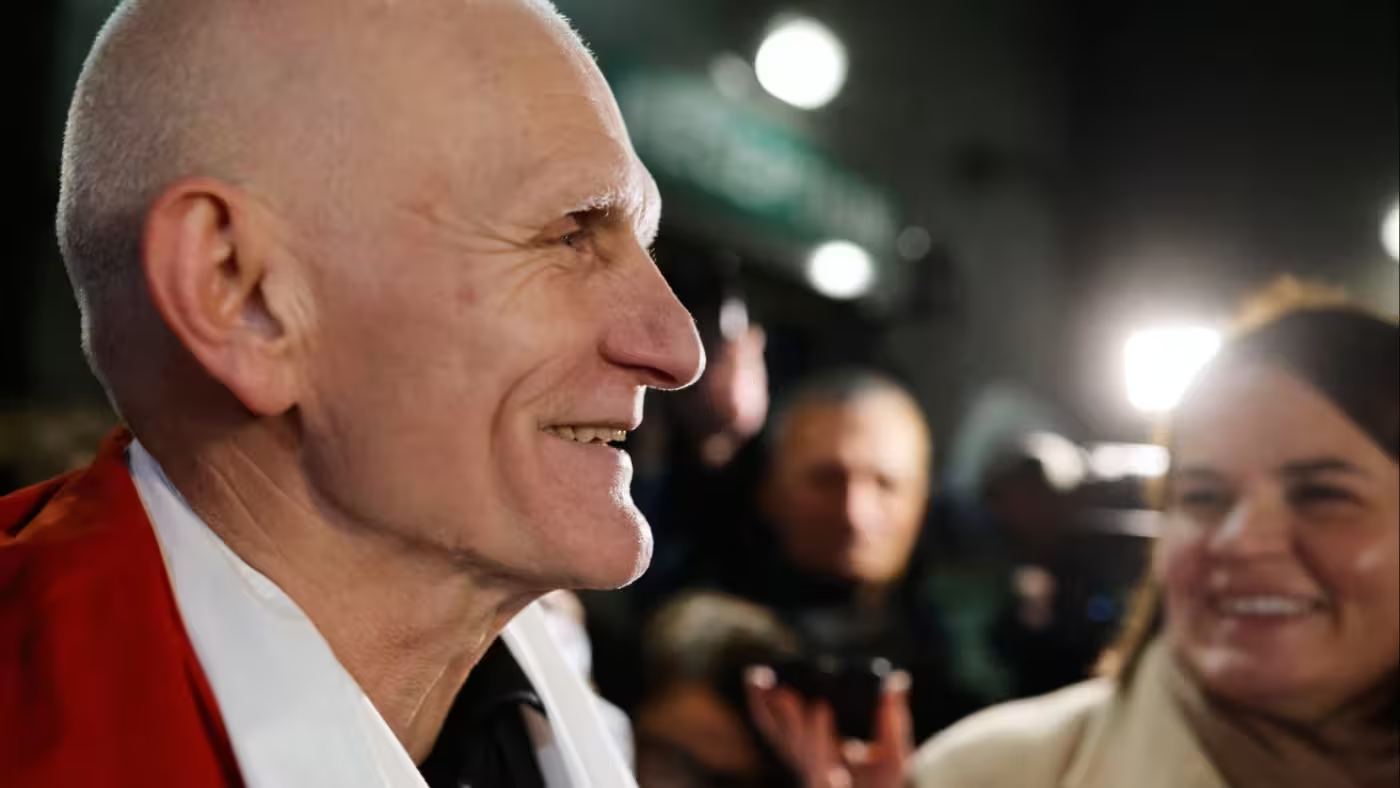
On Saturday, December 13, the Belarusian authorities released 123 political prisoners, including a Nobel Peace Prize laureate, after the United States agreed to lift sanctions on Belarusian potash exports.
The agreement was announced by the press service of President Alexander Lukashenko. It was the largest in a series of mass amnesties this year, as Minsk sought to reset relations with Washington during Donald Trump’s presidency.
The independent human rights group Viasna said that its co-founder, Ales Bialiatski, was among those freed. He was awarded the Nobel Peace Prize in 2022, jointly with Ukrainian and Russian activists.
According to Viasna, several key figures from the 2020 protests against Lukashenko were also released. Among them were Viktar Babaryka, a presidential candidate arrested during that campaign, and Maria Kalesnikava, a former flautist and one of the leaders of the protest movement.
The US special envoy for Belarus, John Cole, said that Trump had lifted sanctions on the country’s potash industry—one of its main export sectors. “As relations between the two countries are normalized, other sanctions will also be removed,” he told reporters after a two-day meeting with Lukashenko in Minsk, according to the state news agency BelTA.
Those released include five Ukrainian citizens. According to Cole, assistance in securing their release was provided by Kyrylo Budanov, head of Ukraine’s Main Intelligence Directorate. Along with the freed Ukrainians, 109 Belarusian citizens were transported to Ukraine on Saturday afternoon.
According to BelTA, Lukashenko has also “in recent times” pardoned citizens of the United States, the United Kingdom, Australia, Japan, Lithuania, and Latvia.
At the same time, according to human rights organizations, more than 1 000 political prisoners remain in Belarusian prisons.
Lukashenko, who has been in power since 1994, is regarded as one of Vladimir Putin’s closest allies in Russia’s war against Ukraine. In 2022, Belarus hosted a substantial contingent of Russian forces involved in the invasion and later reached an agreement with Moscow to deploy nuclear warheads on its territory.
Even so, the United States has sought dialogue with Lukashenko—whom Trump once described as “highly respected”—on the assumption that the former collective farm manager with a moustache could play a mediating role in efforts to end the war in Ukraine.
In November, Washington had already eased sanctions on the Belarusian airline Belavia in exchange for the release of 52 prisoners. Among them was Sergei Tikhanovsky, another former presidential contender whose wife, Sviatlana Tsikhanouskaya, sought to challenge Lukashenko and later emerged as the leader of the opposition in exile.
Last month, Sviatlana Tsikhanouskaya told the Financial Times that Lukashenko was seeking to “deceive” the United States and had no intention of distancing himself from Vladimir Putin, whose backing was instrumental in the suppression of the 2020 protests.
John Cole said that Lukashenko had offered “very measured advice” on how the United States should approach Russia’s war against Ukraine.
“Lukashenko has maintained relations with President Putin for a long time and is in a position to offer him advice. In the current situation, this is extremely useful. They have been friends for many years and possess the level of trust required to discuss issues of this kind,” Cole was quoted as saying by the BelTA news agency.
Cole also conveyed a personal greeting to Lukashenko from Donald Trump and his wife, Melania, in which they thanked the Belarusian leader for his “hospitality” and “gifts,” the state news agency reported.