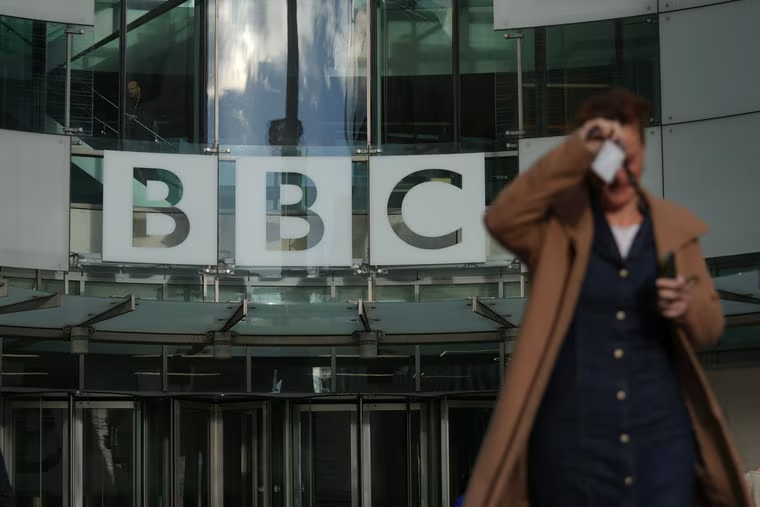
The BBC is seeking to have Donald Trump’s $10bn defamation lawsuit dismissed, arguing that the Panorama documentary at the centre of the claim was not available in the United States. This follows from court filings submitted by the corporation.
The British public broadcaster has filed a motion to dismiss, stating that a Florida court lacks “personal jurisdiction” because the BBC did not create, produce or distribute the disputed film in the state. The filings also note that Trump’s claim that the documentary was available in the US via the BritBox streaming service is not true.
Last year, the BBC acknowledged that a speech delivered by Trump on January 6, 2021 was misleadingly edited in the Panorama documentary, creating the impression that he had encouraged his supporters to storm the US Capitol. The corporation apologised, saying it had “unintentionally” given “the mistaken impression of a direct call by President Trump for violent action”. BBC director-general Tim Davie resigned, in part against the backdrop of the scandal.
Trump has sued the BBC for up to $10bn, accusing it of publishing a “false, defamatory, misleading, derogatory, inflammatory and malicious portrayal”. The lawsuit was filed by him in a personal capacity in a federal court in Florida.
Sources inside the BBC believe the pivotal issue will be whether Trump’s lawyers can demonstrate that the film was actually shown in Florida, since without that the court would be unable to hear the case. The corporation maintains that the documentary was not distributed in the United States and that the iPlayer streaming service was geoblocked for American users.
Trump’s lawyers argue that the programme was available in Florida to BritBox subscribers, as well as to users of virtual private networks that conceal a person’s real location. In response, the BBC said that “it is enough to follow the link cited by the claimant to see that the film is not on BritBox”. The corporation also stressed that Trump’s lawyers do not claim “that any Florida residents actually watched the film using a VPN”, adding that “watching iPlayer without paying the UK television licence fee is a criminal offence”.
The BBC also said the president had failed to “plausibly allege” that the film was published with “actual malice”—a requirement for defamation claims in the United States—and had not provided evidence of any resulting harm. The filings note that, given the numerous allegations levelled at Trump well before the documentary aired, as well as the fact that he went on to win the election and carried Florida by a wide margin, the film could not have damaged his already established reputation.
The BBC has also asked the court to stay the discovery phase until a ruling is issued on the motion, expressing concern that Trump’s lawyers may seek to draw the corporation into an expensive and protracted process. The filings say the claimant could demand an excessively broad range of information, covering the BBC’s reporting on Donald Trump over the past decade and more, and could also allege damage to his entire business and political profile.
Inside the corporation, there are also fears about the financial consequences of a lengthy legal battle, even if it ultimately ends in a victory for the BBC. Lawyers stress that the BBC is a non-profit news organisation funded by UK taxpayers, and that complying with extensive discovery demands would divert its resources away from fulfilling its public mission.
The BBC said that, as previously reported, the corporation intends to defend itself in the case and will not provide further comment on the ongoing legal proceedings. If the case proceeds, a possible start date for the trial has been cited as 2027.