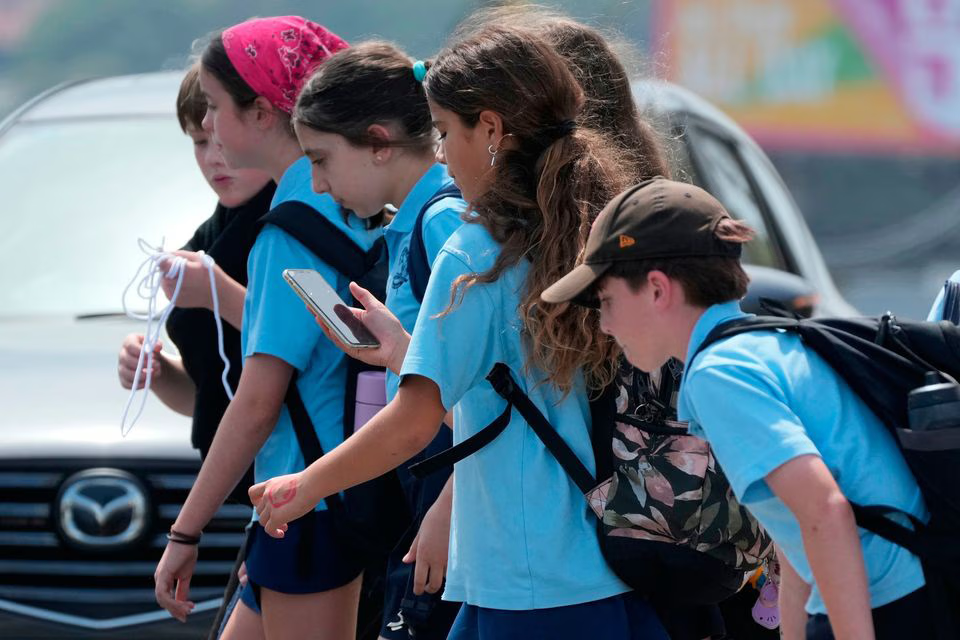
Australia has become the first country to impose a complete ban on social-media access for minors. As of December 10, a new law prohibits children under 16 from using TikTok, Facebook, Instagram, YouTube, X, Reddit, and other platforms.
Responsibility for enforcing the new rules rests with platform owners, who must block underage users. Violations carry fines of up to 49.5 million Australian dollars (33 million US dollars). The required measures include deactivating accounts belonging to users under 16 and denying registration to new users in this age group.
Parliament approved the law in late November 2024, three weeks after Prime Minister Anthony Albanese announced his intention to introduce it. He framed the initiative as a response to growing concerns about young people’s mental health. A government-commissioned study found that 96% of Australians aged 10 to 15 use social media, and seven in ten had encountered harmful material, including content promoting suicide, reports BBC.
For now, the restrictions apply to ten platforms—Facebook, Instagram, Snapchat, Threads, TikTok, X, YouTube, Reddit, Kick, and Twitch. Authorities note that the list will be updated regularly.
Age verification is the responsibility of the platforms themselves. According to The Guardian, the law explicitly prohibits relying solely on the date of birth provided at registration. Verification may draw on bank details, photo-ID documents, or selfies. YouTube has said it will rely on information from Google accounts along with additional signals.
Social-media companies have already outlined the measures they are taking. Snapchat will freeze children’s accounts for three years or until their owners turn 16. YouTube will automatically sign teenagers out and hide their channels, preserving the data until the account is reactivated once the user turns 16. TikTok will deactivate all accounts belonging to children under 16 on December 10, and their content will become inaccessible. On Twitch, the ban on creating new accounts for users under 16 takes effect on December 10, but existing accounts will not be disabled until January 9. Meta began removing under-16 accounts on Facebook and Instagram on December 4.
Ahead of the law’s introduction, Albanese urged teenagers to find alternative activities for the school holidays. “Pick up a new sport, learn to play a musical instrument, or read a book that’s been sitting on your shelf for too long. It’s important to spend time with your friends and family,” he said. In an interview with ABC, the prime minister described the new regime as “a day when Australian families take back control from the big tech companies.” “They are defending children’s right to remain children—and parents’ right to peace of mind,” he added.
Even before the law came into force, Australian users had begun searching for services offering similar features, notes CNN. Yope, a photo-sharing app, reported 100,000 new registrations from Australia within a short period. Among other popular alternatives was Lemon8, often described as a TikTok-style platform.
Teenagers’ reactions to the ban have been mixed. Some have criticised it, while others have responded calmly. Twelve-year-old Paloma from Sydney told BBC reporters that the new restrictions make her “sad.” She spends between 30 minutes and two hours a day on social media. “I’m upset because I’m part of several communities on Snapchat and TikTok. Thanks to them, I’ve formed good friendships with people in the US and New Zealand; we share interests such as gaming, and that helps me feel more connected to the world,” she said.
Fourteen-year-old Emily from Canberra, by contrast, sees the ban as the right step. She notes that social media can be “dangerously addictive,” and believes the new law may reduce the level of bullying children face. At the same time, she acknowledges that she will now communicate less often with her school friends—and worries she will miss that.
Emma Mason, an Australian whose fifteen-year-old child died by suicide after online bullying, supports the government’s decision. Speaking to reporters, she described the ban as a form of “protection” rather than an act of “control.” “We need rules, even if those rules are broken,” she stressed.
Among the critics is 17-year-old Mary, who sees the restriction as an example of “crazy” double standards. “Why are children allowed to watch gambling ads and be sent to prison at 10, but not use social media at 15? Instead of banning social media for everyone under 16, perhaps the government should simply force billionaires to regulate their companies for users of all ages,” she said.
Thirteen-year-old Isabelle admitted it took her less than five minutes to bypass Snapchat’s restrictions. The app notified her that her account would be deleted unless she verified her age, so she used a photo of her mother to complete the check.
One parent told The Guardian that he personally showed his child how to get around the rules. “I showed her how VPNs and other age-workaround methods operate. I had to create an adult YouTube account for her, and I helped her bypass TikTok’s age gate—and I will continue doing so every time TikTok asks,” he said.