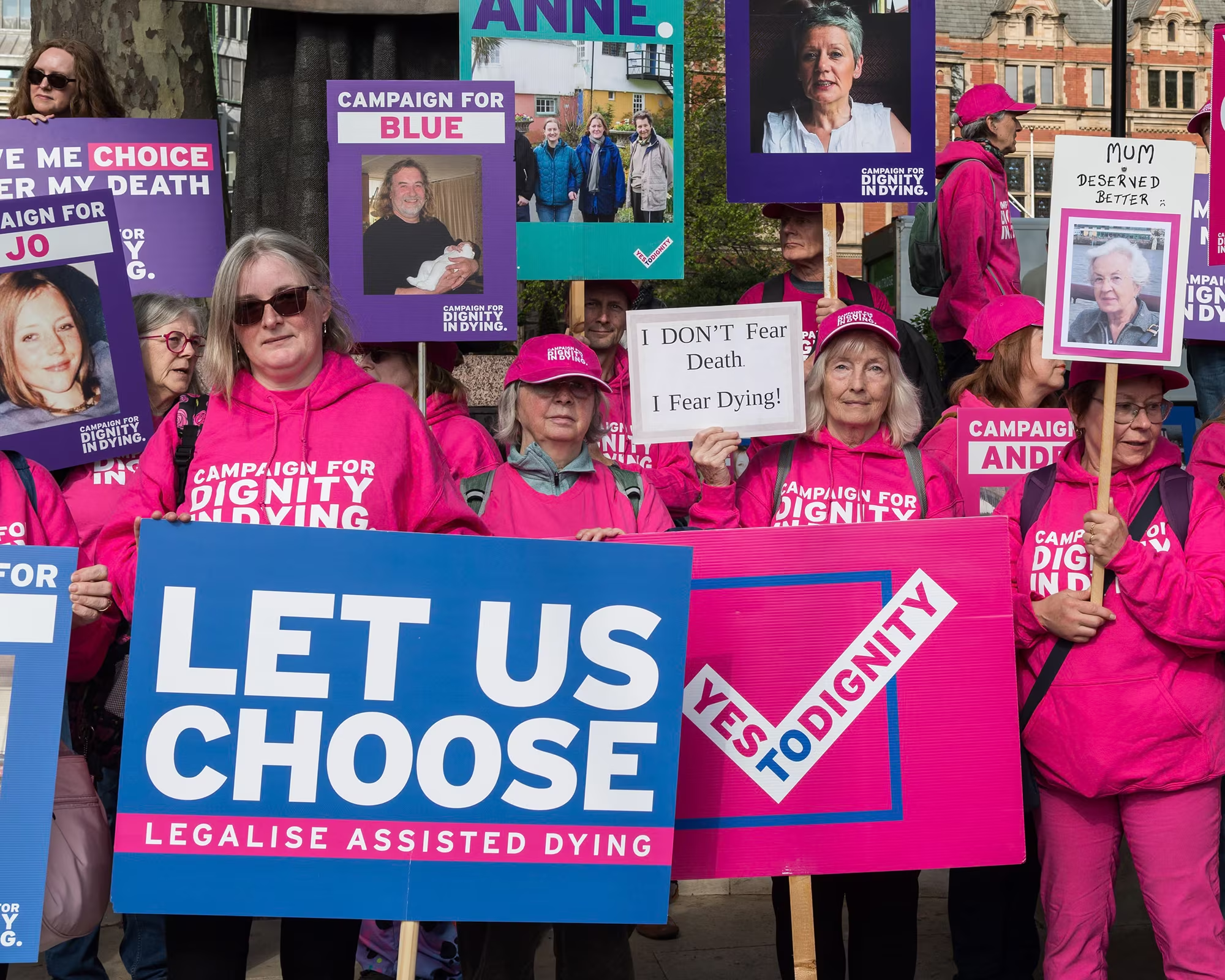
After an attempt to pass a bill allowing assisted dying for terminally ill people with a life expectancy of less than six months collapsed, supporters and opponents of the measure accused one another of derailing the process.
Backers of the bill, including terminally ill people themselves, say the measure—which had already passed the House of Commons—was effectively blocked by a small group of unelected members of the House of Lords.
Opponents, including MPs, peers, and disability-rights campaigners, insist the bill did not fail because of sabotage, but because it was poorly drafted and left practical questions unanswered about how such a system would work.
Sarah Wootton, chief executive of Dignity in Dying, said several peers she described as “implacable opponents of assisted dying” had dominated debate in the House of Lords and buried the bill under amendments in order to obstruct its passage. “It is absolutely shameless—what a tiny group, less than 1% of the unelected upper chamber, has done,” she said. “Their role is to scrutinize, not to block.”
Hannah Slater, 38, who has been diagnosed with terminal breast cancer, called the bill’s failure “undemocratic.” “It is devastating for people who want the ability to choose how they die when they are terminally ill. It is just very, very painful to have that choice taken away at the last moment. It feels truly cruel and unfair.”
One of the seven peers most often criticized by supporters of the bill said the accusations against opponents were unfair. Crossbench peer and former Paralympian Tanni Grey-Thompson, who raised questions about the effectiveness of life-ending drugs and their use during pregnancy, said: “The bill failed because it is badly written. It needs to be far, far more precise than what we have.”
According to Grey-Thompson, criticism of the 1,200 amendments ignores the complexity of legislative work. A single objection may require multiple amendments across all related sections of a bill. For example, her proposal to use the accepted legal term “disabled people” in the bill instead of people with disabilities required 12 separate amendments.
“Our role is to work through those technical details. I think it was difficult because the pressure simply to wave everything through was quite strong. It is not just a handful of people who oppose that.”
Disability-rights campaigner Pete Donnelly backed the peers’ amendments, saying that without them the bill would have been “waved through” without proper scrutiny. Donnelly fears that assisted-dying legislation could over time be expanded to cover disabled people, and he described the measure as “unsafe [and] lethally dangerous.”
“This should be introduced as a government bill so that it can go through a full scrutiny process. Because at the moment it is, in effect, a skeleton bill with enormous gaps—in procedure, in safeguards, and in the question of the drugs that would be used.”
Labour MP Josh Fenton-Glynn, who abstained at the bill’s second reading in the House of Commons, said the measure still did not contain sufficient safeguards to protect terminally ill people from pressure by relatives.
“Ultimately, I think any supporter of assisted dying would want to see a safe and workable bill, and I do not believe this was it. I would have been very happy if they had made a good-faith effort to fix some of those problems, but the stubborn reintroduction of the same bill with the same flaws leaves us with a choice between voting against a dangerous law or not. Unfortunately, my position would remain the same,” he said.
Labour peer Luciana Berger said the bill should have gone through the same kind of pre-legislative scrutiny as other conscience-issue private members’ bills. She said, for example, that private members’ bills that introduced abortion rights and abolished the death penalty “were preceded by a commission even before the document was introduced in the House of Commons.”
“In essence, they recreated that hugely important stage of pre-legislative scrutiny so that the bill had already been agreed with the professional bodies whose members would be responsible for implementing it, and so that the legislation reflected what could be done in practice.”
Andrew Copson, chief executive of Humanists UK, said: “No one can seriously claim that this bill was not scrutinized enough. Assisted dying has gone through unprecedented scrutiny—more than any private member’s bill in history—even before it reached the House of Lords. Opponents often speak as though this were an entirely new issue, when in fact assisted-dying laws are already in force in more than 36 jurisdictions covering hundreds of millions of people. This is one of the most thoroughly examined reforms in parliament, not one of the least examined.”