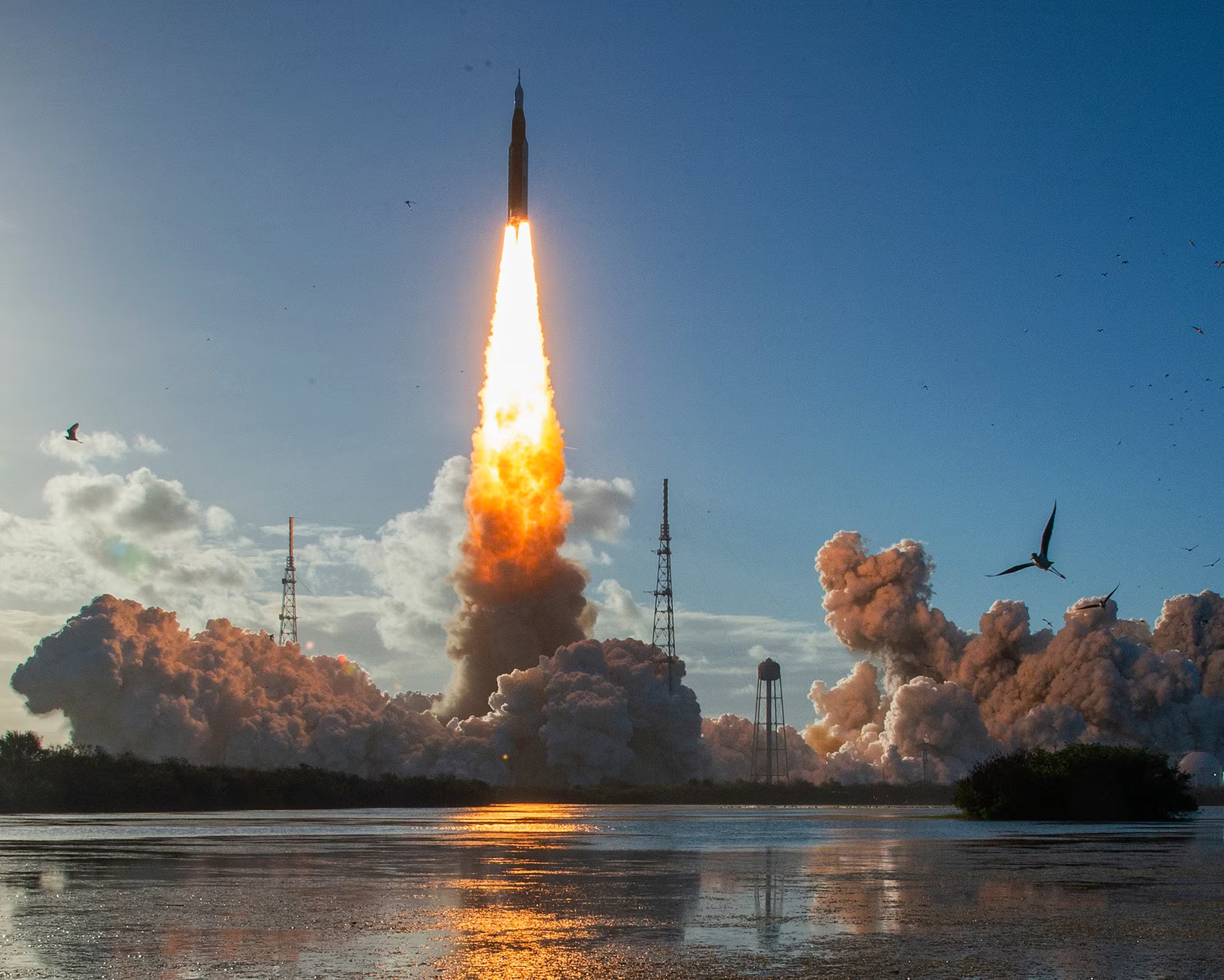
Four astronauts are preparing to leave Earth orbit and enter a trajectory toward the Moon—NASA’s Artemis II mission has entered its second day.
The 10-day journey will mark the first time in half a century that humans travel a significant distance from Earth and return to the Moon’s vicinity. The flight is being seen as a crucial test of NASA’s plans to land humans on the lunar surface again this decade and establish a lasting presence there.
About three and a half hours after launch, following a scheduled rest period, the crew was awakened on instructions from mission control and told to prepare for an Orion engine firing. The maneuver was a one-minute impulse—a so-called burn—designed to raise the spacecraft’s orbit even higher.
“Christina, Houston clears you to burn,” mission control transmitted, addressing mission specialist Christina Koch, who is set to become the first woman to fly around the Moon.
NASA said that if “all systems remain in good working order”, the crew will receive the command to carry out the translunar injection burn—a six-minute engine firing that will send the spacecraft on a 240,000-mile journey.
After that, the capsule will fly around the far side of the Moon—the crew will become the most distant from Earth in history—and then use the Moon’s gravity to return.
Three American astronauts and one Canadian lifted off on Wednesday from the Kennedy Space Center in Florida before tens of thousands of spectators who had gathered to watch the launch of NASA’s most powerful rocket, the Space Launch System.
The scene recalled the launches of the Apollo era in the 1960s and 1970s, when humans first landed on the Moon. In Greek mythology, Artemis is the goddess of the Moon and the twin sister of Apollo, the god of the Sun.
A substantial part of the mission is devoted to testing the systems needed for the programme’s next stages. Minor issues have already been recorded—temporary communications disruptions, crew complaints about low cabin temperatures, and a flashing fault indicator for the toilet system detected shortly after launch.
The astronauts also carried out a demonstration of rendezvous operations—manually flying the capsule to assess how it behaves when docking with another spacecraft. In future missions, a lunar module will have to be attached to the vehicle.
In parallel, the crew is filming Earth from a great distance. “The view from window three, from a distance of about 38,000 nautical miles—the whole Earth in full view—is quite a sight,” said mission commander Reid Wiseman.
Artemis III is intended to continue rehearsing docking operations in Earth orbit, while Artemis IV, scheduled for launch in 2028, is meant to deliver astronauts to the Moon’s south polar region. Washington is entering a new space race—China, too, aims to send a crewed mission to the area by 2030.
NASA intends to build a base on the Moon for a permanent human presence and says the Artemis programme “will bring us closer to living on the Moon and Mars”.