NASA’s Artemis II mission launched successfully on Wednesday from Kennedy Space Center in Florida—marking one of the pivotal steps on the way to humanity’s return to the Moon.
The flight is notable for several reasons at once—from the makeup of its crew to the length of its planned route, expected to last about ten days. Among the less obvious but still significant upgrades is something the crew now has at its disposal that is taken for granted on Earth: a proper toilet with a door.
Although space toilets have existed for decades—including a system aboard the Orion spacecraft, with roughly ten such units in existence overall—it is these newer designs that for the first time make it possible to provide such conditions on a mission flying around the Moon.
This is because Artemis II is the first crewed mission to the Moon since the Apollo program of the 1970s, when no toilets were available. Back then, astronauts relied on urine-collection devices and plastic bags for waste. The used bags were stored in a special container on board, according to the National Air and Space Museum.
Those solutions were far from reliable. During the Apollo 10 mission, an absurd incident occurred when a fragment of feces drifted through the cabin in zero gravity. According to transcripts of the 1969 communications, none of the crew members admitted responsibility, and the culprit was never identified.
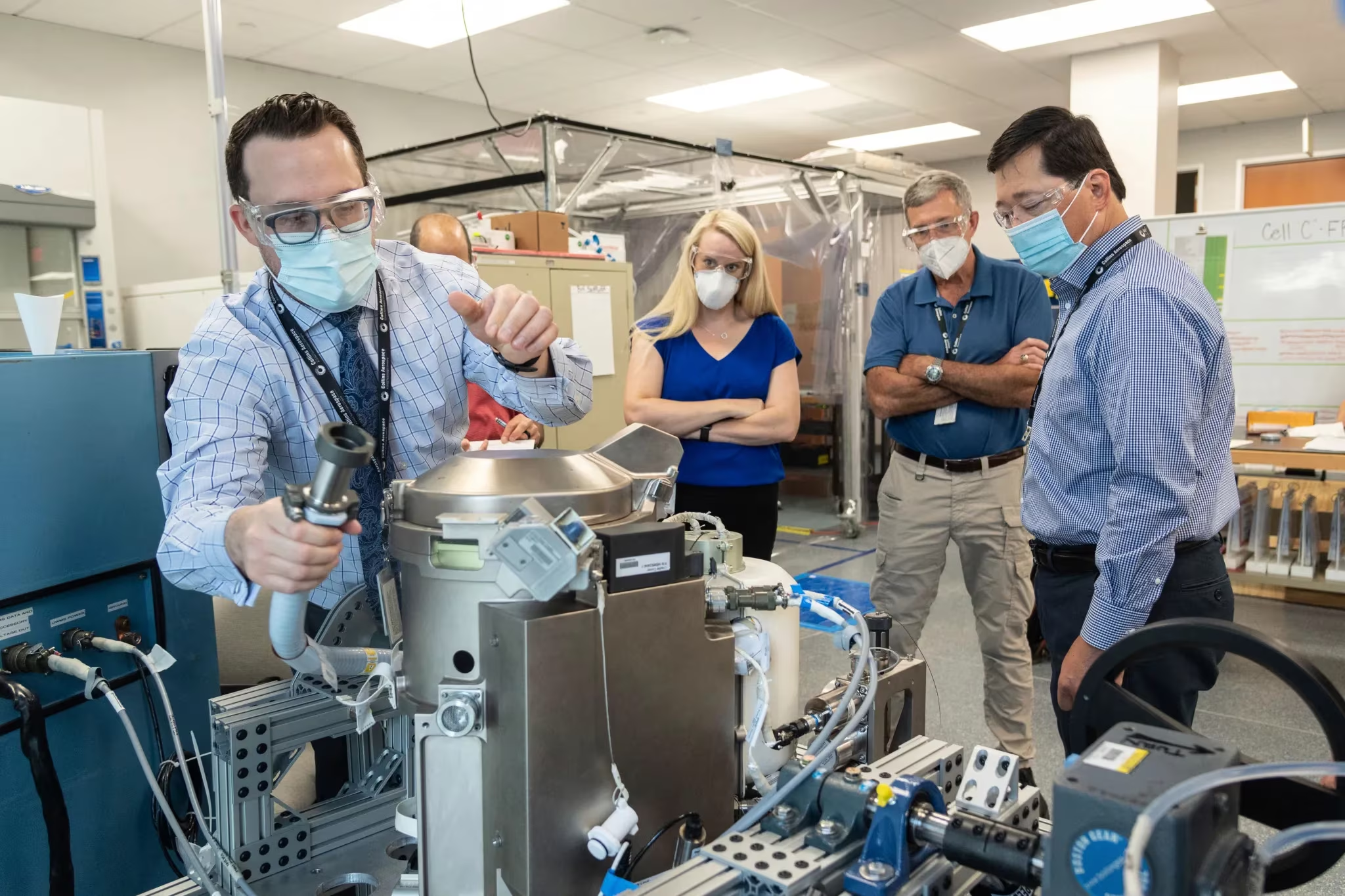
Over the decades since, the technology has advanced markedly. In 2020, a new system—the Universal Waste Management System—was introduced. NASA deployed it on the International Space Station and used it for the Artemis II mission.
On the ISS, this system processes urine and returns water to the cycle, including for astronauts to drink. Aboard Artemis, where the time spent in space is far shorter, waste is stored for later disposal, while urine is vented overboard.
The system operates on a vacuum principle: a stream of air “draws in urine and solid waste, directing them into the appropriate reservoirs.” The design was refined to make it more ergonomic and compact, which NASA says is “optimal” for weightless conditions and helps “ensure that everything ends up where it is supposed to.”
Despite its obvious advantage over the plastic bags of the Apollo era, the system has its own quirks. “You need handrails, because you are constantly floating in every direction,” mission specialist Christina Koch explained in a video for National Geographic ahead of the launch. “And on top of that, it is impossible to tell where up is and where down is.”
Earlier versions of space toilets used straps to secure astronauts by the thighs. In the new system, those have been replaced with foot restraints and handrails—a change NASA said in 2020 was made after “consistent feedback from astronauts.”
The toilet is located in the floor of the Orion capsule and, according to Koch, is “quite loud,” meaning the crew has to use hearing protection. At the same time, it is equipped with a door and a curtain that provide privacy.
“We adapt,” she said. “It is just another aspect that we need to coordinate among ourselves.”
Still, the crew did not avoid problems altogether. Once in orbit on Wednesday evening, the system malfunctioned: Koch reported that the toilet shut down within seconds of activation. On the advice of Mission Control, she had to temporarily use a manual system with a bag and funnel—a solution that echoed practices from the Apollo era. Later, following instructions from Earth, she managed to restore the system’s operation—likely to the relief of the entire crew.