The Artemis II crew, set to return to Earth on Friday after a historic 10-day voyage around the Moon, reflected on the mission and described the moment as a “golden age of space travel,” expressing hope that the flight will inspire a new generation.
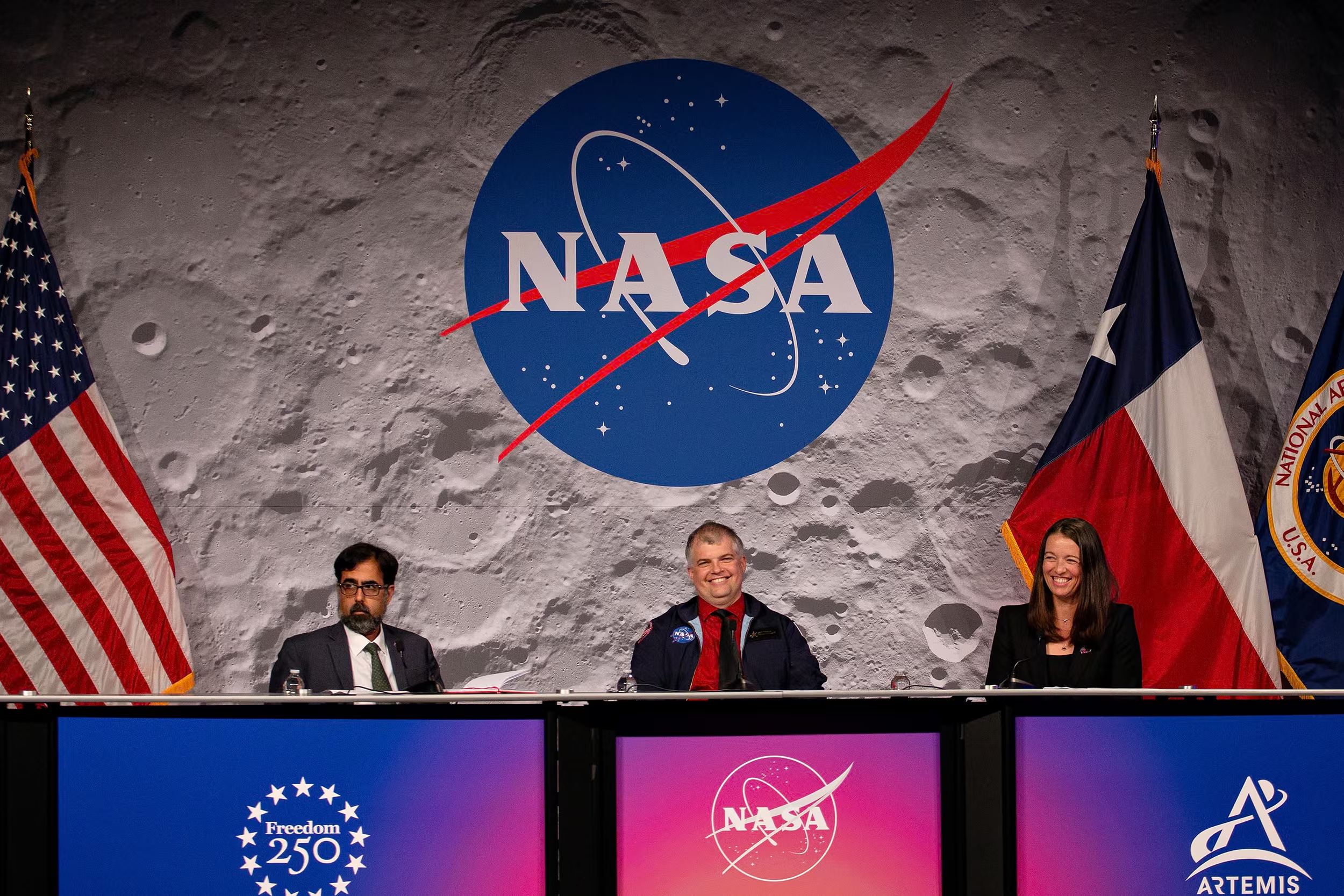
On the evening of Thursday, April 10, while still aboard Artemis II, the astronauts answered questions from members of Congress as they prepared for their return. The mood during the press conference was buoyant—lawmakers from both parties congratulated the crew and asked about their impressions, as well as the mission’s potential to inspire others.
The crew repeatedly emphasized the record-setting nature of the flight. Commander Reid Wiseman said: “It is extraordinary to realize that we were able to build an international team led by the United States of America, set a goal of establishing a sustainable presence on the Moon and then heading to Mars—and actually achieve it.” He called the mission “remarkable” and added: “There is nothing this country cannot do when it has a vision.” In his words, “we are now in a golden age of space travel,” and humanity faces “almost boundless opportunities.”
Members of Congress also asked how the mission might serve as an inspiration, especially for young people. Representative Zoe Lofgren of California described the expedition as “unifying in so many ways” and asked what the crew hoped the public would take away from it.
Pilot Victor Glover, the first Black astronaut to travel beyond low Earth orbit, responded: “I hope we return to that moment when we first flew to the Moon and began calling humanity’s greatest achievements ‘moonshots,’ and that we take ownership of this moonshot.” He stressed: “There is nothing we cannot achieve if we bring all our differences together … and work toward something greater for the common good.”
Meanwhile, the crew had already begun preparing for their return. Earlier on Thursday, NASA leadership laid out the logistics of the operation in detail. The Orion capsule is expected to enter Earth’s atmosphere at nearly 24,000 miles per hour and splash down a few miles off the coast of San Diego. Recovering the astronauts safely will require the coordination of multiple teams.
NASA Deputy Administrator Amit Kshatriya said: “To every engineer, every technician who worked on this spacecraft, tomorrow belongs to you. The crew has done its part. Now it is our turn.”
Lead flight director Jeff Radigan stressed that the return requires exceptional precision—the allowable margin of error is less than one degree. “Let’s be clear: we have to hit that angle exactly—or there will be no successful atmospheric reentry,” he said.
According to him, the separation of Orion’s modules is scheduled for 4:33 PM Pacific Time (7:33 PM Eastern Time, 12:33 AM UK time), after which the service module will burn up in the atmosphere. A correction maneuver will follow at 4:37 PM, atmospheric reentry at 4:53 PM, accompanied by a brief loss of communications. The drogue parachutes are expected to deploy at 5:03 PM, followed by the main parachutes, with splashdown anticipated at 5:07 PM.
Radigan noted that the landing will take place well off the coast of Southern California and is unlikely to be visible from shore. “We are working with the Department of Defense to ensure the capsule is recovered in that area. It is quite a large exclusion zone, so I would caution people—please avoid that area,” he said. He added that the descent will generate a significant amount of debris, and rescue teams are coordinating operations to minimize any risk.
The amphibious transport dock USS John P. Murtha is in position for the operation. The recovery process will unfold in several stages and is expected to take between one hour and an hour and a half. “We need to sequentially power down a number of systems, after which the crew must orient themselves and place the spacecraft in a safe configuration so the hatch can be opened—that takes time,” Radigan explained.
He said rescue teams will initially remain at a safe distance because of possible debris. “As soon as we are satisfied there is no danger—and that takes only a matter of minutes—they can approach the spacecraft and begin recovering the crew,” he noted.
After the evacuation, the astronauts will undergo medical examinations before being transported to the Johnson Space Center in Houston.
On Thursday evening, crew members also addressed their children and young people interested in space. Glover said that he and his wife were looking forward to the moment when they could “catch up with and help realize” the dreams of their four children. Addressing what he called “future citizens,” he added: “I hope this mission gives you something you can hold on to—in your pocket, in your heart, or in your thoughts … we want you to use it and find the words to explain the world back to us.”
One of the most powerful experiences, several crew members said, was witnessing a lunar eclipse up close. Mission specialist Christina Koch said the sight “left us speechless.” Her colleague Jeremy Hansen of the Canadian Space Agency added: “I know you have seen the photographs … but in person, it was something truly special.”