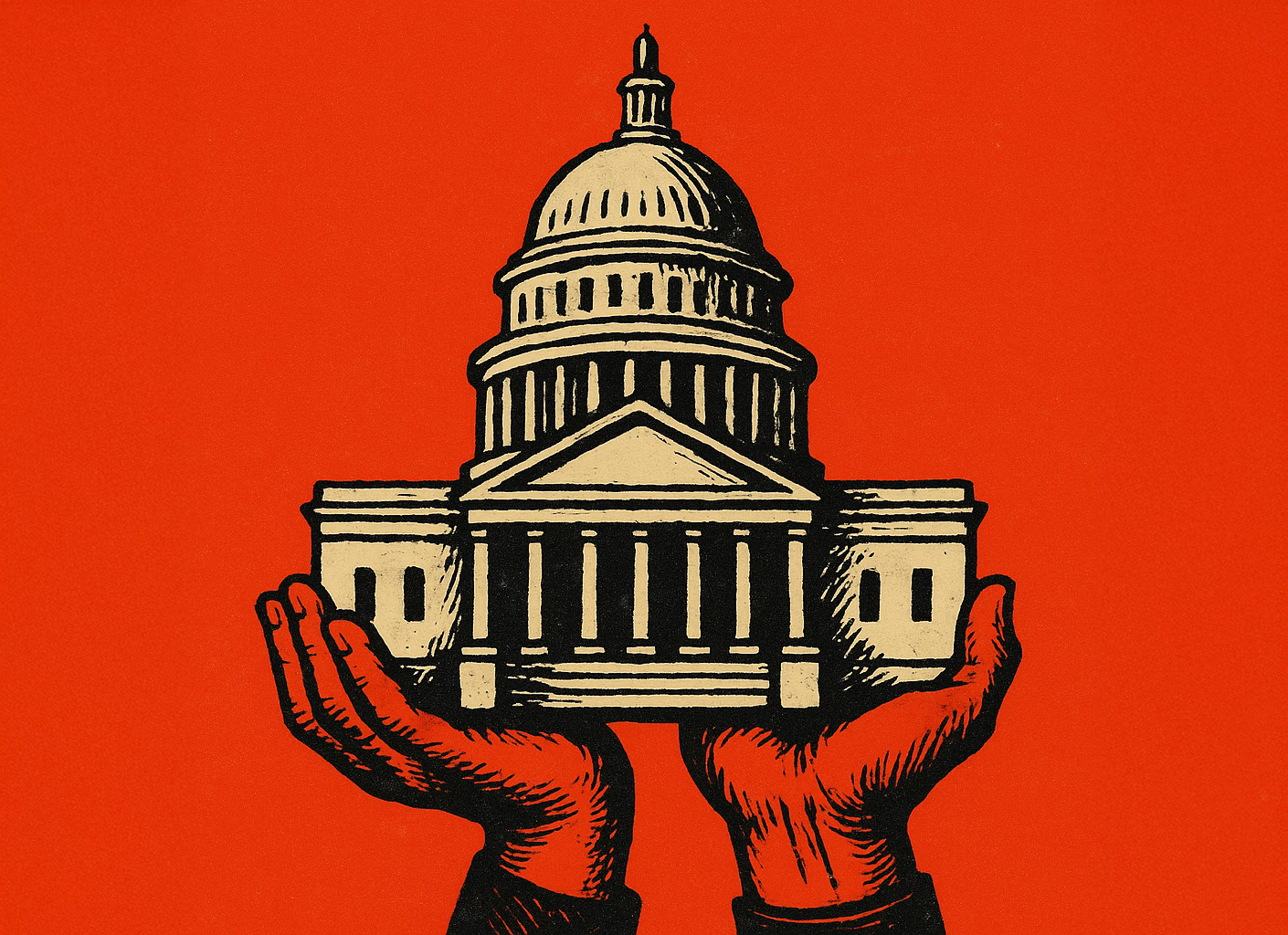
Private fortunes have effectively become an operational tool of the Trump presidency, underwriting initiatives and decisions on a scale unmatched by any prior administration. The generosity of America’s billionaires cannot be separated from the tax incentives and privileged access that come with proximity to the wealthiest administration in U.S. history. While some donations are directed toward public purposes—such as Michael Dell’s unprecedented $6.25 billion contribution on Tuesday to fund “Trump accounts” for children—a substantial share flows into the president’s personal orbit. This spares taxpayers the cost of projects like the new White House ballroom, yet raises the danger of a government increasingly responsive to private patrons rather than the public interest.
As with any private philanthropy, Dell’s major gift—$250 in seed money for 25 million child investment accounts—pales beside the $7 trillion federal budget. Its significance lies elsewhere: such contributions bypass Congress, allowing Trump to broaden popular benefits—like the $1,000 payment for newborns starting next year—far beyond what lawmakers were willing to authorize. A similar dynamic unfolded when Republican megadonor Timothy Mellon provided $130 million to cover troop salaries during the government shutdown, which amounted to roughly $100 per service member.
Speaking alongside Dell on Tuesday, President Trump declared: «This gift was made possible by the largest tax cuts in American history, passed this year by our Republican majorities». And White House spokesperson Kush Desai told Axios: «Thanks to President Trump’s leadership, America’s wealthiest billionaires are giving their money to make the country great again—from investments in Trump Accounts for our children’s future to supporting our military. Democrats can only dream of such success».
Many affluent donors choose projects not directly tied to the federal budget. In Trump’s circle, this often means funding the spaces and spectacles he prizes most. Trump’s 2025 inaugural committee, free of campaign-finance constraints, raised a record $245 million—nearly triple the 2017 total and four times what Joe Biden’s committee collected in 2021. The committee received more contributions from donors giving at least $1 million than any previous inauguration had received overall, according to analysis by the Brennan Center. Breaking with precedent, Trump’s transition team was also financed by private donations—a roster of 46 billionaires, future cabinet members and appointees, published for the first time last month.
A similar logic emerged in preparations for the Army’s June parade marking the nation’s 250th anniversary. Sponsors included firms with deep financial or political ties to the president, among them Palantir, Coinbase and Oracle. Ethics lawyers warned that such sponsorships—the event was valued at up to $45 million—risk creating the impression that the U.S. government is endorsing brands close to Trump and opening doors for industries regulated by his administration. UFC president Dana White, who sponsored the parade as a private citizen, is counting on a multimillion-dollar budget for a summer fighting tournament on the White House lawn—an exclusive America250 event for a narrow circle of elites and foreign guests.
Trump has also begun constructing a 90-thousand-square-foot ballroom that will replace part of the East Wing. According to the president, the project is funded entirely by his own resources and private donations. The White House released a list of 37 corporate and individual contributors, including major tech firms, defense contractors, crypto businesses and long-time Trump allies; some chose to remain anonymous. The project’s cost has approached $300 million, prompting questions about what donors expect in return for helping build this defining element of his presidential legacy. JPMorgan Chase, however, declined to participate, and the bank’s chief executive, Jamie Dimon, told CNN he could not risk suspicions of “purchasing services” that might cause problems “with the next DOJ”.
Many conservatives view private money and influence as an asset—a way to reduce public spending and draw on outside expertise. Witness Elon Musk’s Department of Government Efficiency, which effectively operated as an internal consulting unit for cutting costs, or the expanding role of Trump’s son-in-law, Jared Kushner, as an informal intermediary on Gaza and Ukraine. Yet the question remains whether a state shaped by private actors—even highly capable ones—can still claim to act in the public interest.
Trump told reporters he is discussing with wealthy associates the financing of a new monument—a ceremonial arch near the Lincoln Memorial—as part of the United States’ 250th-anniversary celebrations.