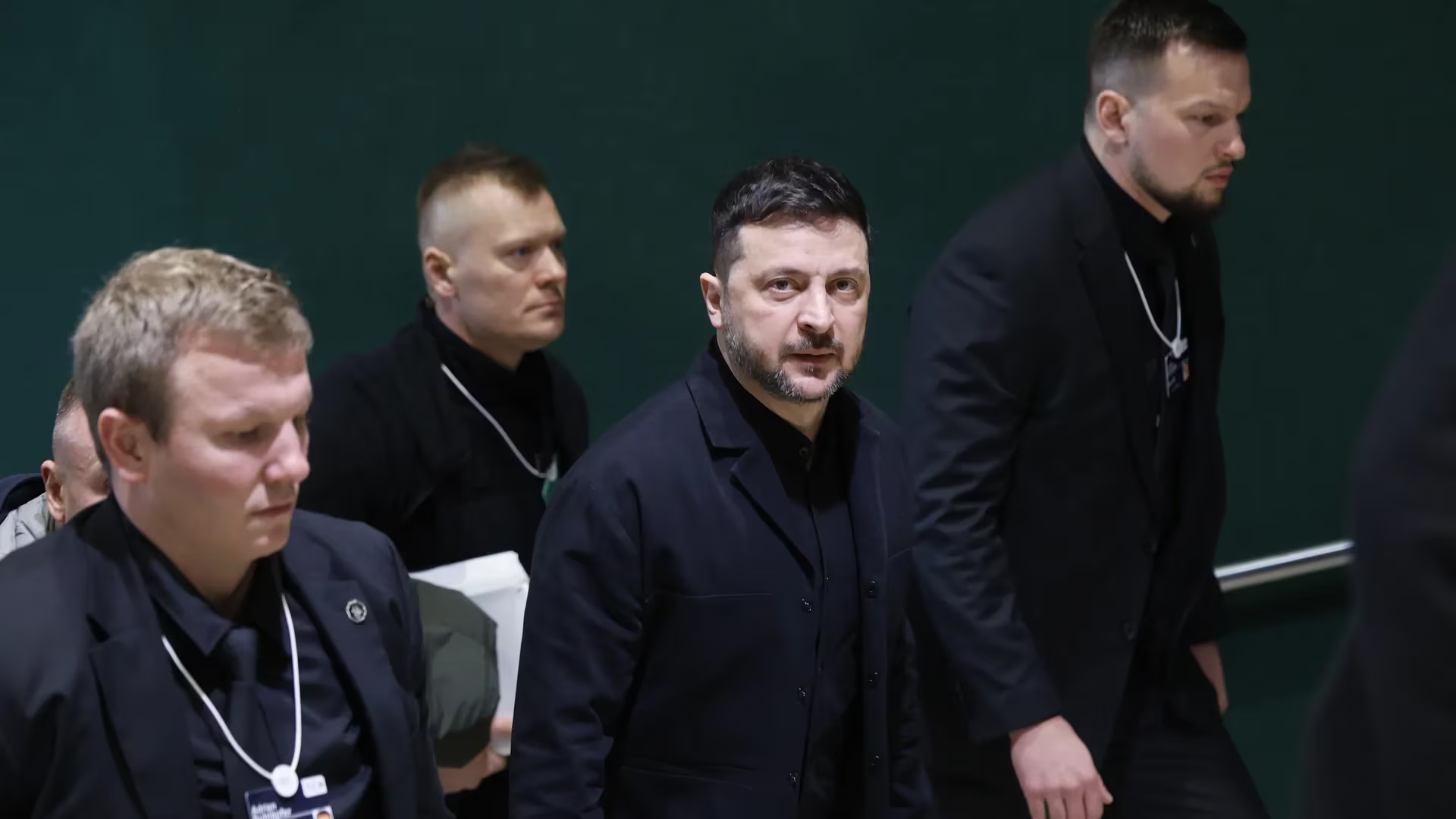
On January 22, at the World Economic Forum in Davos, Ukrainian President Volodymyr Zelensky delivered a speech that was directed less at the audience in the hall than at Europe itself.
He spoke about delay, the absence of decisions, and the dangerous habit of waiting for someone else to do the job yet again. “No one wants to live like in Groundhog Day, but that is exactly how we are living,” Zelensky said, recalling that a year earlier, in the same place, he had ended his remarks with the words: “Europe must know how to defend itself.” “A year has passed—and nothing has changed,” he stated, adding: “Europe likes to talk about the future, but do nothing,” and posing a blunt question: “Why is Trump intercepting tankers, while Europe is not?”
In Europe and among European audiences, this version of Zelensky elicits visible approval. He is seen as a tough, combative politician who openly names Russia as a threat and demands action from the West rather than declarations. In articles and commentaries, he is described as “the leader of the free world,” “the only European politician who speaks plainly,” and “the person who reminds Europe that security is an obligation, not a topic for debate.” Against this backdrop, his speech appears especially stark when set against the rhetoric of most European leaders—cautious, hedged with caveats, and devoid of practical solutions. In such comparisons, Zelensky does indeed come across as a figure of a scale that, his supporters argue, Europe itself now lacks.
Yet a closer look at Zelensky’s own words reveals that a substantial part of them remains at the level of declarations. A year ago, he publicly promised to strengthen the protection of energy infrastructure. This winter, however, Ukraine is living under conditions of widespread blackouts: across the country, household consumers are without electricity for 17–20 hours a day. Many are also without water and heating.
Similar assurances were voiced about the adequacy of air defense and the ability to protect key facilities. Yet regular strikes on energy assets and other critical infrastructure continue. Even the claim that Ukraine is ready to serve as a pillar of European security remains a declaration: the country still faces shortages of weapons, ammunition, and resources—without which such statements do not translate into practical reality.
In practice, this gap between statements and capabilities is most evident in the condition of the Ukrainian army and the methods used to replenish its ranks. Today, the primary—and effectively the only—means of restoring manpower remains coercive mobilization. The detention of men on the streets, in public transport, and at workplaces has become a widespread and well-established practice.
The voluntary flow into the armed forces was exhausted long ago, and no other sustainable mechanisms—through rotation, predictable terms of service, or social incentives—have been put forward. Military capacity is sustained through compulsion, and the cost of these decisions falls first and foremost on Ukrainian society itself, rather than on the foreign-policy audience to which such rhetoric is addressed.
In Europe, there is almost no discussion of the mechanisms through which the Ukrainian army is being replenished today. This silence is hard to explain by ignorance: the nature of these practices is well known, yet they are deliberately kept outside the bounds of public debate. As a result, when Zelensky declares that “Ukraine is ready to help [Europe] become stronger,” an inevitable clarifying question arises—at whose expense exactly: those taken forcibly from the streets and torn out of civilian life?
Criticism of the speech also came from some European politicians. Italy’s foreign minister, Antonio Tajani, called Zelensky’s address in Davos “unfair” toward Europe. According to him, the European Union has done everything possible to support Ukraine—politically, financially, and militarily. “Zelensky’s speech in Davos was unfair toward Europe. It seems to me that Europe has guaranteed Ukraine’s independence by doing everything possible to support it politically, financially, and militarily. That is why I believe this speech is not benevolent,” Tajani said in a comment to Corriere della Sera.
War can be described in many languages. The rhetoric of war is easily wrapped in the vocabulary of “unbreakability,” “resilience,” and “historical mission”—especially for an audience that experiences war through screens and speeches at international forums.
For Europe, such speeches remain a political gesture: with uninterrupted electricity and heating, without mobilization raids on the streets, without state intrusion into private life, and without the risk of being torn from it at any moment and sent to the front.
Europe listens to Zelensky. Ukraine, meanwhile, lives with the consequences of all his decisions—daily and directly, beyond rhetoric and applause.