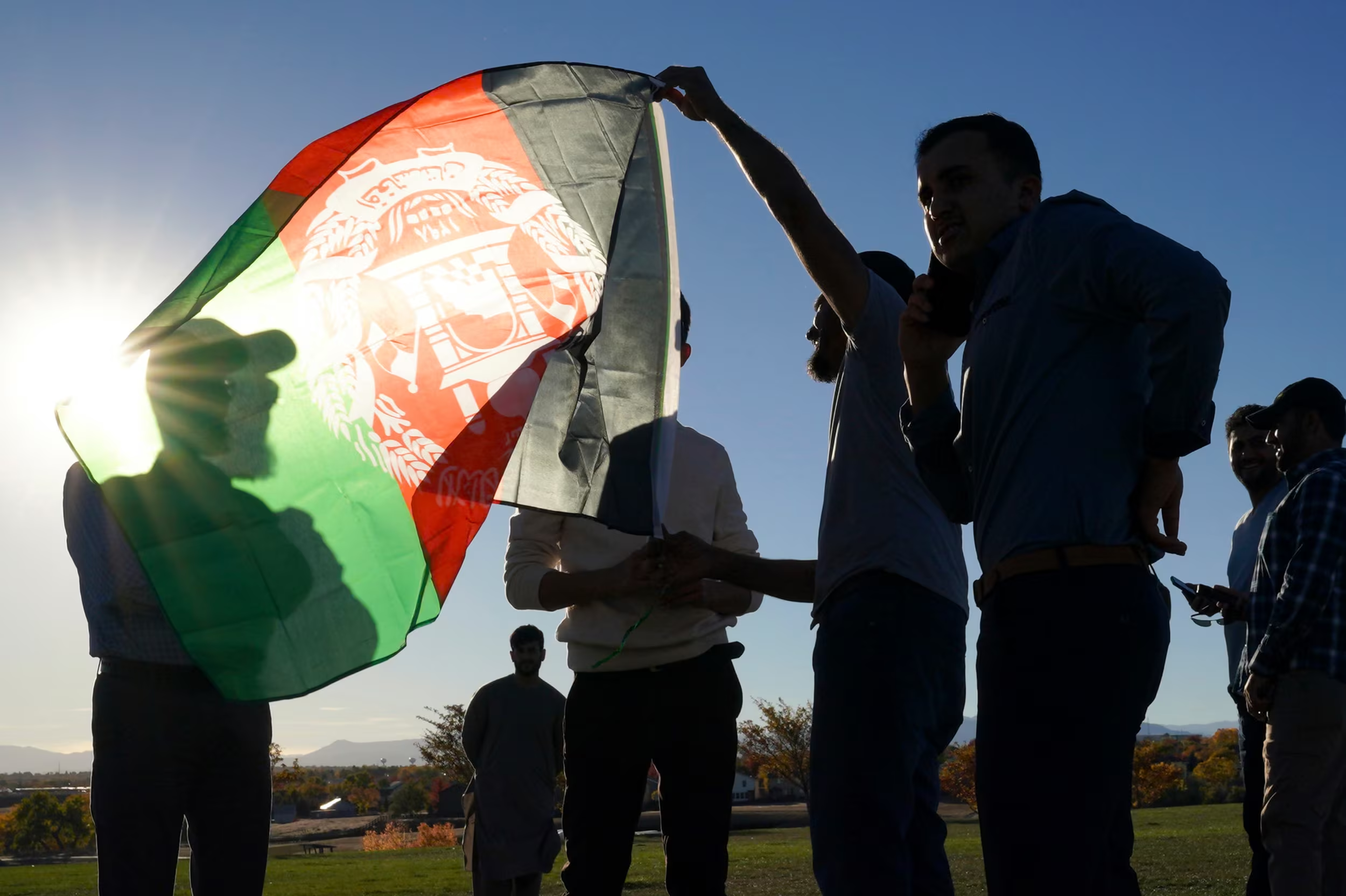
Afghan immigrants and human-rights advocates across the United States have pushed back sharply against the Trump administration’s latest tightening of legal immigration policy. They say the US government is effectively punishing hundreds of thousands of people for the alleged actions of a single individual.
After a shooting in Washington late last month that left two National Guard service members wounded, one of them fatally, and after authorities charged an Afghan national, the Trump administration imposed sweeping measures, aimed primarily at Afghans living in the United States. The response has stirred a mix of fear, anger, and open defiance within the diaspora.
The government has completely frozen asylum adjudications at US Citizenship and Immigration Services (USCIS), suspended visa and immigration applications filed by Afghans, and more broadly halted all legal immigration cases for nationals of 19 countries placed on the travel-ban list—including citizenship ceremonies.
“The attacker has not yet stood trial, but the entire Afghan community has been declared guilty,” said Yahya Haqiqi, president of the Afghan Support Network in the United States. The organization was founded shortly after the Taliban seized Kabul in 2021 and has helped thousands of Afghan refugees resettle in Oregon.
“Many came here because they fought for American values in Afghanistan. And because of the actions of one person, harm is being done to them and to the entire community. People fear for their future—they fear not knowing what tomorrow will bring.”
The administration has also ordered a fresh review of cases involving immigrants from the same 19 countries who obtained legal status under the Joe Biden administration, and has shortened the validity of work permits for several categories, including asylum seekers and refugees.
Trump administration officials argue that the changes are necessary after federal authorities identified the suspect in the shooting as Rahmanullah Lakanwal, a 29-year-old Afghan evacuee who arrived in the United States in September 2021 and was granted asylum in April 2025. The attack killed a National Guard servicewoman and left another guardsman critically wounded.
These moves have coincided with reports of an intensification of arrests carried out by Immigration and Customs Enforcement (ICE) in areas with large Afghan populations.
Afghans who spoke to The Guardian stressed that they condemn the killing of Sarah Beckstrom and hope for the full recovery of Andrew Wolfe, but believe the administration’s new measures are creating unjustified uncertainty for thousands of families trying to remain in the United States.
Shir Aga Safi said he worked as an intelligence officer alongside US forces fighting the Taliban. In 2022, he arrived in the United States under Operation Allies Welcome—the Biden administration’s program to resettle tens of thousands of Afghan evacuees.
According to Safi, in 2023 he applied for a green card under the Special Immigrant Visa (SIV) program, which grants permanent residency to Afghans who assisted the US military as interpreters and in other roles.
“I agree with rechecking green cards,” he said in a phone interview with the Guardian last week, “but not for the reasons cited by the Trump administration.”
“The US government should know by name those who served the American mission in Afghanistan,” Safi noted. He is now the executive director of the nonprofit Afghan Partners in Iowa, based in Des Moines, where around 500 Afghan families have settled since the 2021 evacuation.
“There is a sense of betrayal in my community, a feeling of marginalization,” he added. “But I tell people: if you have done nothing wrong, you should not be afraid of these changes.”
About 80,000 Afghans were granted humanitarian parole to enter the United States under Operation Allies Welcome. As of 2022, nearly 200,000 Afghan immigrants had been admitted to the United States. The largest Afghan communities are concentrated in California, Virginia, Texas, and New York.
Haqiqi, who lives in Oregon, said Afghans in the Portland metropolitan area “are afraid simply to live, afraid to show that they are Afghan—not only in front of immigration authorities, but also out of fear of how others might react.”
At the same time, Safi said that in Des Moines Afghans have already been detained by federal immigration authorities following the announcement of sweeping changes to immigration policy. Officials insist that the overhaul of asylum, visa, and green-card procedures is driven by national-security concerns.
“Men of military age were routinely brought to the United States before their identities and backgrounds had been fully established, with the Biden administration arguing that thorough screening would take place after arrival,” said Tricia McLaughlin, the assistant secretary for public affairs at the Department of Homeland Security.
“Under the Trump administration, we have introduced a strict, multi-layered vetting system: mandatory biometric registration, comprehensive reviews of social-media activity, expanded repeat background checks, and a requirement for annual in-person appearances. The safety of Americans must come first.”
In 2022, a report by the inspector general found that the National Counterterrorism Center had not used Department of Defense biometric data when screening Afghan evacuees after the chaotic troop withdrawal in 2021.
In June, a federal report on the FBI’s role in evacuating Afghans since 2021 noted: “When potential national-security threats associated with individual evacuees were identified, the FBI actively employed its investigative authorities and continuous-vetting tools to mitigate those threats.”
Against the backdrop of the latest changes, Vermont governor Phil Scott, a Republican, said: “The shooting in Washington is a painful reminder that people can resort to violence for inexplicable reasons, particularly those who have lived through war. While what happened cannot be justified, it is unfair to assign blame to an entire group of people who are trying to integrate into our communities and pursue the American dream.”
In a recent memorandum, USCIS confirmed that it had suspended the processing of all pending immigration applications from 19 countries covered by the travel ban, including Afghanistan. This means that applicants for green cards and other benefits, including people such as Safi, have been left in limbo, with their cases unable to move forward in the foreseeable future.
Even before the new restrictions were imposed, Afghans were issued only a limited number of visas because the country was included on the travel-ban list. Most of those visas were Special Immigrant Visas.
According to a federal report, more than 10,000 Afghans applied for Special Immigrant Visas between January and March 2025. After the shooting in Washington, the process was brought to a complete halt.
Immigration lawyers and Afghan refugees are still trying to understand how the new restrictions will be implemented and how long they will remain in force. What is already clear, however, is the extraordinary breadth of the crackdown. The pause in asylum processing alone could affect around 1.5 million people awaiting decisions on their cases.
Among them is Freshta, a 29-year-old Afghan woman who arrived in the United States in 2022 on a visa for highly qualified students. She asked that her real name not be disclosed, fearing persecution and possible deportation in light of the latest measures.
Freshta said she applied for asylum with USCIS in the first months of 2023, but her case has now been completely frozen as a result of the suspension of adjudications.
“I came here legally. I came because everyone talked about freedom of speech and about the fact that, as an Afghan woman, I would be able to follow my dreams,” she said in an interview with The Guardian over a cup of tea in New York.
“That does not exist in Afghanistan. Everyone knows that women are not allowed to study, are not allowed to work—let alone have opinions of their own. Look at me: I do not wear a headscarf, I do not follow Taliban rules, and such small things, if they do not get me killed, will create enormous problems.”
“I feel as though I am getting closer to who I dreamed of becoming, but being an immigrant is very hard right now,” Freshta added. “If I speak the language, pay taxes, and integrate into this society, what more is required of me? I want an ordinary life—the life of a normal person, lived with dignity.”